
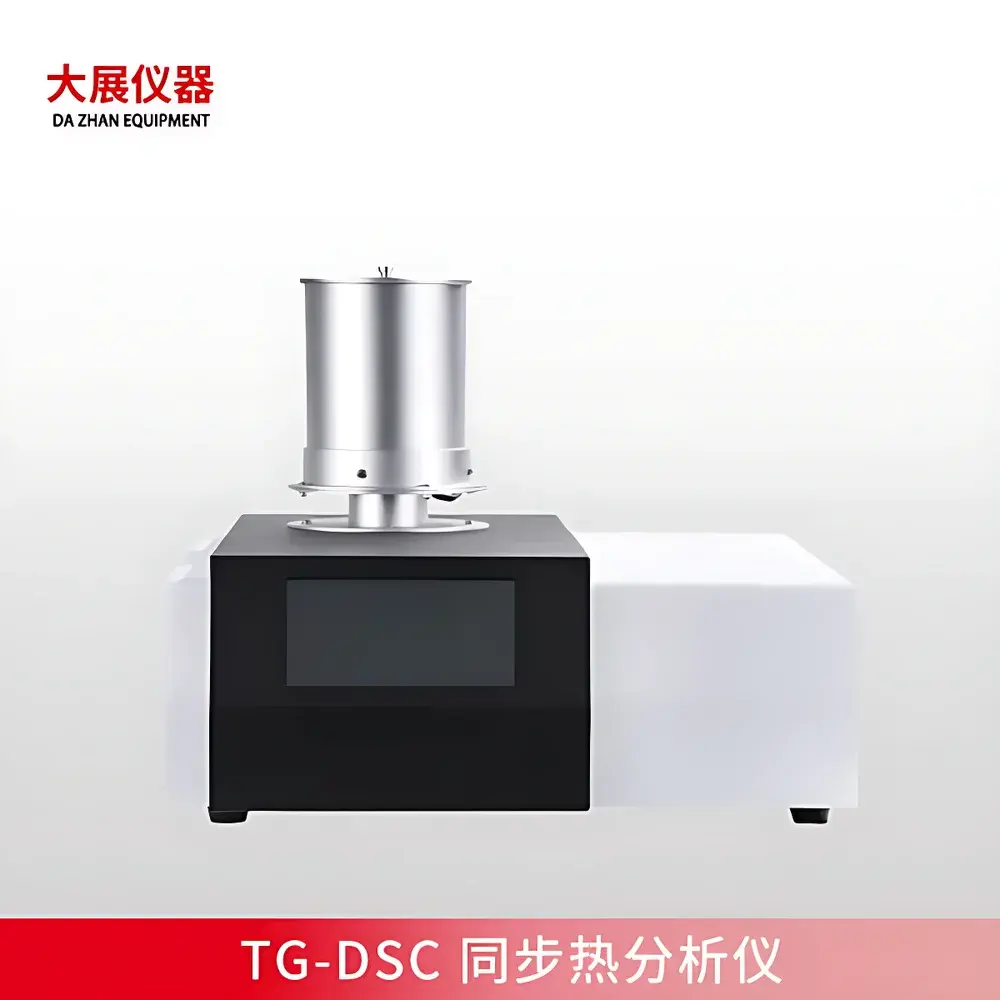
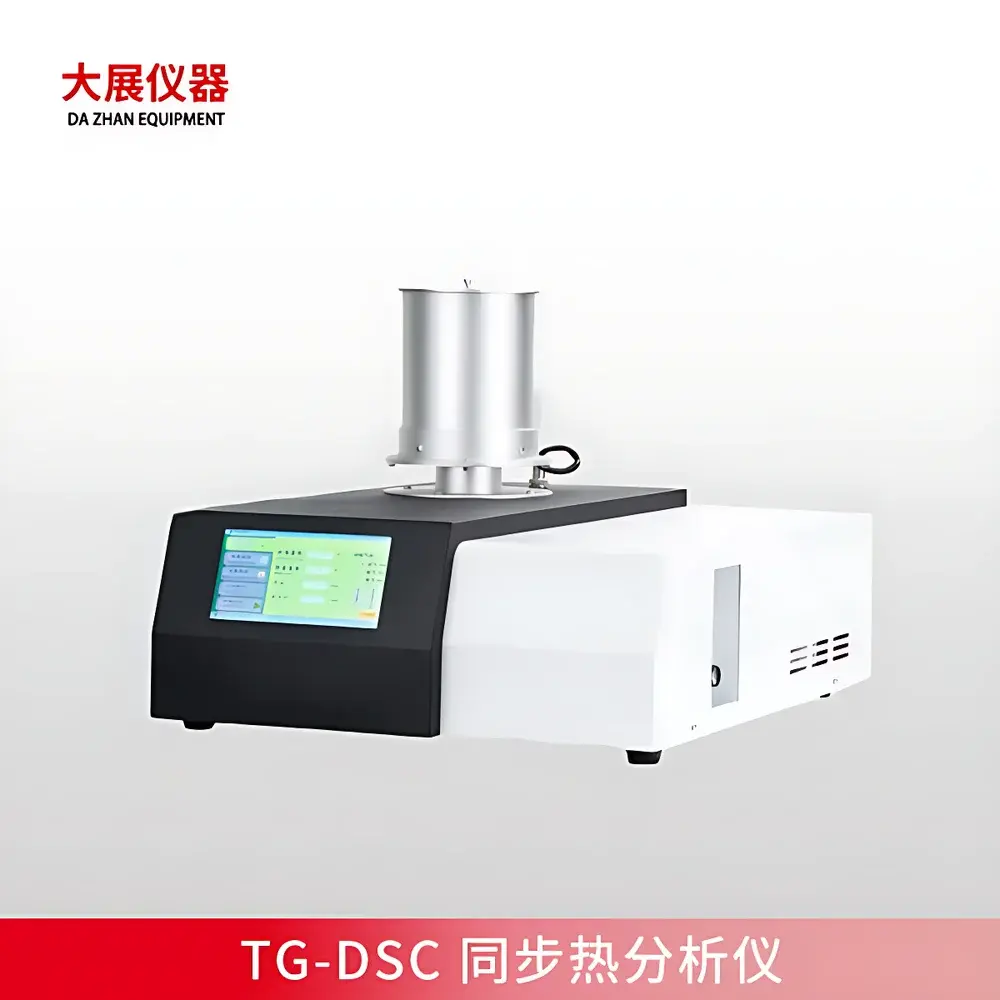
Nanjing Dazhan STA200 Simultaneous Thermal Analyzer
| Brand | Nanjing Dazhan |
|---|---|
| Origin | Jiangsu, China |
| Manufacturer Type | Direct Manufacturer |
| Product Category | Domestic |
| Model | STA200 |
| Price Range | USD 11,200–14,000 (FOB) |
| Temperature Range | Ambient to 1200 °C |
| Heating Rate | 0.1–100 °C/min |
| Max Sample Mass | 5 g |
| Atmosphere Control | Inert, Oxidizing, Reducing |
| Temperature Resolution | 0.01 °C |
| Temperature Stability | ±0.1 °C |
| TG Sensitivity | 0.01 mg |
| TG Resolution | 0.1 µg |
| DSC Range | ±1000 mW |
| DSC Resolution | 0.1 µW |
| DSC Accuracy | 0.01 mW |
| Cooling Time (1000 °C → 100 °C) | ≤15 min |
| Gas Control | Dual-channel mass flow control with integrated digital flow meters |
| Data Interface | USB 2.0 |
| Display | 7-inch 24-bit color touchscreen LCD |
| Calibration | Multi-point temperature and enthalpy calibration per ISO 11357 & ASTM E1269 |
Overview
The Nanjing Dazhan STA200 Simultaneous Thermal Analyzer is an engineered platform for concurrent thermogravimetric analysis (TGA) and differential scanning calorimetry (DSC), operating on the principle of simultaneous measurement of mass change and heat flow from a single sample under controlled thermal conditions. This dual-signal acquisition architecture enables precise correlation between thermal events—such as phase transitions, decomposition onset, oxidative degradation, and enthalpic changes—and corresponding mass loss or gain. The instrument employs a high-stability microbalance coupled with a precisely regulated furnace system, ensuring high reproducibility across repeated measurements. Its design conforms to core requirements of ISO 11357 (Plastics — Differential Scanning Calorimetry), ISO 11358 (Plastics — Thermogravimetry), and ASTM E1269 (Standard Test Method for Determining Heat Capacities by DSC), supporting method validation in R&D, quality control, and regulatory environments.
Key Features
- High-temperature furnace with dual-wound precious-metal alloy heating elements, delivering uniform thermal distribution and extended service life up to 1200 °C.
- Ceramic rod–based sensor suspension system for the balance mechanism—resistant to oxidation, corrosion, and thermal creep at elevated temperatures.
- Physically decoupled power supply and forced-air cooling modules, minimizing electromagnetic interference and mechanical vibration transmission to the microbalance.
- Top-opening furnace design with integrated thermal shielding, reducing thermal leakage to the instrument chassis and enhancing baseline stability during long-duration runs.
- Modular furnace configuration—compatible with optional high-sensitivity or fast-response furnace variants upon request—enabling adaptation to specialized application needs.
- Integrated dual-gas manifold with digital mass flow controllers (MFCs), supporting seamless switching between inert (N₂, Ar), oxidizing (air, O₂), and reducing (H₂/N₂, CO/N₂) atmospheres under static or dynamic flow conditions (0–200 mL/min per channel).
Sample Compatibility & Compliance
The STA200 accommodates standard crucible formats—including alumina, platinum, and aluminum—with maximum sample mass capacity of 5 g. It supports both quantitative and qualitative thermal characterization of polymers, pharmaceuticals, ceramics, composites, battery materials, and catalysts. All thermal calibration procedures follow traceable multi-point protocols aligned with NIST-traceable reference materials (e.g., indium, zinc, and sapphire). The system meets essential functional criteria for GLP-compliant laboratories, including audit-trail-enabled software logging, user-access controls, and electronic signature support (per FDA 21 CFR Part 11 when deployed with validated software configuration). Compliance documentation—including Declaration of Conformity to CE directives (EMC & LVD) and RoHS certification—is provided with each unit.
Software & Data Management
The embedded intelligent thermal analysis software provides real-time visualization and post-run processing of TG, DTG, DSC, and derivative curves. Functions include automatic peak detection, baseline correction, kinetic modeling (e.g., Kissinger, Ozawa–Flynn–Wall), enthalpy integration, and multi-step decomposition fitting. Data export options include CSV, Excel (.xlsx), and PDF report generation with customizable templates. Raw data files are stored in vendor-neutral binary format with metadata tagging (operator ID, timestamp, atmosphere, heating rate, crucible type). USB 2.0 interface enables direct transfer to external workstations for advanced statistical analysis or integration into LIMS environments. Software supports multi-point temperature and enthalpy calibration across three distinct thermal ranges (low-, mid-, and high-temperature), ensuring accuracy consistency from ambient to 1200 °C.
Applications
- Thermal stability assessment of polymer blends and flame-retardant formulations via TGA residue quantification and decomposition kinetics.
- Determination of crystallinity, melting point depression, and cold-crystallization behavior in semi-crystalline thermoplastics using DSC.
- Quantification of bound water, solvent residues, and inorganic filler content in pharmaceutical intermediates per USP and ICH Q5C guidelines.
- Oxidative induction time (OIT) evaluation of polyolefins under flowing oxygen, aligned with ASTM D3895.
- Decomposition pathway mapping of cathode materials (e.g., NMC, LFP) in lithium-ion batteries under controlled atmospheres.
- Reaction enthalpy determination for solid-state synthesis processes, including carbonate decomposition and metal oxide reduction steps.
FAQ
What types of crucibles are compatible with the STA200?
Alumina, platinum, and aluminum crucibles are supported; custom crucible geometries can be accommodated upon request.
Does the instrument support purge gas switching during a single run?
Yes—dual-channel gas control allows automated, programmable switching between two gases (e.g., N₂ → air) at user-defined temperature or time points.
Is the software compliant with 21 CFR Part 11 for regulated environments?
The base software includes audit trail, electronic signature, and role-based access features; full Part 11 compliance requires installation under a validated IT infrastructure and documented SOPs.
Can the STA200 perform isothermal TGA or DSC holds?
Yes—isothermal segments up to 300 minutes are standard; extended hold capability (up to 72 hours) is available via firmware upgrade.
How is temperature calibration verified across the full range?
Calibration uses certified reference materials (indium, tin, zinc, aluminum, and sapphire) at ≥5 points; deviation reports are generated automatically and stored with each calibration event.



