
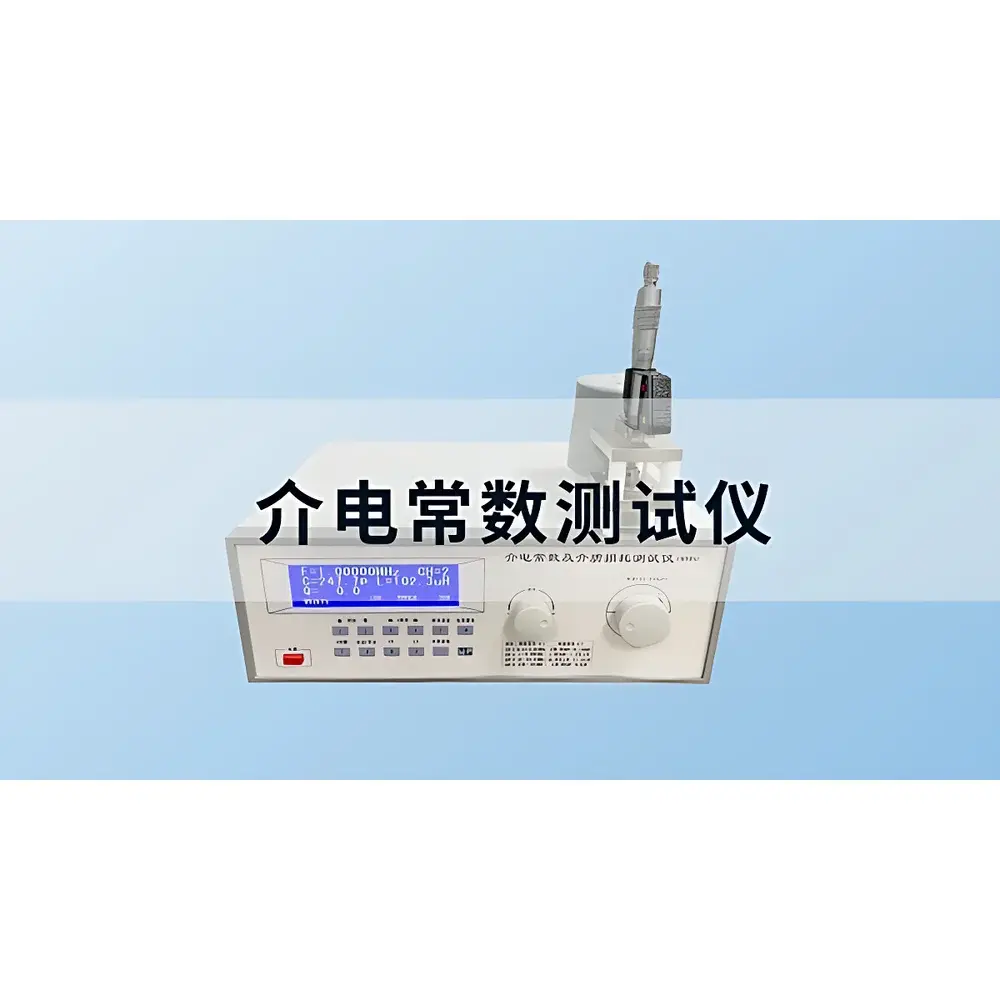
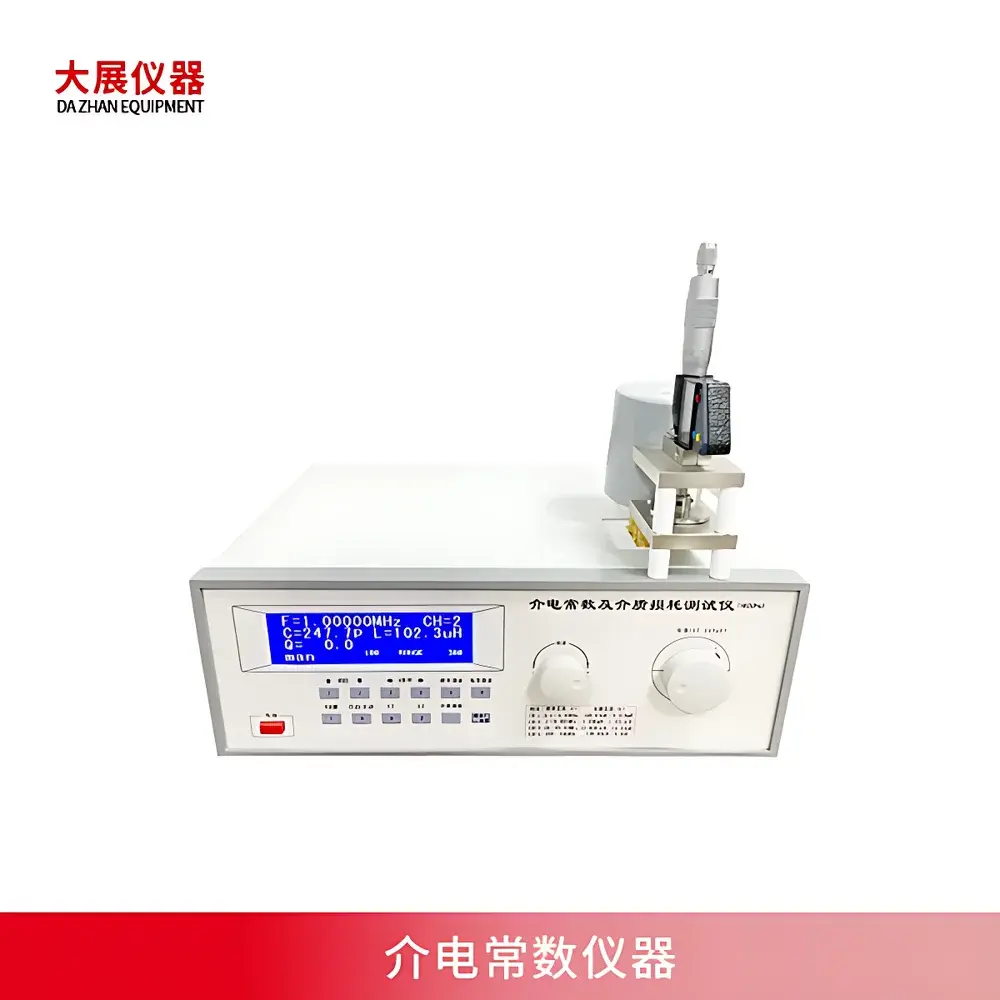
DZ5001 DAZHAN High-Frequency Resonance Dielectric Constant and Loss Tangent Analyzer
| Brand | DAZHAN (Nanjing Dazhan Instrument Co., Ltd.) |
|---|---|
| Model | DZ5001 |
| Measurement Principle | High-Frequency Resonance Method (Q-factor-based) |
| Frequency Range | 10 kHz – 100 MHz |
| Frequency Accuracy | ±3×10⁻⁵ (6-digit resolution) |
| Q Factor Range | 1–1000 |
| Q Resolution | 0.1 (4-digit effective) |
| Q Measurement Error | <5% |
| Inductance Range | 1 nH – 140 mH |
| Inductance Resolution | 0.1 nH |
| Inductance Error | <3% |
| Main Tuning Capacitance | 17–240 pF (silver-plated monolithic capacitor) |
| Direct Capacitance Measurement Range | 1 pF – 25 nF |
| Capacitance Resolution | 0.1 pF |
| Capacitance Accuracy | ±1 pF or <1% |
| Automatic Capacitance Search | Yes (stepper motor-driven) |
| Residual Inductance Compensation | Yes |
| Display | LCD showing F, L, C, Q, Lt, Ct, εᵣ, Tn, tanδ |
| Compliance | GB/T 1409–2006, GB/T 1693–2007 |
Overview
The DZ5001 DAZHAN High-Frequency Resonance Dielectric Constant and Loss Tangent Analyzer is a precision instrument engineered for the quantitative determination of complex permittivity (ε* = ε′ − jε″) and dielectric loss tangent (tan δ = ε″/ε′) in solid and ceramic dielectric materials. It operates on the principle of series-resonant cavity perturbation, where the sample’s insertion into a high-Q LC resonator alters the system’s natural resonance frequency and bandwidth—enabling simultaneous extraction of relative permittivity (εᵣ) and dissipation factor via rigorous Q-factor analysis. Unlike broadband impedance analyzers or parallel-plate capacitance bridges, this instrument leverages discrete-frequency harmonic resonance at tunable RF/microwave-adjacent frequencies (10 kHz to 100 MHz), delivering superior signal-to-noise ratio and phase stability for low-loss materials (tan δ < 10⁻³). Its architecture is optimized for laboratory-grade reproducibility in R&D environments where traceable, standards-aligned measurements of insulating ceramics, polymer films, and composite laminates are required under controlled ambient conditions.
Key Features
- DDS-based digital signal synthesis with 6-digit frequency resolution and ±3×10⁻⁵ absolute accuracy across 10 kHz–100 MHz range
- Automated stepper-motor-driven tuning capacitor (17–240 pF, silver-plated monolithic construction) enabling precise resonance tracking and repeatable cavity calibration
- Integrated residual inductance compensation algorithm that dynamically subtracts parasitic inductance from test leads and fixture geometry—critical for sub-nanohenry measurement integrity
- 12-bit high-speed ADC acquisition ensuring stable Q-factor quantification even for ultra-low-loss materials (e.g., fused quartz, sapphire, PTFE)
- LCD interface displaying real-time parameters: resonance frequency (F), inductance (L), capacitance (C), Q-factor, loaded/unloaded inductance (Lt), tuned capacitance (Ct), relative permittivity (εᵣ), and normalized temperature coefficient (Tn)
- Auto-scan resonance detection with acoustic-optical alert upon Q-value entry into user-defined pass/fail thresholds (5–1000)
Sample Compatibility & Compliance
The DZ5001 supports planar, disc-shaped, and rectangular solid specimens up to Ø50 mm × 10 mm thick—including metal oxides (Al₂O₃, TiO₂), technical ceramics (steatite, cordierite), glass compositions (borosilicate, soda-lime), thermoplastics (PP, PE, PET), thermosets (epoxy, phenolic), and biological insulators (cellulose derivatives, chitosan films). Specimen mounting requires no metallization or electrode deposition; measurements are performed in air using non-contact capacitive coupling within the calibrated resonator cavity. The instrument conforms to two primary Chinese national standards: GB/T 1409–2006 (equivalent in scope to IEC 60250:1969 and ASTM D150–21 for permittivity and loss tangent at power, audio, and radio frequencies) and GB/T 1693–2007 (aligned with ISO 4624 and ASTM D257 for vulcanized rubber characterization). While not FDA 21 CFR Part 11–certified out-of-box, its data logging output supports GLP/GMP-compliant audit trails when integrated with validated third-party acquisition software.
Software & Data Management
The DZ5001 operates as a standalone benchtop analyzer with embedded firmware—no external PC dependency for core measurements. All acquired parameters (F, C, L, Q, εᵣ, tan δ) are stored internally with timestamping and can be exported via RS-232 serial interface to CSV-compatible spreadsheet applications or laboratory information management systems (LIMS). Raw Q-factor and resonance frequency datasets are retained with full 12-bit ADC resolution, preserving metrological traceability for post-acquisition reprocessing. For regulated environments, users may implement custom validation protocols per ISO/IEC 17025:2017 requirements, including periodic verification against NIST-traceable reference standards (e.g., air-dielectric cavity, certified alumina tiles). Firmware updates are delivered via USB memory stick, with version history and checksum logs accessible through service mode.
Applications
This analyzer serves critical functions in materials science laboratories evaluating dielectric performance for high-frequency electronics packaging (e.g., LTCC substrates, antenna dielectrics), electrical insulation qualification (transformer bushings, cable jacketing), quality control of ceramic capacitor formulations, and development of low-k polymer matrices for advanced PCB laminates. In academic research, it supports structure–property correlation studies linking microstructural features (grain size, porosity, crystallinity) to bulk electromagnetic response. Within energy infrastructure, utilities apply it to assess aging mechanisms in high-voltage porcelain insulators and composite polymer housings exposed to UV/thermal cycling. Environmental and biomedical researchers utilize it to quantify hydration-dependent permittivity shifts in hydrogels and tissue-mimicking phantoms for microwave imaging calibration.
FAQ
What sample preparation is required prior to measurement?
No surface metallization or electrode attachment is needed. Samples must be flat, parallel-faced discs or rectangles with dimensions compatible with the cavity aperture (max Ø50 mm × 10 mm thickness). Surface contamination (oil, dust, moisture) must be removed via isopropanol wipe and desiccation.
Can the DZ5001 measure liquid or powder samples?
No—it is designed exclusively for solid, self-supporting dielectrics. Liquids require coaxial probe or waveguide-based systems; powders necessitate pelletization under controlled pressure and binder-free sintering to eliminate interfacial voids.
How is calibration performed?
Calibration uses air-only resonance baseline (C₀, L₀, Q₀) followed by insertion of a certified reference material (e.g., high-purity alumina tile, εᵣ ≈ 9.8 ± 0.1 at 1 MHz). The system applies cavity perturbation theory to compute εᵣ and tan δ without iterative curve-fitting.
Is temperature control supported?
The base unit does not include environmental chamber integration. However, the RS-232 port allows synchronization with external temperature controllers via TTL-triggered acquisition start/stop signals.
Does the instrument support automated batch testing?
Yes—through ASCII command protocol over RS-232, users can script sequential measurements across multiple frequencies or samples using Python, LabVIEW, or MATLAB, with full parameter logging and error flagging.



