
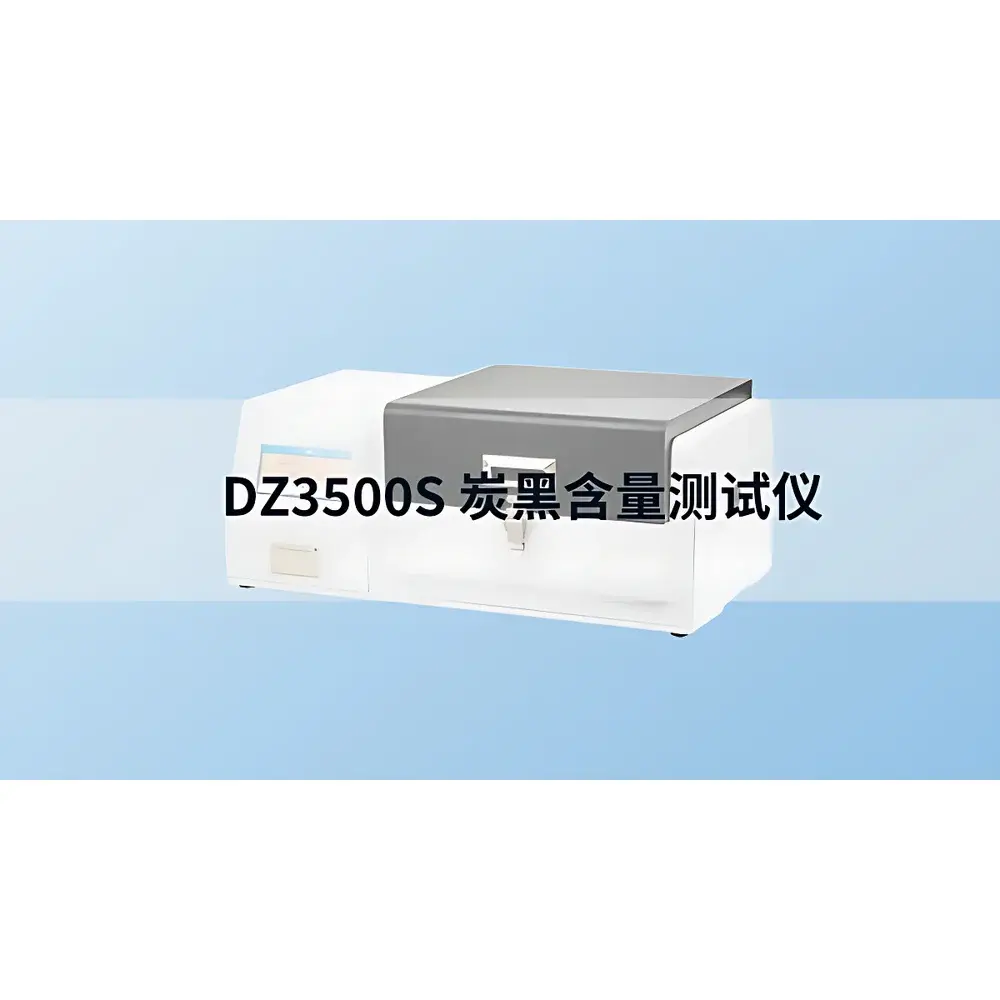
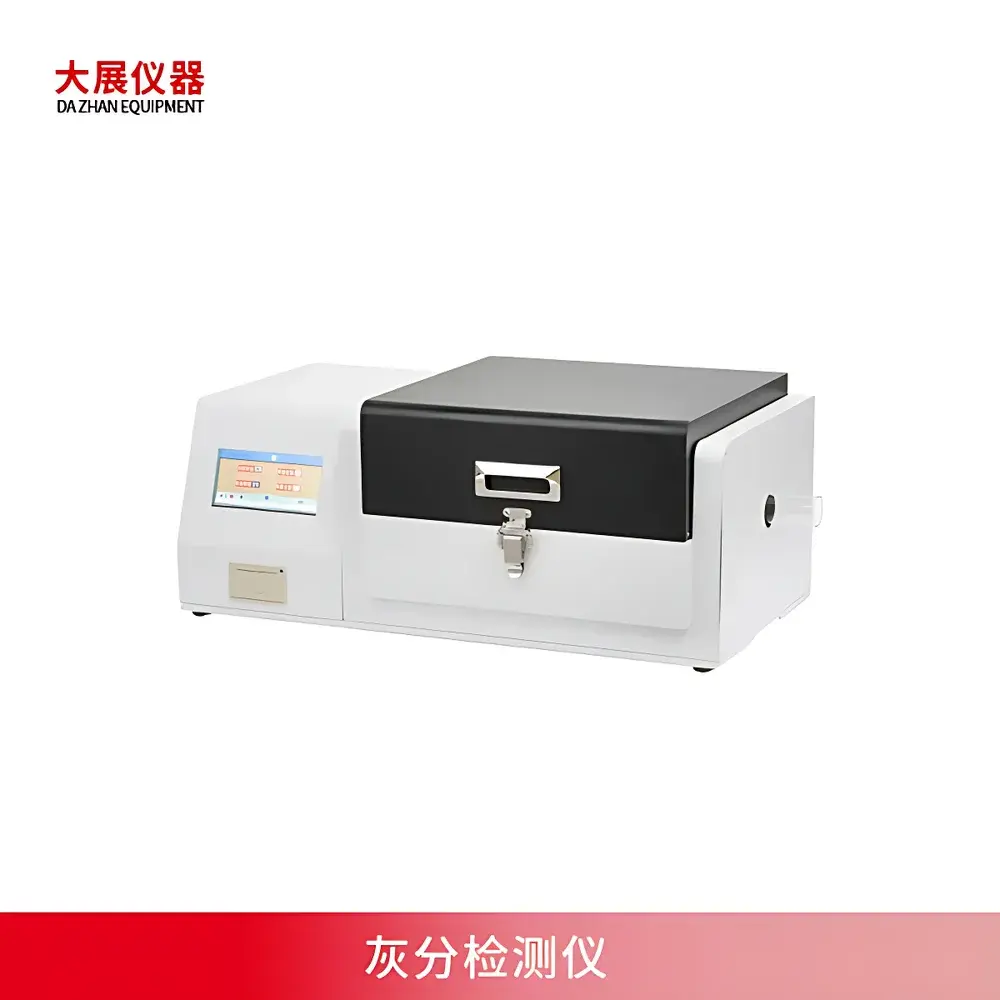
DZHAN DZ3500S Carbon Black and Ash Content Analyzer for Rubber & Plastics
| Brand | DAZHAN |
|---|---|
| Model | DZ3500S |
| Application | Carbon black dispersion & ash content determination in polyolefins, rubber, cable compounds, and polymer composites |
| Temperature Range | Ambient to 1200 °C |
| Heating Zone Length | 350 mm |
| Quartz Tube Dimensions | Ø44 × 600 ± 5 mm |
| Furnace Chamber Dimensions | Ø45 × 300 ± 5 mm |
| Sample Capacity | 4 positions (simultaneous analysis) |
| Cooling Time | ≤20 min (900 °C → ambient, with lid open) |
| Control Interface | 7-inch capacitive touchscreen |
| Temperature Control | Intelligent programmable multi-segment PID |
| Power Supply | AC 220 V / 50–60 Hz |
| Temperature Sensor Resolution | 0.1 °C |
| Gas Flow Control | Dual-channel automated switching |
| Optional | Exhaust filtration unit, thermal printer |
| Compliance | Designed per ASTM D1606, ISO 6964, GB/T 3512, and relevant portions of USP <467> residual carbon methodology |
Overview
The DZHAN DZ3500S Carbon Black and Ash Content Analyzer is a dedicated thermal gravimetric instrument engineered for precise quantification of carbon black loading and inorganic ash residue in thermoplastic and elastomeric materials. It operates on the principle of controlled pyrolysis under inert (N₂) or oxidative (air/O₂) atmospheres, followed by high-temperature calcination to volatilize organic matrix components while retaining carbon black or mineral fillers. The system conforms to standardized test protocols including ASTM D1606 (Standard Test Method for Carbon Black in Rubber Compounds), ISO 6964 (Rubber—Determination of carbon black content), and GB/T 3512 (Rubber—Determination of ash content). Its dual-atmosphere capability enables differentiation between total carbon black (via nitrogen pyrolysis) and residual ash (via air combustion), supporting both QC release testing and R&D formulation validation in polymer compounding labs.
Key Features
- Four-position parallel sample processing — increases throughput by 4× versus single-sample furnaces without compromising temperature uniformity or inter-sample reproducibility.
- Open-lid furnace architecture — facilitates rapid manual sample insertion/extraction and accelerates cooling (≤20 min from 900 °C to ambient), minimizing turnaround time between runs.
- Intelligent programmable temperature control — supports multi-step heating profiles (e.g., ramp-hold-ramp sequences) with independent setpoints for pyrolysis, oxidation, and final ash stabilization phases.
- High-stability quartz tube reactor (Ø44 × 600 mm) housed within a uniformly heated alloy furnace zone (350 mm active length), ensuring ±2 °C axial temperature homogeneity across all four sample locations.
- Integrated dual-gas manifold with solenoid-driven automatic switching between N₂ and air streams — eliminates manual gas line changes and reduces operator-induced variability.
- Capacitive 7-inch touchscreen interface — provides real-time temperature curve visualization, parameter logging, and direct access to preloaded ASTM/ISO-compliant test templates.
Sample Compatibility & Compliance
The DZ3500S is validated for use with polyethylene (PE), polypropylene (PP), polybutene (PB), ethylene-propylene-diene monomer (EPDM), styrene-butadiene rubber (SBR), and halogenated cable insulation compounds (e.g., XLPE, PVC, LSZH). It accommodates standard crucibles (alumina or platinum) up to 30 mL volume and accepts specimens ranging from 0.5 g to 2.0 g — sufficient for statistically representative sampling per ASTM D1606 requirements. Instrument design incorporates GLP-aligned operational safeguards: full audit trail of method parameters, user login authentication, timestamped run logs, and non-volatile storage of raw mass vs. time data. Optional exhaust filtration meets local occupational exposure limits (OELs) for particulate and volatile organic emissions during high-temperature decomposition.
Software & Data Management
The embedded firmware includes an integrated calculation engine compliant with ASTM D1606 Annex A1 (carbon black mass fraction = [(m₁ − m₂) / m₀] × 100%) and ISO 6964 Equation 1 (ash content = [(m₃ − m₄) / m₀] × 100%), where m₀ = initial sample mass, m₁ = mass after pyrolysis, m₂ = mass after oxidation, m₃ = crucible + ash mass, and m₄ = tare crucible mass. All intermediate and final values are automatically recorded, tagged with operator ID, date/time, and method version. Export options include CSV for LIMS integration and PDF report generation (with optional thermal printer support). Data integrity adheres to FDA 21 CFR Part 11 principles through electronic signature prompts and immutable run archives.
Applications
This analyzer serves as a core tool in quality assurance laboratories for rubber and plastic compounders, wire & cable manufacturers, and additive masterbatch producers. Typical use cases include batch-to-batch verification of carbon black loading in tire tread compounds; ash content screening of flame-retardant filled polyolefins; validation of pigment dispersion stability in color concentrates; and regulatory compliance testing for RoHS-restricted elements (e.g., Pb, Cd, Cr) when coupled with post-ash ICP-OES analysis. Its rapid cooldown and multi-sample capacity make it especially suited for high-volume production environments requiring <30-minute cycle times.
FAQ
What standards does the DZ3500S directly support?
ASTM D1606, ISO 6964, GB/T 3512, and portions of ISO 248 (rubber—determination of ash) and ASTM D5630 (plastics—determination of ash).
Can the instrument distinguish between carbon black and other carbonaceous residues?
Yes — by sequential N₂ pyrolysis (retaining carbon black) followed by air oxidation (removing residual organics), the system isolates carbon black mass via differential gravimetry.
Is calibration traceable to national standards?
Temperature calibration is performed using NIST-traceable reference thermocouples; mass measurements rely on user-supplied analytical balances meeting ISO/IEC 17025 calibration requirements.
Does the system require external ventilation or fume hood integration?
While the optional exhaust filter mitigates airborne particulates, installation in a certified chemical fume hood is recommended for full compliance with OSHA 1910.1200 and local industrial hygiene regulations.
How is data security maintained during networked operation?
The standalone unit operates offline by default; when connected to LAN, all data transfers are encrypted (TLS 1.2+), and remote access requires role-based authentication aligned with ISO 27001 controls.
Related Products




