
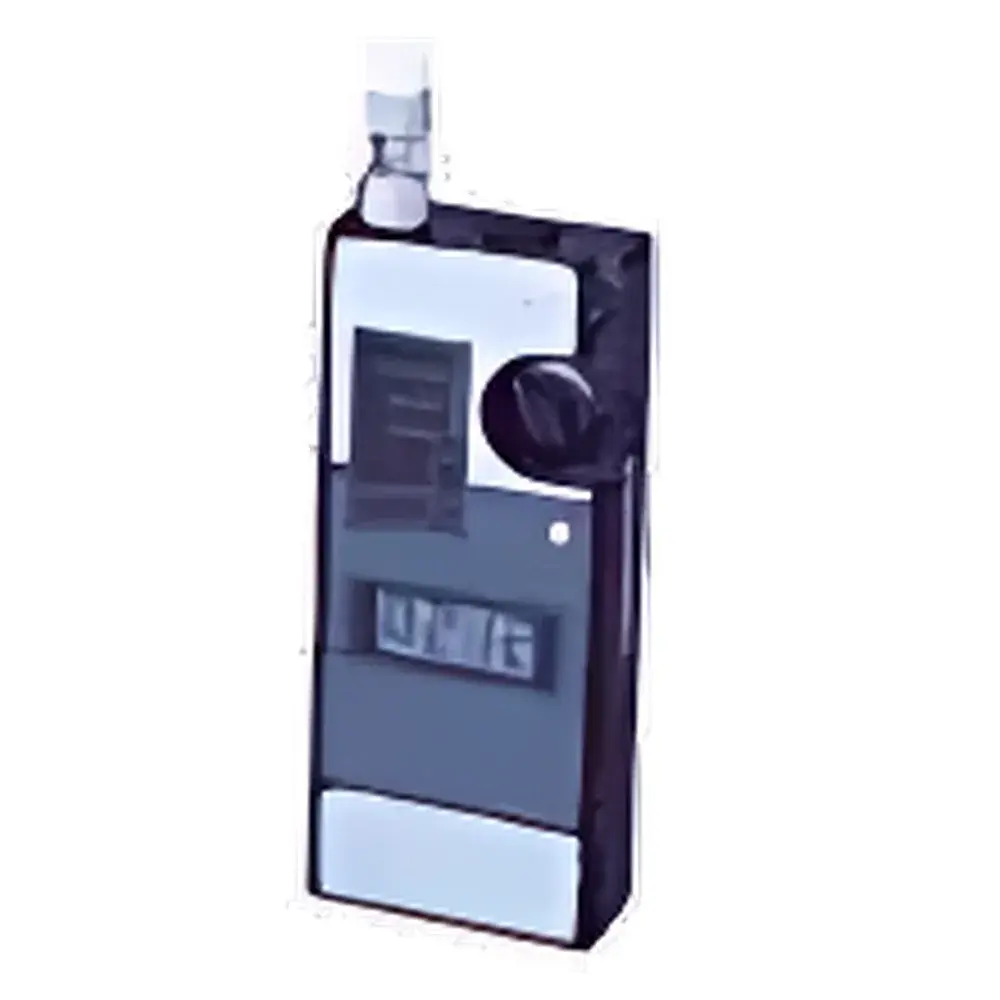
XP-329III Automatic Suction-Type Odor Intensity Analyzer
| Detection Principle | High-Sensitivity Indium Oxide-Based Heated Semiconductor Sensor |
|---|---|
| Display | 64×128 Dot-Matrix LCD |
| Measurement Modes | Real-Time Monitoring / Batch Sampling |
| Odor Intensity Range | 0–40 (Odor Unit Scale) |
| Odor Level Range | 0–2000 (Arbitrary Unit Scale) |
| Data Storage Capacity | Up to 8,188 points (Monitoring Mode), Up to 4,095 points (Batch Mode) |
| Operating Environment | 0°C–40°C, 30–80% RH |
| Power Supply | 4 × AA Alkaline Batteries (≈8 h operation) or Optional AC Adapter |
| Dimensions & Weight | 84 × 275 × 40 mm, ≈640 g (incl. batteries) |
| Analog Output | 0–200 mV DC (scalable to either 0–2000 or 0–40 scale) |
| Communication Interface | RS-232C with Dedicated PC Software |
| Accessories Included | Activated Carbon Filter, Exhaust Filter, Suction Kit, Metal Cap for Tubing, AC Adapter, Carrying Case, Connectorized Output Cable, Odor Analysis Software Suite, 4 × AA Batteries, 1 × PTFE Sampling Tube, 20 × Filter Cloths, 2 × Activated Carbon Packs |
Overview
The XP-329III Automatic Suction-Type Odor Intensity Analyzer is a field-deployable, portable odor quantification instrument engineered for objective, repeatable assessment of volatile organic compounds (VOCs) and complex odorant mixtures in ambient air, industrial exhaust streams, wastewater treatment facilities, and food processing environments. Unlike subjective human olfactometry, the XP-329III employs a calibrated metal oxide semiconductor (MOS) sensor array based on sintered indium oxide (In₂O₃) heated elements—optimized for broad-spectrum sensitivity to sulfur-containing compounds (e.g., H₂S, mercaptans), nitrogenous volatiles (e.g., amines, ammonia), aldehydes, ketones, and short-chain fatty acids commonly associated with malodors. The instrument operates on the principle of resistance modulation: odorant molecules adsorb onto the heated sensing surface, altering its electrical resistance in proportion to concentration and compound class. This analog signal is digitized and mapped to two parallel output scales—arbitrary “odor level” (0–2000) and standardized “odor index” (0–40)—the latter aligned with Japan’s Ordinance on Odor Control (Ministry of the Environment Notification No. 75, 2002) and compatible with ISO 16000-28:2012 (Indoor air — Part 28: Determination of odour concentration by dynamic olfactometry) reference frameworks for regulatory reporting.
Key Features
- Integrated automatic suction pump with flow-regulated sampling (no manual bellows or external vacuum source required), ensuring consistent draw rate and minimizing operator variability.
- Dual-scale real-time display: switch instantly between linear odor level (0–2000) and logarithmic odor index (0–40), enabling direct comparison with Japanese Environmental Ministry thresholds and municipal odor ordinances.
- Onboard non-volatile memory stores up to 8,188 time-stamped readings in monitoring mode or 4,095 batch-averaged values—each tagged with sensor status, battery level, and operational mode.
- RS-232C serial interface with bundled Windows-compatible software (XP-Link) supports bidirectional communication: download stored datasets, configure measurement parameters, calibrate zero offset, and generate CSV/Excel-compatible reports traceable to GLP-compliant audit trails.
- Modular filtration system includes replaceable activated carbon pre-filter (for hydrocarbon removal), exhaust filter (to prevent sensor saturation), and PTFE sampling tubing (inert, low-adsorption path for humid or acidic gas streams).
- Robust handheld form factor (640 g, IP54-rated enclosure) with ergonomic grip and backlit LCD (64×128 pixels) ensures legibility under variable lighting conditions—from laboratory benches to outdoor stack monitoring sites.
Sample Compatibility & Compliance
The XP-329III is validated for use with gaseous samples containing total volatile organic compounds (TVOCs) at ambient concentrations typical of municipal wastewater lift stations (H₂S: 0.01–5 ppm), composting facility headspaces (dimethyl sulfide, skatole), food manufacturing exhaust (acetaldehyde, butyric acid), and HVAC duct air (mold-related microbial volatile organic compounds, MVOCs). It complies with JIS Z 8401 (Rules for the Expression of Uncertainty of Measurement) for reported values and supports documentation required under Japan’s Odor Control Law Article 7 (facility self-monitoring records). While not a certified olfactometer per ISO 13733, its response profile correlates empirically with dynamic dilution olfactometry results for common odorants—making it suitable for trend analysis, process control verification, and pre-screening prior to formal olfactometric validation. All firmware and calibration routines adhere to IEC 61508 functional safety guidelines for measurement instrumentation.
Software & Data Management
The included XP-Link software provides full instrument control via USB-to-serial adapter (included cable). Users can define custom odor index conversion tables—up to three distinct mappings—to accommodate site-specific odorant profiles (e.g., sewage vs. rendering plant emissions). Raw data exports include timestamp (YYYY-MM-DD HH:MM:SS), measured value, selected scale, battery voltage, and sensor health indicator. Audit logs record all configuration changes, firmware updates, and calibration events with user ID and system timestamp—meeting FDA 21 CFR Part 11 requirements for electronic records when deployed in regulated food QA/QC settings. Data files are structured for direct import into LIMS platforms or statistical process control (SPC) tools such as Minitab or JMP.
Applications
- Verification of odor abatement system performance—including activated carbon filters, biofilters, and chemical scrubbers—by quantifying inlet/outlet odor index reduction ratios.
- Routine monitoring of sewer networks, pumping stations, and anaerobic digesters to detect early-stage process upsets signaled by rising sulfur or amine indices.
- Objective evaluation of deodorizing agents in consumer products (fabric softeners, air fresheners) and food packaging materials under controlled chamber conditions.
- Supporting HACCP plans in seafood processing plants by tracking trimethylamine (TMA) evolution during storage—correlated to sensory spoilage thresholds.
- Baseline odor mapping for environmental impact assessments (EIAs) near landfill boundaries or agricultural operations subject to nuisance odor complaints.
FAQ
Is the XP-329III compliant with international odor standards such as ISO 13733 or EN 13725?
No—the XP-329III is not a certified dynamic olfactometer and does not replace human-panel-based odor concentration measurements required by ISO 13725. It serves as a rapid, objective screening tool aligned with Japanese regulatory odor index conventions.
Can sensor drift be corrected in-field?
Yes—zero calibration is supported using clean, filtered air (via included activated carbon filter); full recalibration requires factory service using certified odor standard gases.
What maintenance intervals are recommended for the MOS sensor?
Sensor lifespan is typically 18–24 months under normal use; performance degradation is monitored via built-in sensor health bar and baseline resistance diagnostics.
Is the analog output signal compatible with PLC or SCADA systems?
Yes—the 0–200 mV DC output is isolated and scalable; users may configure scaling to match either 0–2000 (level) or 0–40 (index) ranges for direct integration with industrial controllers.
Does the device support multi-point averaging for spatial odor profiling?
Not natively—the XP-329III performs single-point measurements; however, batch mode data (up to 4,095 points) enables post-processing of sequential grid-based surveys using the supplied software.







