
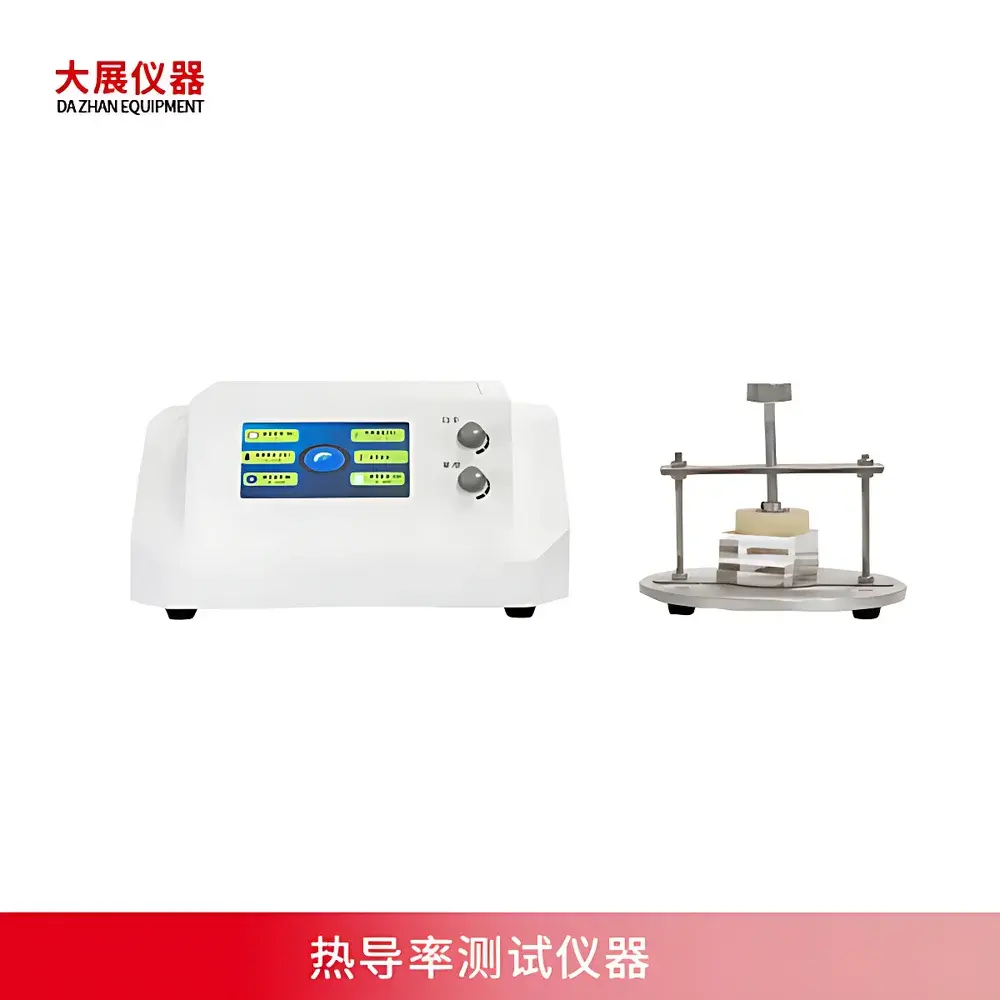
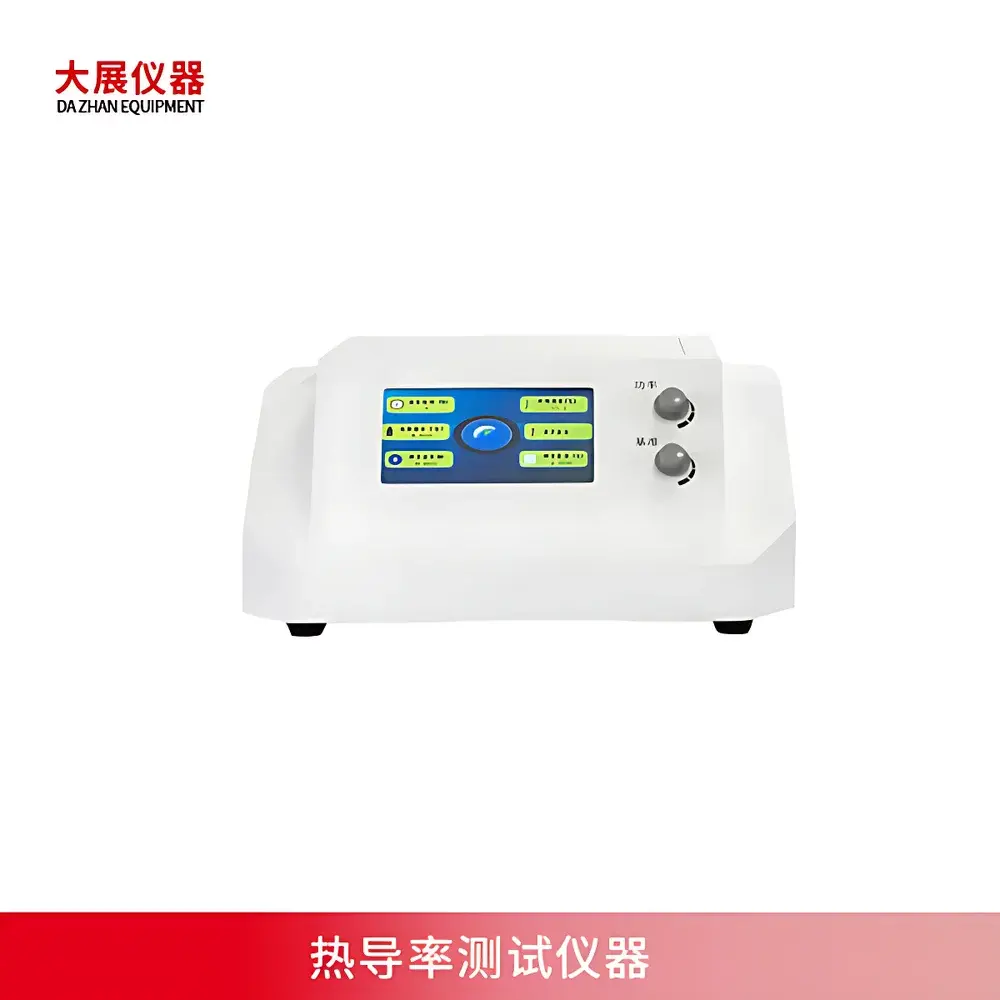
Nanjing Dazhan DZDR-S Transient Plane Source (TPS) Thermal Conductivity Analyzer
| Brand | Nanjing Dazhan |
|---|---|
| Origin | Jiangsu, China |
| Manufacturer Type | Direct Manufacturer |
| Country of Origin | China |
| Model | DZDR-S |
| Instrument Type | Transient Plane Source (TPS) Method |
| Sample Throughput | Single sample per test |
| Test Environment | Ambient temperature (standard) |
| Thermal Conductivity Range | 0.0001–300 W/(m·K) |
| Accuracy | ±3% |
| Repeatability | ≤3% |
| Sample Forms | Solids (bulk, granular, coated, thin-film), powders, liquids, pastes, gels, and metallic specimens |
| Probe Options | 7.5 mm (No. 1), 15 mm (No. 2), 50 mm (No. 3, optional/customizable) |
| Minimum Sample Dimensions | ≥15×15×3.75 mm (No. 1), ≥30×30×7.5 mm (No. 2), ≥50×50×7.5 mm (No. 3) |
| Test Duration | 5–160 s (user-configurable) |
| Power Supply | AC 220 V, <500 W |
| Onboard Controller | ARM-based microprocessor |
| Data Acquisition | High-resolution integrated ADC chip |
| Probe Design | Dual-helix sensor geometry with proprietary thermal response modeling |
Overview
The Nanjing Dazhan DZDR-S Transient Plane Source (TPS) Thermal Conductivity Analyzer is a precision instrument engineered for direct, non-destructive measurement of thermal conductivity (λ), thermal diffusivity (α), and volumetric heat capacity (ρcp) across a broad spectrum of homogeneous and heterogeneous materials. Based on the internationally standardized transient plane source method (ISO 22007-2, ASTM D7984), the system applies a known, time-limited joule heating pulse to a thin, sandwiched sensor acting simultaneously as heat source and resistance thermometer. The resulting transient temperature rise at the sensor–sample interface is recorded with microsecond-level temporal resolution. Using inverse numerical modeling grounded in Fourier’s law and heat diffusion theory, the instrument computes thermal transport properties without requiring steady-state equilibrium—enabling rapid characterization in seconds rather than minutes or hours.
Key Features
- True TPS methodology compliant with ISO 22007-2 and ASTM D7984 for traceable, physics-based thermal property determination.
- Three interchangeable dual-helix planar sensors (7.5 mm, 15 mm, 50 mm diameters) optimized for different sample geometries and thermal effusivity ranges.
- ARM-based embedded control architecture delivering real-time signal processing, adaptive pulse duration adjustment, and deterministic computational latency.
- High-resolution analog-to-digital conversion (ADC) with low-noise front-end electronics ensures stable baseline capture and high signal-to-noise ratio during transient response acquisition.
- Modular sample stage accommodates variable thicknesses and surface topographies; no machining or coating required—only minimal surface flatness (≥2× probe diameter in lateral dimensions) is necessary for reliable contact.
- Configurable test duration (5–160 s) allows optimization for low-conductivity insulators (e.g., aerogels, foams) and high-conductivity metals alike.
- Optional extended temperature range (−40 °C to 300 °C) available via auxiliary environmental chamber integration, supporting thermally activated property mapping.
Sample Compatibility & Compliance
The DZDR-S accepts diverse physical forms without phase-specific hardware modification: rigid solids (metals, ceramics, polymers), flexible sheets, loose powders (with included compression fixture), viscous pastes, Newtonian and non-Newtonian liquids, and composite laminates. Its contact-based design eliminates optical path constraints inherent in laser-flash or infrared methods, making it suitable for opaque, scattering, or highly anisotropic media. All measurements adhere to GLP principles; audit trails, user authentication, and electronic signature support are implemented in firmware to align with FDA 21 CFR Part 11 requirements when paired with validated software configurations. Calibration verification is performed using NIST-traceable reference materials (e.g., SRM 1470a, Pyroceram® 9606).
Software & Data Management
The instrument operates under DZDR Control Suite—a Windows-based application enabling bidirectional communication, automated protocol sequencing, and real-time visualization of voltage vs. time curves. Raw thermistor resistance data is stored in HDF5 format with embedded metadata (operator ID, timestamp, probe ID, ambient conditions). Export options include CSV, Excel, and PDF reports conforming to ISO/IEC 17025 documentation standards. Batch analysis mode supports statistical comparison across sample sets, while uncertainty propagation algorithms calculate combined standard uncertainty (k=2) per ISO/IEC Guide 98-3. Software updates are delivered via secure HTTPS channel with SHA-256 integrity verification.
Applications
This analyzer serves R&D laboratories and QC departments in battery materials development (cathode/anode thermal management), aerospace composites qualification (carbon fiber–epoxy, thermal interface materials), building science (insulation performance certification), pharmaceutical solid dosage form analysis (tablet thermal stability), and geotechnical engineering (soil thermal resistivity assessment). It is routinely employed in academic studies of nanofluids, phase-change materials, and 2D material heterostructures where conventional guarded-hot-plate techniques lack spatial resolution or throughput.
FAQ
What standards does the DZDR-S comply with?
ISO 22007-2 (Plastics — Determination of thermal conductivity and thermal diffusivity — Part 2: Transient plane source (hot disc) method) and ASTM D7984 (Standard Test Method for Thermal Conductivity of Plastics by Transient Plane Source Technique).
Can the system measure anisotropic materials?
Yes—by orienting the probe normal to principal axes and performing orthogonal measurements; directional thermal conductivity tensors can be reconstructed with appropriate sample alignment fixtures.
Is vacuum or inert atmosphere testing supported?
The base configuration operates in ambient air; optional glove-box or vacuum chamber integration is available for moisture-sensitive or oxidation-prone samples.
How is probe calibration maintained?
Each probe is individually characterized using certified reference materials; drift compensation is applied automatically during each test cycle based on pre-stored calibration coefficients.
Does the software support LIMS integration?
Yes—via configurable ODBC drivers and HL7-compliant API endpoints for seamless data ingestion into enterprise laboratory information management systems.
Related Products



