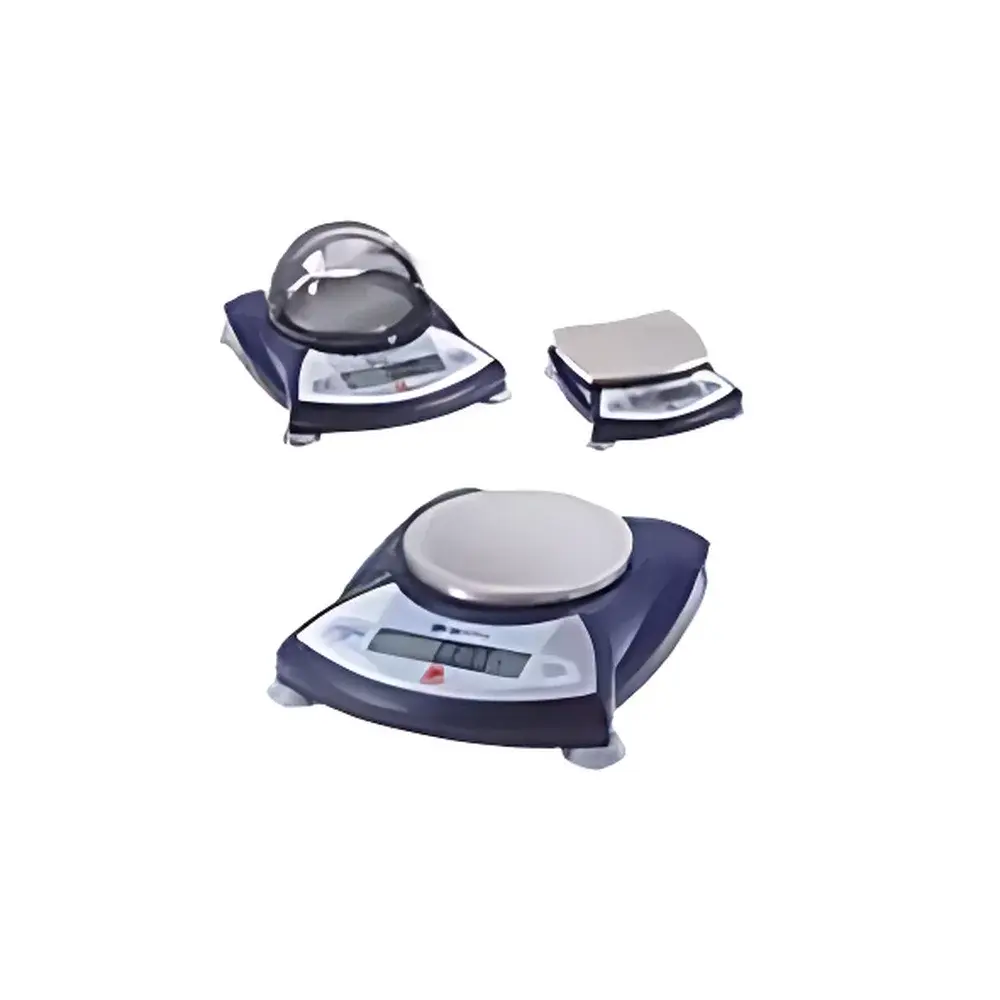
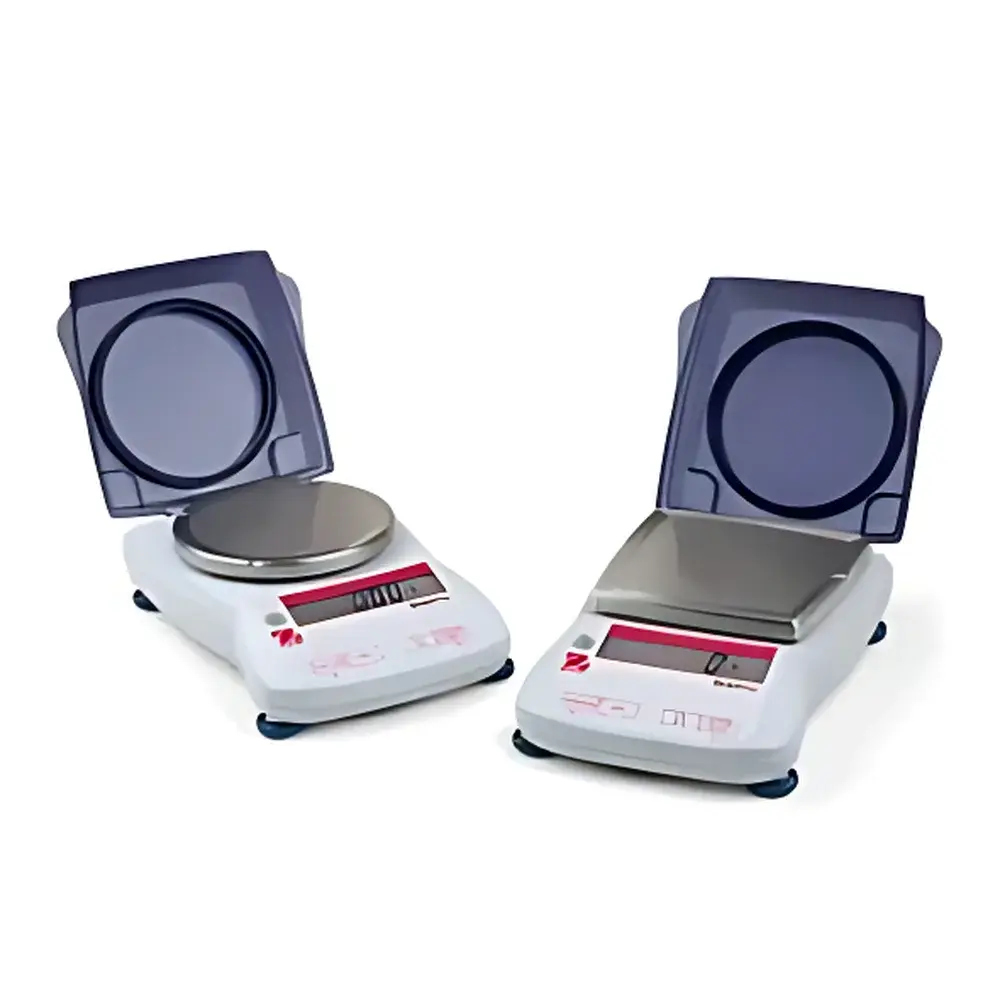
OHAUS Scout SE Portable Balance
| Key | Origin: USA |
|---|---|
| Manufacturer Type | Distributor |
| Product Origin | Imported |
| Model | SE202F |
| Maximum Capacity | 20 g |
| Readability | 0.01 g |
| Calibration | Internal single-point calibration |
| Repeatability | ≤ ±0.01 g |
| Compliance | Designed for general laboratory use per OIML R76 and NIST Handbook 44 guidelines |
| Power | AC adapter or 4×AA batteries (included) |
| Display | Backlit LCD, 15-mm digit height |
| Tare Range | Full capacity |
| Weighing Units | g, oz, ct, dwt, grain, lb:oz, kg |
Overview
The OHAUS Scout SE Portable Balance is an entry-level precision weighing instrument engineered for consistent performance in educational laboratories, quality control checkpoints, field sampling, and light industrial applications. Built on a robust strain-gauge load cell architecture, the SE series employs electromagnetic force compensation principles optimized for static mass measurement under ambient conditions. Unlike analytical balances requiring draft shields or vibration isolation, the Scout SE is designed for operational flexibility—its compact footprint (152 × 180 × 53 mm), integrated leveling feet, and battery-powered mobility support rapid deployment across classrooms, production floors, or mobile testing stations. The SE202F variant delivers a maximum capacity of 20 g with 0.01 g readability, meeting ISO/IEC 17025–recommended uncertainty thresholds for non-critical mass verification tasks where traceable calibration is required but full GLP-grade documentation is not mandated.
Key Features
- Internal single-point calibration routine activated via front-panel key—no external weights required for daily verification.
- Backlit LCD display with 15-mm high digits ensures legibility under variable lighting, including low-illumination field environments.
- Dual power mode: operates continuously via included AC adapter or up to 100 hours on four standard AA alkaline batteries (IEC LR6).
- Auto-zero tracking and auto-stabilization algorithms minimize drift during short-term measurements; stabilization time ≤1.5 seconds at full load.
- Stainless steel pan (90 mm diameter) and ABS housing provide resistance to common lab solvents and mechanical abrasion.
- Tare function supports sequential weighing of multiple samples without manual reset; tare range spans full 20 g capacity.
- RS232 interface (optional cable) enables direct data transfer to PCs or printers for basic recordkeeping—compatible with Windows-based terminal emulation software.
Sample Compatibility & Compliance
The Scout SE202F accommodates solid, granular, and low-viscosity liquid samples within its 20 g limit. Its open pan design permits direct placement of Petri dishes, weighing boats, or small vials (max. 80 mm diameter). While not certified for hazardous area use (e.g., Class I Div 1), it complies with general safety standards IEC 61010-1:2010 and UL 3101-1. For regulatory environments, the balance supports basic audit readiness: calibration logs can be manually recorded, and internal calibration events are timestamped upon execution. Though not FDA 21 CFR Part 11–compliant out-of-the-box (lacking electronic signature or audit trail features), it meets foundational requirements for ISO 9001 and ISO/IEC 17025 Annex A.2 documentation workflows when paired with controlled procedural SOPs.
Software & Data Management
The Scout SE operates as a standalone device without proprietary software dependency. RS232 output transmits ASCII-formatted weight data (e.g., “+20.00 g”) at 9600 baud, 8N1 configuration. Users may capture outputs using generic serial terminal programs (e.g., PuTTY, Tera Term) or import into Excel via VBA macros. No firmware updates or cloud connectivity are supported—firmware remains fixed at factory release to ensure long-term stability and eliminate version-control risks in regulated settings. Data export is limited to real-time streaming; no onboard memory or historical storage is provided.
Applications
- Student experiments in chemistry and biology labs requiring repeatable mass determination of reagents, precipitates, or biological specimens.
- In-process checks for tablet weight variation in pharmaceutical pilot-scale manufacturing (per USP <905> preliminary screening).
- Weighing of calibration standards prior to use in higher-precision instrumentation (e.g., microbalances or analytical balances).
- Inventory management of small components (e.g., screws, sensors, PCBs) where sub-centigram resolution suffices.
- Field-based environmental sampling—soil aliquots, filter papers, or insect specimens—where portability and battery operation are critical.
- Teaching demonstrations of metrological concepts: least count, repeatability, calibration hierarchy, and uncertainty propagation.
FAQ
What is the recommended recalibration frequency for the SE202F?
OHAUS recommends performing internal calibration before first use, after relocation, following temperature shifts >5°C, and at least once per shift in continuous operation environments.
Can the SE202F weigh volatile or hygroscopic samples accurately?
No—it lacks a draft shield or enclosed chamber; such samples require containment vessels and correction for evaporation or moisture uptake, which this model does not compensate for.
Is external calibration with certified weights possible?
Yes—though the unit only supports internal calibration, users may perform external verification using NIST-traceable Class M2 or better weights; deviation beyond ±0.02 g warrants service evaluation.
Does the balance meet legal-for-trade requirements?
No—the Scout SE series is not type-approved for commercial transactions (e.g., retail, shipping); it is designated for laboratory and internal process use only.
How is leveling performed?
Two adjustable front feet and a rear bubble level indicator enable mechanical leveling; optimal accuracy requires stable, non-resonant surfaces free from air currents.