
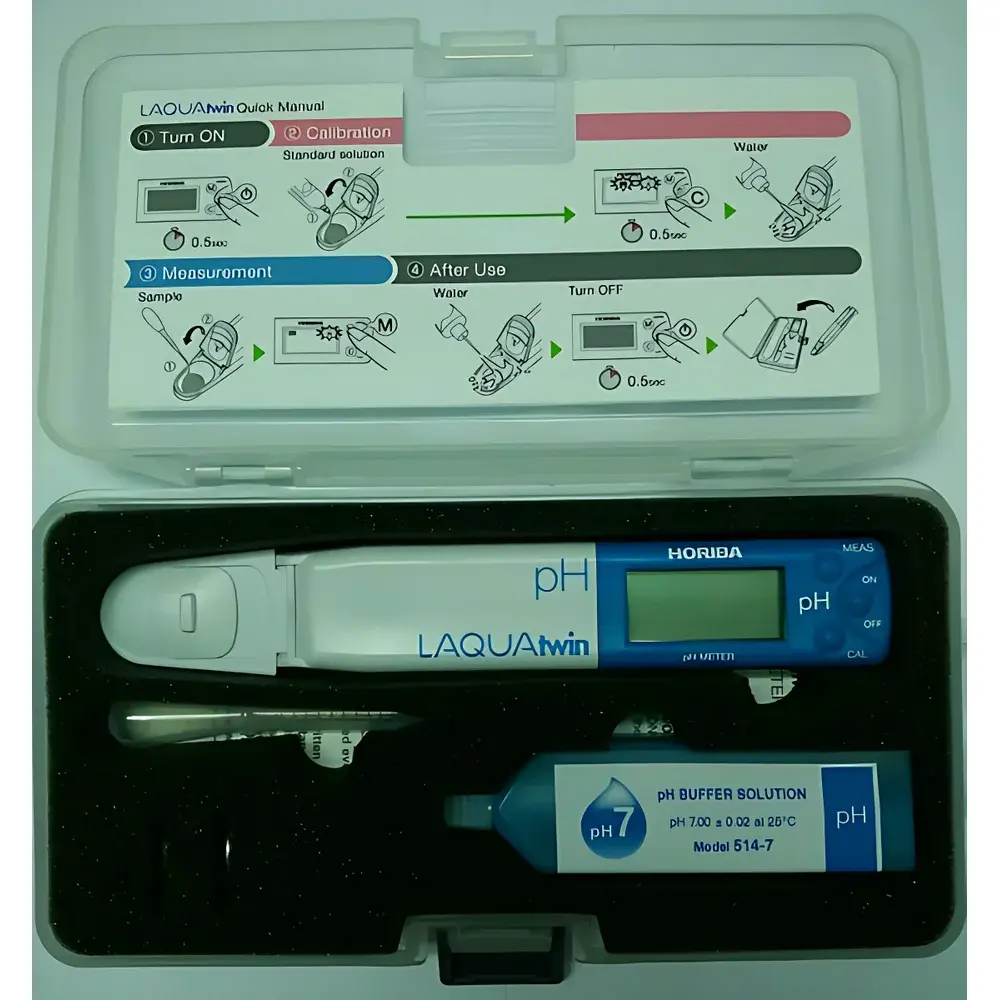
HORIBA PH-22 Portable Pen-Type pH Meter
| Brand | HORIBA |
|---|---|
| Origin | Japan |
| Model | PH-22 |
| Instrument Type | Pen-Style pH Meter |
| Parameter Type | Single-Parameter (pH) |
| Measurement Range | 0–14 pH |
| Resolution | ±0.01 pH |
| Accuracy | ±0.01 pH |
| Calibration Solutions | pH 4.01 and pH 7.00 standard buffers |
| Temperature Compensation | Automatic (ATC) |
| Electrode Type | Flat-Surface pH Sensor |
| Minimum Sample Volume | 100 µL |
| Compliance | Designed for GLP-compliant field and lab use |
Overview
The HORIBA PH-22 is a compact, pen-style portable pH meter engineered for rapid, high-reproducibility pH measurements in resource-constrained or field-deployed environments. Built upon HORIBA’s legacy of electrochemical sensor design, the PH-22 employs a flat-surface glass pH electrode architecture optimized for surface contact measurements — enabling reliable readings on semi-solid matrices (e.g., moist soil surfaces, food gels, or agar plates) and ultra-low-volume liquid samples down to 100 µL. Its measurement principle follows the Nernst equation, where the potential difference between the pH-sensitive glass membrane and a stable internal reference electrode is converted into a digital pH value. Integrated automatic temperature compensation (ATC) ensures traceable accuracy across ambient conditions from 0 °C to 50 °C without manual correction. The device operates in accordance with ISO 3696 (Grade 3 water specifications), ASTM D1293 (Standard Test Method for pH of Water), and supports routine calibration verification per USP and EP 2.2.3 guidelines.
Key Features
- Flat-surface pH electrode geometry — eliminates air bubble entrapment and enables direct contact with heterogeneous or viscous samples including wet soil, cheese surfaces, and hydrogel films
- True single-button operation with auto-ranging display — no mode switching required; unit powers on, stabilizes, and displays pH within 8 seconds
- ATC via integrated thermistor — compensates for temperature-induced electrode slope drift in real time, maintaining ±0.01 pH accuracy across 0–50 °C
- IP67-rated housing — dust-tight and submersible up to 1 m for 30 minutes, suitable for humid aquaculture tanks, outdoor fieldwork, and washdown-intensive food processing zones
- Low-power CMOS circuitry — delivers >200 hours of continuous operation on two AAA alkaline batteries, with auto-shutdown after 10 minutes of inactivity
- Calibration memory retention — stores last calibration date, buffer values used (pH 4.01/7.00), and electrode offset — critical for audit readiness under ISO/IEC 17025 and FDA 21 CFR Part 11 environments
Sample Compatibility & Compliance
The PH-22 accommodates diverse sample forms without dilution or filtration: aqueous solutions, slurries, emulsions, and semi-solids with surface moisture content ≥15%. Its flat electrode design avoids puncturing delicate biological tissues (e.g., fish skin, leaf epidermis) while ensuring stable junction potential. For regulatory workflows, the instrument meets essential requirements for routine QC testing under ISO 17025-accredited laboratories, supports documented calibration procedures aligned with ASTM E2064, and maintains data integrity through non-volatile EEPROM storage of calibration logs. It is not intended for sterilizable or autoclavable applications, nor for measurements in organic solvents or strong oxidizers (e.g., concentrated HNO₃ or ClO₄⁻ media).
Software & Data Management
While the PH-22 operates as a standalone field instrument, its calibration history and timestamped measurement records (up to 50 entries) are accessible via optional IR data transfer module (HORIBA IR-Link Adapter, sold separately). Exported CSV files include UTC timestamps, temperature, pH value, electrode mV output, and calibration status flags — compatible with LIMS platforms such as LabWare LIMS and Thermo Fisher SampleManager. All stored data comply with ALCOA+ principles (Attributable, Legible, Contemporaneous, Original, Accurate, Complete, Consistent, Enduring, Available) and support retrospective audit trails required by GMP Annex 11 and GLP OECD 17025:2017 Clause 7.7.
Applications
- Aquaculture and wastewater monitoring — rapid spot-checking of pond, tank, or effluent pH with minimal sample disturbance
- Food safety and quality assurance — surface pH mapping of meat cuts, dairy products, and fermented vegetables per Codex Alimentarius standards
- Agricultural soil health assessment — in-situ pH profiling at multiple depths using moistened soil paste method (ISO 10390)
- Academic teaching labs — robust entry-level tool for electrochemistry fundamentals, buffer preparation validation, and error analysis exercises
- Pharmaceutical excipient screening — preliminary pH evaluation of gelatin-based or hydroxypropyl methylcellulose (HPMC) suspensions prior to rheological testing
FAQ
What calibration buffers are required for daily use?
The PH-22 requires two-point calibration using certified NIST-traceable pH 4.01 and pH 7.00 standard buffer solutions at 25 °C. Calibration should be performed before each measurement session or when ambient temperature shifts by >5 °C.
Can the electrode be cleaned with ethanol or isopropyl alcohol?
No — alcohol-based solvents may dehydrate the glass membrane and compromise hydration layer integrity. Use only deionized water or mild detergent solution followed by thorough rinsing with DI water.
Is the PH-22 compliant with FDA 21 CFR Part 11 for electronic records?
The standalone unit does not provide electronic signature capability; however, when paired with the IR-Link Adapter and validated LIMS integration, full Part 11 compliance (audit trail, electronic signatures, role-based access) can be achieved through system-level validation.
How often should the electrode be replaced?
Under typical field use (≤5 measurements/day), the flat-surface electrode maintains metrological stability for 12–18 months. Replacement is recommended when calibration slope falls below 92% or when response time exceeds 15 seconds to 95% stabilization.





