
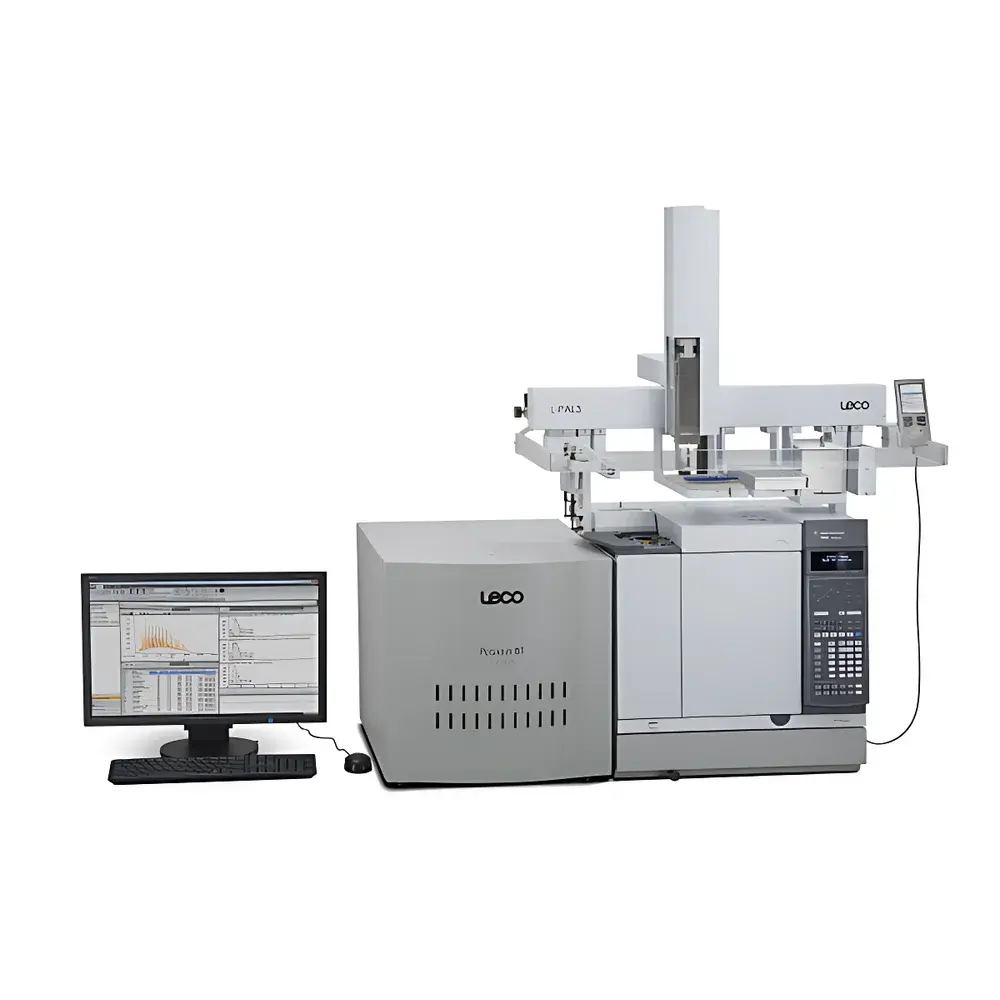
LECO Pegasus BT Gas Chromatography Time-of-Flight Mass Spectrometer
| Brand | LECO |
|---|---|
| Origin | USA |
| Manufacturer | LECO Corporation |
| Instrument Type | Time-of-Flight Mass Spectrometer (TOFMS) |
| GC Configuration | Conventional Capillary GC-MS |
| Mass Range | 10–1500 Da |
| Resolution | 2500 (FWHM at m/z 502) |
| IDL | <8 fg Octafluoronaphthalene (OFN) |
| Acquisition Speed | 50,000,000 amu/s |
| Dynamic Linear Range | >6 orders of magnitude |
| Ion Source | Stay Clean™ Self-Cleaning Electron Ionization Source |
Overview
The LECO Pegasus BT is a benchtop gas chromatography time-of-flight mass spectrometer (GC-TOFMS) engineered for high-fidelity, full-spectrum acquisition in routine and research laboratories. Unlike scanning mass analyzers—such as quadrupole or ion trap systems—the Pegasus BT employs orthogonal acceleration time-of-flight (oa-TOF) mass analysis, enabling simultaneous detection of all ions across the entire mass range with microsecond-level duty cycle. This architecture eliminates the trade-off between scan speed, sensitivity, and mass accuracy inherent in sequential detection instruments. The system delivers true full-scan data at up to 50 million amu per second, supporting rapid chromatographic methods—including time-compressed GC—with no spectral undersampling or loss of quantitative integrity. Its compact footprint and integrated vacuum architecture make it suitable for installation in standard analytical labs without dedicated infrastructure, while maintaining the performance benchmarks expected from high-end TOF platforms.
Key Features
- High-Speed Full-Spectrum Acquisition: Real-time acquisition at 35 kHz transient rate (50,000,000 amu/s), ensuring complete spectral fidelity even under ultrafast GC conditions (e.g., sub-10 min runs).
- Enhanced High-Mass Response & Isotopic Fidelity: Optimized ion optics and reflectron design improve signal intensity and isotopic peak shape above m/z 500—addressing a common limitation in conventional TOFMS systems.
- Stay Clean™ Ion Source: A self-cleaning electron ionization (EI) source that minimizes carbon buildup and reduces routine maintenance intervals; no manual cleaning required under normal operating conditions.
- Automated Peak Finding™: Intelligent baseline correction and peak detection algorithm that identifies co-eluting components without user-defined parameters.
- Nontarget Deconvolution™ (2nd Generation): Advanced mathematical deconvolution capable of resolving overlapping peaks from complex matrices—critical for metabolomics, environmental screening, and pesticide residue analysis.
- Target Analyte Finding™ (TAF): Targeted post-acquisition search engine that scans acquired full-scan datasets for predefined compounds using retention time windows and spectral libraries—enabling retrospective analysis without re-injection.
Sample Compatibility & Compliance
The Pegasus BT supports a wide range of volatile and semi-volatile organic compounds (VOCs/SVOCs) via standard capillary GC interfaces. It is compatible with LECO’s TriVersa™ autosampler platform—supporting liquid injection, headspace, and SPME modes with automated module switching. The instrument meets key regulatory requirements for method validation in food safety (AOAC, EN 15662), environmental testing (EPA Methods 8270, 8260), and clinical research (CLIA-aligned workflows). Data acquisition and processing comply with audit-trail functionality per FDA 21 CFR Part 11 when used with certified software configurations. All mass calibration and tuning procedures are traceable to NIST-standard reference compounds (e.g., FC-43, DFTPP), ensuring long-term reproducibility across laboratories.
Software & Data Management
ChromaTOF® software provides an integrated environment for instrument control, real-time spectral visualization, library searching (NIST, Wiley, custom libraries), and quantitative reporting. Its embedded chemometric tools support multivariate analysis (PCA, PLS-DA) for untargeted studies. Raw data files (.tdf) are stored in open, non-proprietary format, facilitating third-party integration and long-term archival compliance. The software includes GLP/GMP-ready features: electronic signatures, user access levels, change logs, and full audit trail for all processing steps—including deconvolution, peak integration, and calibration updates. Batch processing workflows enable automated reprocessing of legacy datasets as new standards or libraries become available—maximizing data reuse value.
Applications
The Pegasus BT is validated for use in diverse analytical domains requiring both qualitative confidence and quantitative robustness. In agricultural chemistry, it enables comprehensive pesticide multiresidue analysis with confirmatory-level identification per EU SANTE/11312/2021 guidelines. In metabolomics, its wide dynamic range (>6 orders) and high mass accuracy (<5 ppm RMS error) support relative quantitation of low-abundance endogenous metabolites alongside high-concentration lipids or amino acids. Environmental labs deploy it for persistent organic pollutant (POP) profiling in soil and water extracts, where co-elution challenges demand superior deconvolution capability. Food authenticity testing benefits from its ability to detect trace adulterants or process contaminants (e.g., acrylamide, furan) in complex matrices such as roasted coffee or infant formula. Additionally, petroleum and polymer labs utilize its high-mass resolution for additive identification and degradation product profiling in hydrocarbon streams.
FAQ
What distinguishes Pegasus BT from quadrupole or triple-quadrupole GC-MS systems?
The Pegasus BT acquires full-spectrum data at every retention time point, eliminating the need for pre-defined ion selection (SIM/MRM). This preserves all chemical information for retrospective analysis and improves compound identification confidence through library matching and isotopic pattern verification.
Is the Stay Clean™ ion source truly maintenance-free?
Under typical EI operating conditions (e.g., 70 eV, <1 µA emission current), the Stay Clean™ source requires no manual cleaning for ≥6 months of continuous operation—even with dirty samples such as crude oil extracts or wastewater concentrates.
Can ChromaTOF software be validated for regulated environments?
Yes. When deployed on validated Windows OS configurations and paired with documented IQ/OQ protocols, ChromaTOF meets requirements for GxP-compliant laboratories conducting stability testing, impurity profiling, or residue monitoring.
How does the system handle co-eluting peaks in complex samples?
Nontarget Deconvolution™ applies iterative fitting algorithms constrained by known isotopic distributions and retention index behavior—resolving components with ≤0.5 s chromatographic separation and mass differences ≥1 Da.
What GC inlet and column configurations are recommended?
The system is optimized for standard 0.25 mm ID fused silica columns (e.g., DB-5ms, Rxi-5Sil MS) with split/splitless inlets. For maximum sensitivity, cold on-column or programmed temperature vaporization (PTV) inlets are supported via optional hardware interfaces.





