
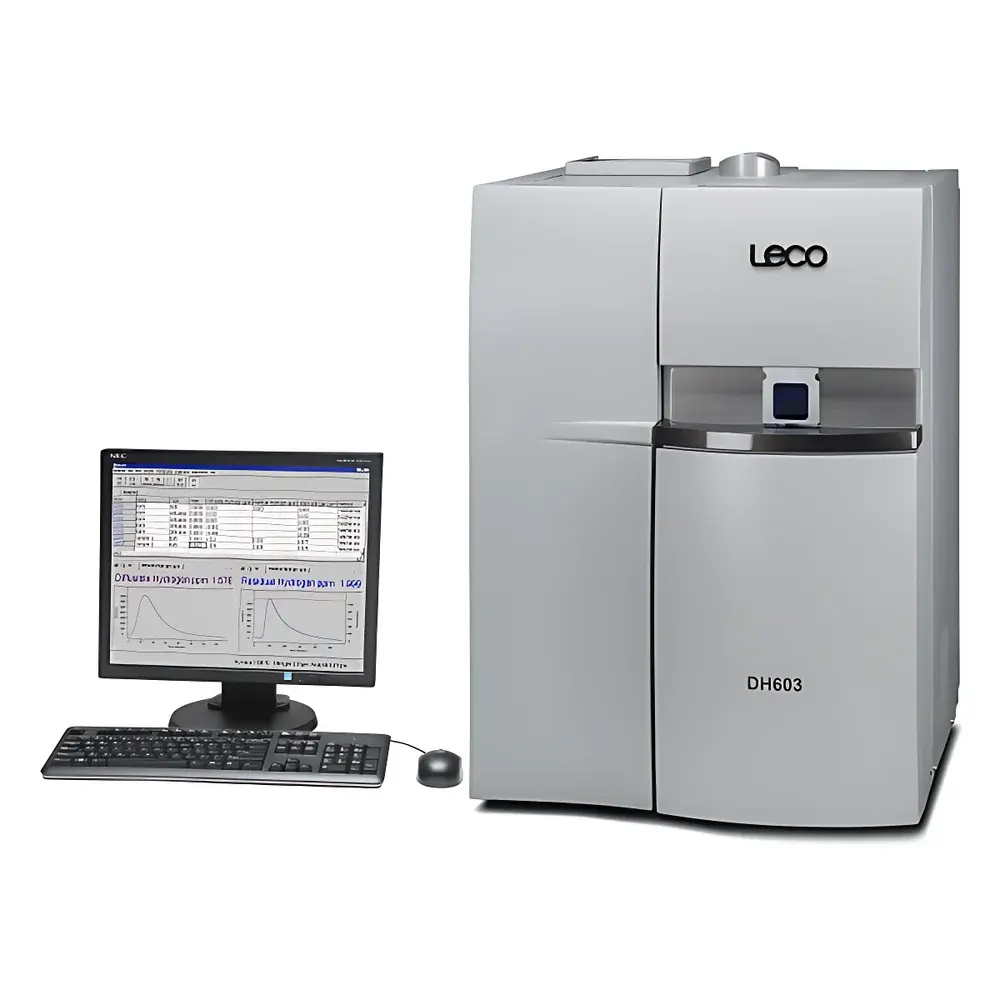
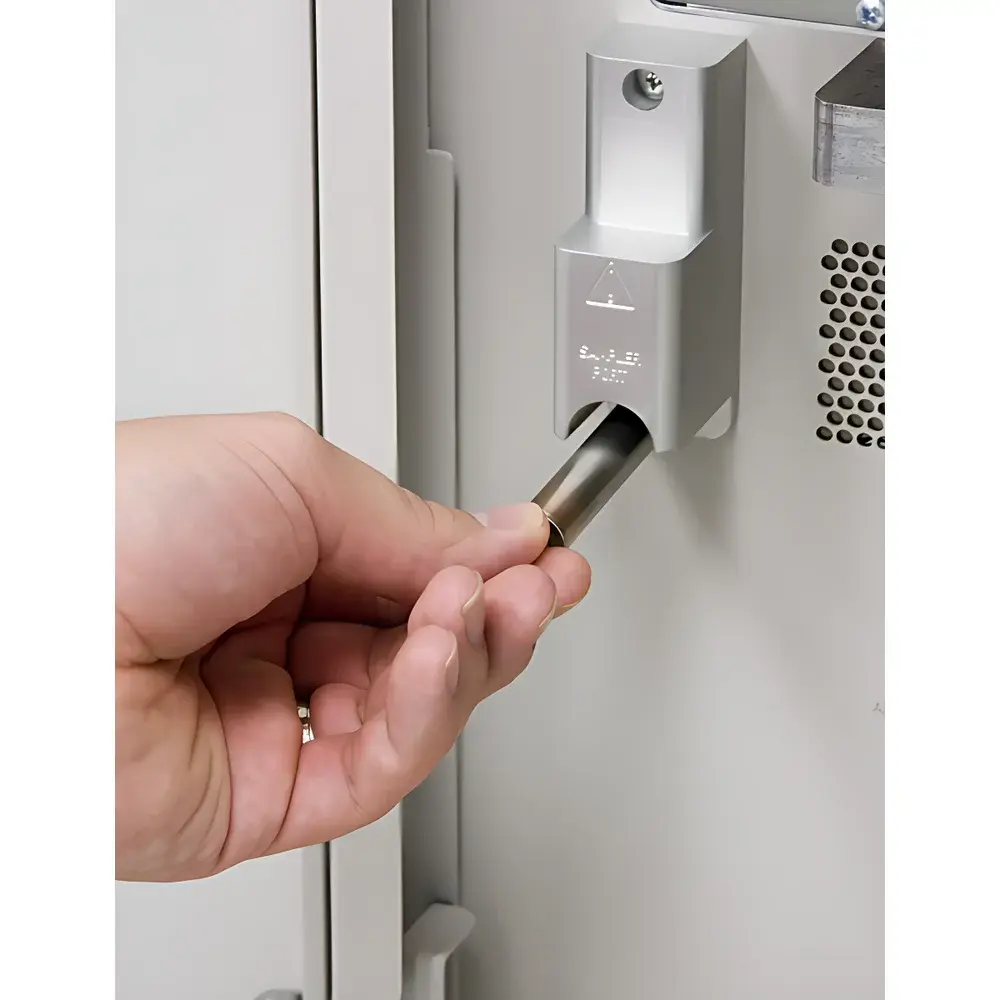
LECO DH603 Diffusible Hydrogen Analyzer
| Brand | LECO |
|---|---|
| Origin | USA |
| Manufacturer Type | Original Equipment Manufacturer (OEM) |
| Product Category | Imported Instrument |
| Model | DH603 |
| Instrument Type | Hydrogen Analyzer |
| Measurement Principle | Thermal Extraction with Solid-State Detection |
| Temperature Range | Ambient to 1100 °C |
| Sample Form | Solid Metallic Specimens (Ferrous Alloys, Weld Metals, Castings, Forgings) |
| Optional Accessories | Diffusible Hydrogen Sampler, Residual Hydrogen Sampler, Vacuum Sampling Probes for Molten Metal |
| Calibration Method | Standardless Gas Calibration via Internal Reference Signal Stabilization |
| Compliance | Designed to Support ASTM E1442, ISO 3690, AWS A4.3, and EN ISO 17025–accredited laboratory workflows |
Overview
The LECO DH603 Diffusible Hydrogen Analyzer is a thermally driven, solid-state detection system engineered for the precise quantification of diffusible hydrogen, residual hydrogen, and total hydrogen in ferrous metallic materials—including weld deposits, castings, forgings, and heat-affected zones. Operating on the principle of thermal extraction under controlled inert gas flow, the DH603 heats solid specimens to elevated temperatures (up to 1100 °C) to release hydrogen trapped in lattice interstices or microstructural defects. Released hydrogen is carried by high-purity argon through a catalytic converter and into a highly stable solid-state sensor—eliminating reliance on consumable reagents or external calibration gases. Unlike traditional carrier-gas chromatographic or thermal conductivity-based systems, the DH603 employs LECO’s proprietary ECLIPSE circuit architecture, which integrates real-time signal normalization, drift compensation, and thermal mass compensation to ensure long-term baseline stability and measurement reproducibility across multi-shift operation.
Key Features
- Fixed-furnace design with optimized thermal uniformity—replaces mechanically unstable tilting furnaces and eliminates positional variability during heating cycles.
- Modular gas path architecture featuring quick-disconnect fittings and low-dead-volume manifolds—reduces maintenance time and minimizes carryover risk between analyses.
- Ergonomically reconfigured internal layout with front-access service panels and tool-free component removal—enables routine maintenance without disassembly of primary thermal or detection modules.
- Advanced furnace temperature control system with dual-zone PID regulation and integrated thermocouple redundancy—ensures ±1 °C accuracy from ambient to 1100 °C, critical for differentiating diffusible vs. residual hydrogen release kinetics.
- Standardless calibration capability via internal reference signal stabilization—eliminates dependency on certified gas standards while maintaining traceability to NIST-traceable reference materials when required for GLP/GMP environments.
- Optional diffusible hydrogen sampler (DHS) and residual hydrogen sampler (RHS) kits—enable method-specific extraction protocols aligned with ASTM E1442 (diffusible H in weld metal) and ISO 3690 (hydrogen in arc-welded joints).
Sample Compatibility & Compliance
The DH603 accepts solid metallic samples up to 10 g in mass, including machined coupons, weld metal chips, and as-welded stubs. When paired with LECO’s vacuum sampling probes, the system supports direct hydrogen analysis of molten steel and aluminum alloys at pouring temperature. All analytical methods implemented on the DH603 are fully compatible with internationally recognized standards: ASTM E1442 (Standard Test Method for Determination of Diffusible Hydrogen in Steel), ISO 3690 (Welding — Determination of Hydrogen in Arc-Welded Joints), AWS A4.3 (Standard Test Methods for Determining the Diffusible Hydrogen Content of Martensitic, Bainitic, and Ferritic Steels), and EN ISO 17025 requirements for method validation and uncertainty estimation. The instrument’s firmware and data handling routines support audit-ready electronic records compliant with FDA 21 CFR Part 11 when deployed with optional secure user authentication and electronic signature modules.
Software & Data Management
The DH603 operates with LECO’s Windows-based Horizon software—a lightweight, memory-efficient application designed for continuous 24/7 operation on industrial-grade PCs. Horizon provides full method configuration (heating ramp profiles, hold times, gas flow rates), real-time sensor diagnostics, automatic peak integration, and customizable reporting templates. All raw sensor outputs, temperature logs, and gas flow metadata are stored in a relational SQLite database with built-in versioning and timestamped backups. Export options include CSV, PDF, and XML formats compatible with LIMS integration. Audit trails record all user actions—including method edits, calibration events, and result approvals—with immutable timestamps and operator ID linkage. Software updates are delivered via signed firmware packages verified against SHA-256 checksums.
Applications
- Quality assurance of welding consumables and procedure qualification records (PQRs) per ASME Section IX and ISO 15614.
- Hydrogen-induced cracking (HIC) and sulfide stress cracking (SSC) mitigation in oil & gas pipeline steels and sour-service components.
- Process validation of hydrogen bake-out cycles in aerospace titanium and high-strength alloy fabrication.
- Research into hydrogen embrittlement mechanisms using controlled thermal desorption spectroscopy (TDS) protocols.
- In-process monitoring of hydrogen pickup during hot rolling, pickling, and electroplating operations.
FAQ
What sample types can be analyzed on the DH603?
Solid metallic specimens—including carbon steels, low-alloy steels, stainless steels, and nickel-based superalloys—are routinely analyzed. With optional vacuum sampling hardware, molten metal samples may also be processed.
Does the DH603 require daily calibration with standard gases?
No. The instrument uses an internal reference stabilization algorithm that enables standardless operation. Certified reference materials may be used periodically for verification or regulatory compliance.
How does the DH603 differentiate diffusible from residual hydrogen?
By combining programmable heating profiles with the optional Diffusible Hydrogen Sampler (DHS), the system isolates hydrogen released below 100 °C (diffusible) from that liberated above 300 °C (residual), in accordance with ASTM E1442 and ISO 3690 protocols.
Is the DH603 compatible with laboratory information management systems (LIMS)?
Yes. Horizon software supports ODBC-compliant database exports and HL7/ASTM E1384 message formatting for seamless LIMS integration.
What maintenance intervals are recommended for routine operation?
Gas line inspection every 200 runs; furnace tube cleaning every 1,000 analyses; sensor verification quarterly using NIST-traceable reference material—per LECO’s documented maintenance schedule.




