
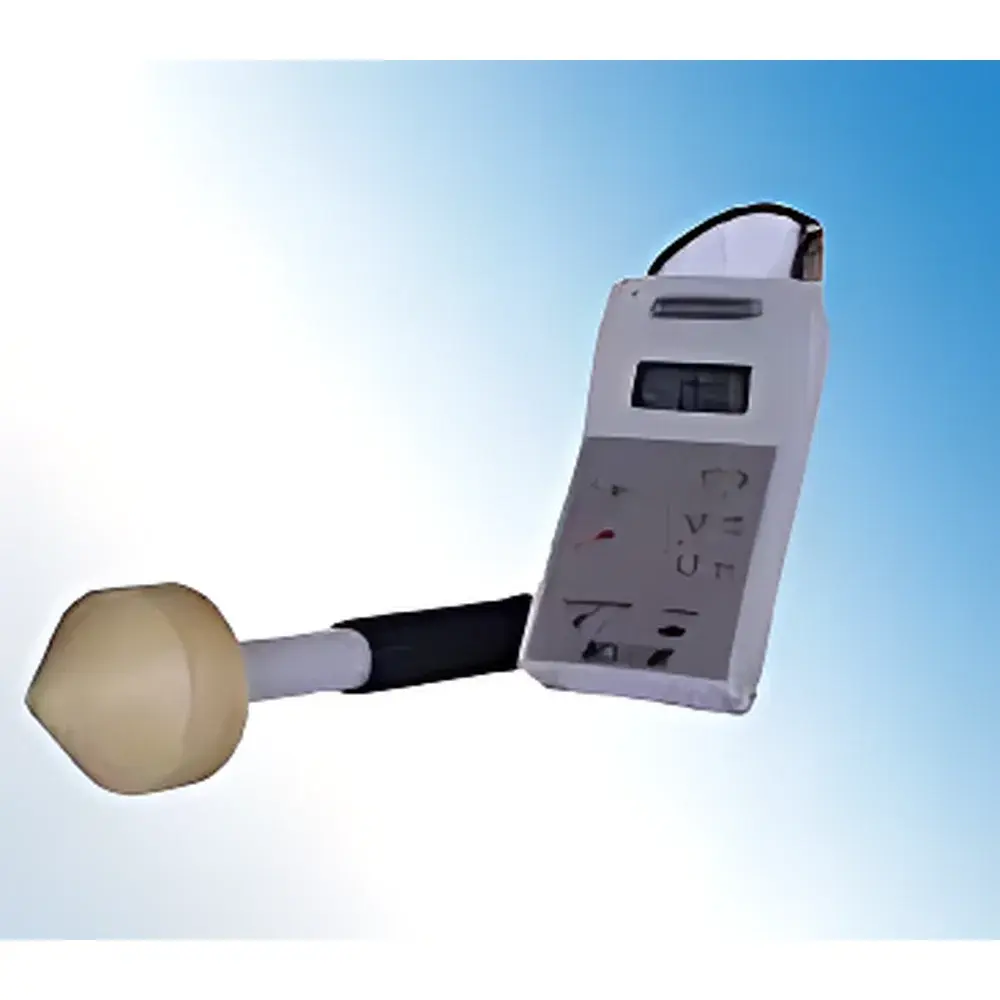
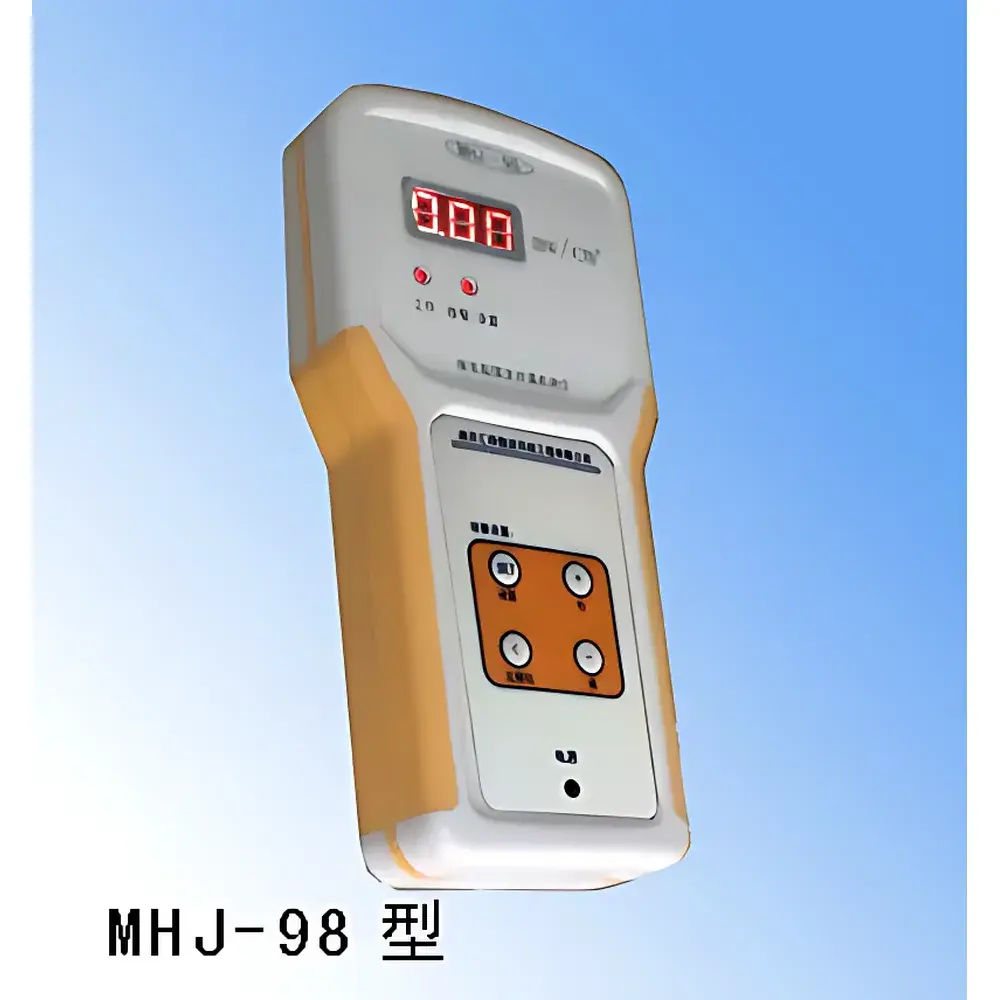
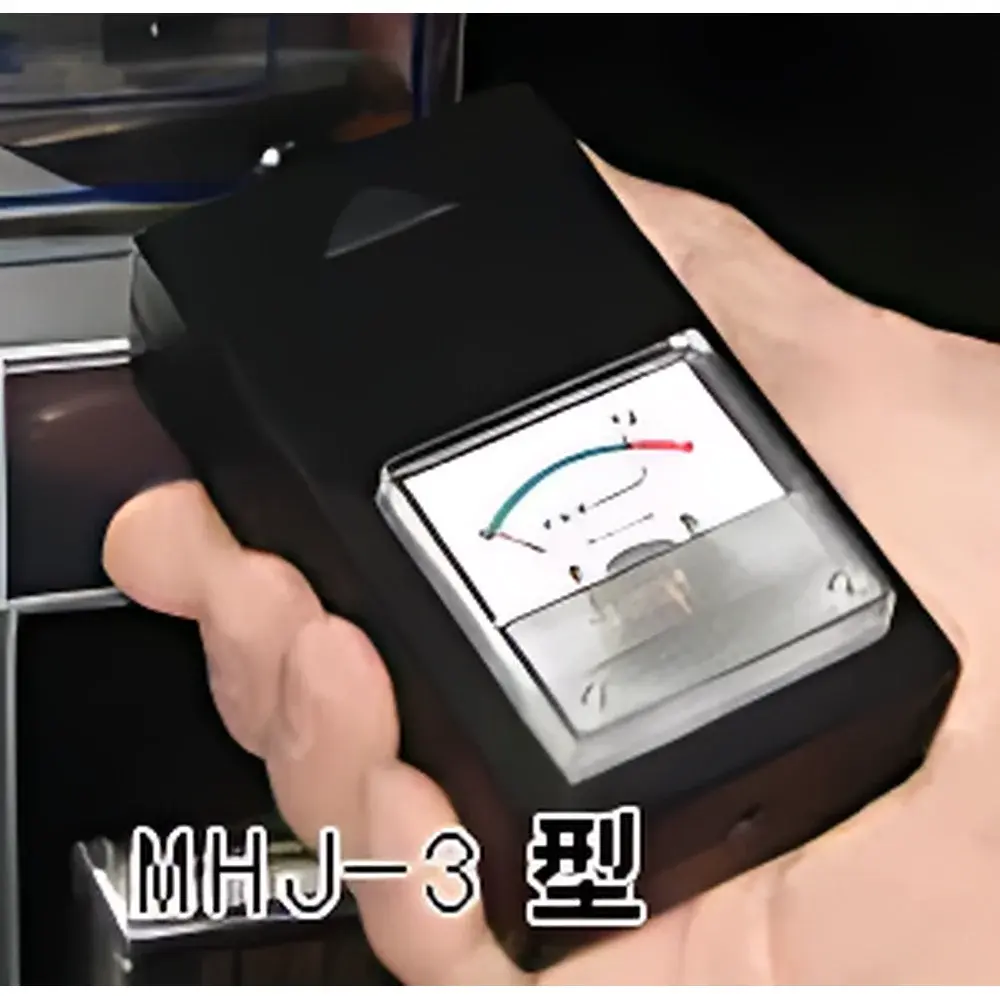
Huiyan ML-91 Portable Microwave Leakage Power Density Meter
| Brand | Huiyan |
|---|---|
| Origin | Jiangsu, China |
| Model | ML-91 |
| Instrument Type | RF Power Density Meter (Radiation Dosimetry) |
| Frequency Range | 0.9–12.4 GHz |
| Measurement Range | 0.2 µW/cm² to 20 mW/cm² |
| Resolution | 0.2 µW/cm² |
| Display | Digital LCD with Auto-ranging (3 ranges: 200 µW/cm², 2 mW/cm², 20 mW/cm²) |
| Alarm Threshold | Factory-set at 5 mW/cm² (adjustable only by manufacturer) |
| Operating Modes | CW and Pulsed RF |
| Sensor Burnout Limit | 100 mW/cm² (CW), 3 W/cm² peak (pulsed) |
| Calibration Uncertainty | ±0.75 dB |
| Indicating Device Accuracy | ≤ ±1.5% of full scale |
| Dimensions (Indicator Unit) | 82 × 40 × 172 mm |
| Weight (Indicator Unit) | ~0.8 kg |
| Environmental Operating Range | –10 °C to +40 °C, RH 51–81%, Atmospheric Pressure 720–780 mmHg |
Overview
The Huiyan ML-91 Portable Microwave Leakage Power Density Meter is a field-deployable, broadband RF measurement instrument engineered for quantitative assessment of electromagnetic energy leakage from microwave-emitting equipment. It operates on the principle of isotropic detection using thermocouple-based or diode-loaded broadband sensors—calibrated to respond linearly across its specified frequency band (0.9–12.4 GHz), which encompasses common industrial, scientific, medical (ISM), and telecommunications bands including 915 MHz and 2.45 GHz. Designed in accordance with fundamental RF safety evaluation protocols, the ML-91 delivers traceable power density readings in µW/cm² and mW/cm² units—enabling compliance verification against occupational exposure limits defined in IEEE C95.1, ICNIRP Guidelines, and national regulatory frameworks such as China’s GB 8702–2014 and the EU’s Directive 2013/35/EU. Its portable architecture, integrated digital indicator, and dual-sensor configuration support rapid, repeatable surveys in production facilities, R&D labs, maintenance bays, and regulatory inspection scenarios.
Key Features
- Wideband isotropic sensor system covering 0.9–12.4 GHz—validated for use with microwave ovens, industrial heating systems, radar transceivers, satellite uplink terminals, and point-to-point microwave links.
- Dual-sensor configuration: one active probe and one factory-calibrated spare—minimizing downtime during field calibration or sensor replacement.
- Three auto-ranging measurement scales (200 µW/cm², 2 mW/cm², 20 mW/cm²) with LED range indicators and real-time dynamic scaling—ensuring optimal signal-to-noise ratio across the full operational span.
- Auto-zeroing circuitry compensates for thermal drift and ambient RF background, improving baseline stability during extended measurements.
- Programmable alarm threshold (factory preset at 5 mW/cm²); alarm activation triggers audible tone and visual LED flash—designed to alert personnel when measured power density exceeds predefined safety thresholds.
- Robust overload protection: continuous-wave burnout limit of 100 mW/cm²; pulsed-mode survivability up to 3 W/cm² peak power density—preserving sensor integrity under transient overexposure.
- Simultaneous support for continuous-wave (CW) and pulsed RF sources; all displayed values represent time-averaged power density, calculated per IEC 62233 and ANSI C95.3 definitions.
Sample Compatibility & Compliance
The ML-91 is optimized for non-invasive, near-field scanning of microwave-generating devices without requiring physical coupling or device modification. It is routinely deployed for leakage testing of domestic and commercial microwave ovens (per IEC 60335-2-25), industrial microwave dryers and vulcanizers (per ISO 11452-2), radar enclosures (per MIL-STD-461G RS103), and satellite ground station feed horns. While not certified to EN 61000-4-3 or ANSI C63.4 for EMC emissions testing, its calibrated response curve and ±0.75 dB field uniformity meet metrological requirements for routine occupational health monitoring. The instrument complies with general-purpose radiation safety instrumentation standards referenced in OSHA Technical Manual TED 1-0.15.A and aligns with GLP documentation practices for environmental health and safety (EHS) recordkeeping.
Software & Data Management
The ML-91 operates as a standalone analog-digital hybrid meter with no embedded firmware, USB interface, or onboard data logging capability. All measurements are presented in real time on the integrated LCD display. For audit-trail compliance in regulated environments (e.g., pharmaceutical manufacturing or aerospace MRO), users are advised to pair the instrument with external validated recording systems—such as calibrated chart recorders or time-stamped video documentation synchronized with manual log entries. While the device itself does not support FDA 21 CFR Part 11 electronic signature functionality, its fixed-range analog front-end and stable calibration history facilitate inclusion in GMP-aligned validation protocols when accompanied by documented sensor calibration certificates (traceable to NIM or CNAS-accredited labs).
Applications
- Pre-shipment safety verification of microwave oven door seals and interlock mechanisms.
- Periodic leakage audits of industrial microwave processing lines used in food dehydration, rubber curing, and ceramic sintering.
- RF safety surveys around radar installations, microwave relay towers, and 5G small-cell base stations operating below 12.4 GHz.
- Field verification of shielding integrity in anechoic chambers, RF test enclosures, and EMI/EMC laboratories.
- Educational demonstrations of inverse-square law decay, antenna near-field behavior, and waveguide mode leakage patterns.
- Supporting occupational hygiene programs under ISO 45001 Clause 8.1.2 (hazard identification and assessment).
FAQ
Is the ML-91 suitable for measuring 5G mmWave frequencies?
No—the instrument’s upper frequency limit is 12.4 GHz, and it is not designed for operation in the 24–47 GHz mmWave bands used by advanced 5G NR deployments.
Can the alarm threshold be adjusted by the end user?
No—alarm threshold adjustment requires proprietary calibration hardware and firmware access reserved for authorized service centers. Users must return the unit to Huiyan or an authorized distributor for reconfiguration.
Does the ML-91 require periodic recalibration?
Yes—annual calibration against a NIST-traceable reference source is recommended to maintain measurement integrity per ISO/IEC 17025 guidelines. Calibration certificates include uncertainty budgets and field uniformity verification.
What is the difference between power density and electric field strength measurements?
The ML-91 reports power density (µW/cm²), a far-field metric derived from incident RF energy flux. It does not measure electric field (V/m) directly; conversion requires known impedance assumptions (e.g., 377 Ω free-space) and is not performed internally.
Can the ML-91 detect leakage from shielded cables or waveguides?
It can identify radiated leakage from imperfect joints, gaskets, or apertures—but cannot assess conducted emissions or internal cable shielding effectiveness. For such tasks, spectrum analyzers with near-field probes are required.







