
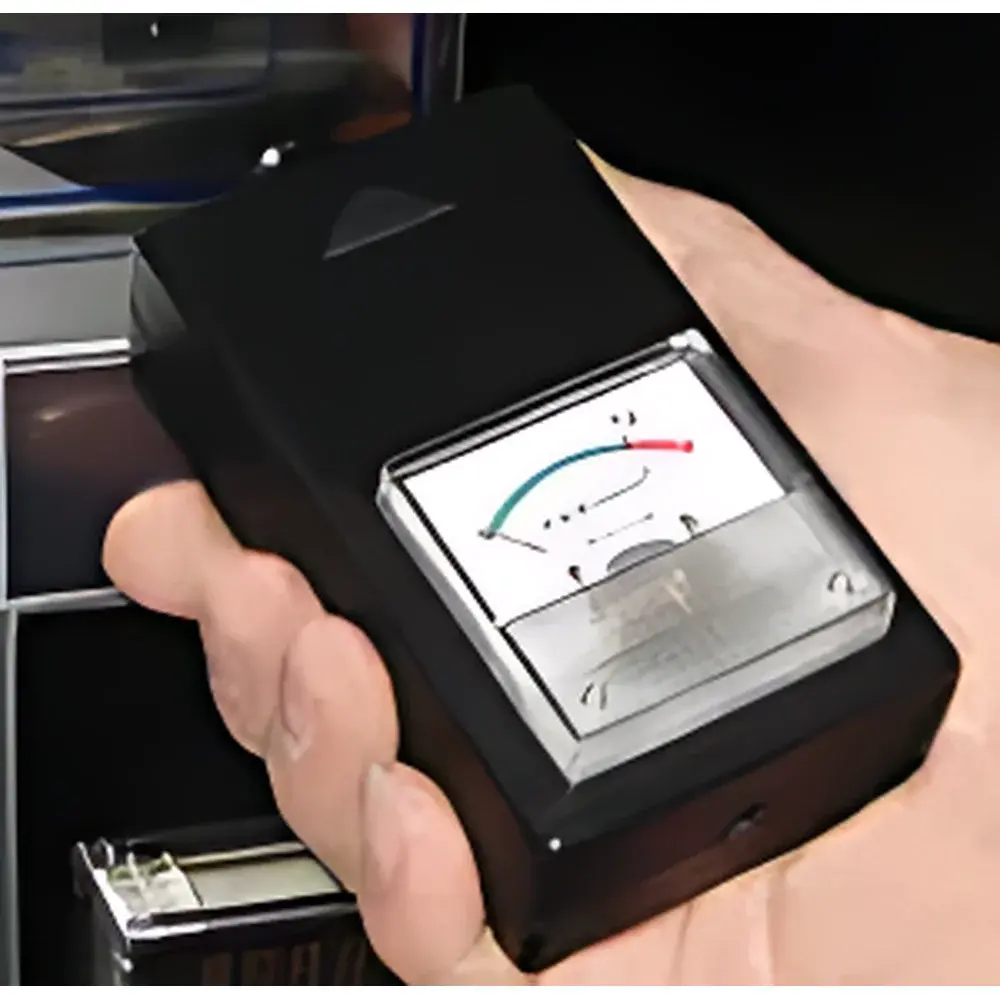
Microwave Leakage Detector MHJ-3 by Huiyan
| Brand | Huiyan |
|---|---|
| Model | MHJ-3 |
| Instrument Type | Microwave Power Density Meter |
| Frequency Range | 0.9–3 GHz |
| Antenna Gain | >2 dBi |
| Measurement Range | 0.2 µW/cm² to 20 mW/cm² |
| Dimensions | 118 mm × 60 mm × 39 mm |
| Weight | <80 g |
| Power Supply | Passive (RF-powered, no battery required) |
| Compliance | Designed for IEC 60705:2017 (Household Microwave Ovens – Methods for Measuring Performance) and FDA 21 CFR §1030.10 (Performance Standard for Microwave and Radio Frequency Emitting Products) |
Overview
The Huiyan MHJ-3 Microwave Leakage Detector is a compact, passive-field RF power density meter engineered specifically for rapid, on-site verification of electromagnetic leakage from domestic and light-commercial microwave ovens operating at standard industrial frequencies—primarily 915 MHz and 2450 MHz. Unlike active broadband spectrum analyzers or calibrated E-field probes requiring external power and complex calibration traceability, the MHJ-3 employs a self-powered, diode-based RF energy harvesting architecture. It converts incident microwave energy directly into measurable DC voltage via a high-efficiency Schottky barrier detector integrated with a tuned patch antenna, eliminating dependence on batteries or external power sources. This design ensures intrinsic safety—no emitted RF, no thermal drift from internal circuitry, and zero risk of instrument-induced interference during measurement. The device complies with the fundamental operational intent of IEC 60705:2017 Annex D (leakage testing procedures) and aligns with the exposure limit thresholds defined in FDA 21 CFR §1030.10 (5 mW/cm² maximum allowable leakage at 5 cm distance). Its primary function is not spectral analysis but deterministic pass/fail assessment against regulatory threshold values under real-world usage conditions.
Key Features
- Passive RF-powered operation: No internal battery or external power supply required; powered solely by incident microwave energy.
- Dual-band sensitivity: Optimized response across 0.9–3 GHz, covering both ISM bands (915 MHz and 2450 MHz) used in domestic and industrial microwave systems.
- High-impedance detector circuit: Minimizes loading effects on the near-field environment, preserving measurement integrity during proximity scanning.
- Integrated directional patch antenna: >2 dBi gain with front-facing radiation pattern optimized for oven door seam and viewing window inspection.
- Compact ergonomic form factor: 118 × 60 × 39 mm housing with non-slip textured surface; weight <80 g enables one-handed operation and extended field use.
- Direct analog readout interface: Analog needle or digital display variant available (model-dependent); eliminates latency associated with digital signal processing in low-cost handheld units.
Sample Compatibility & Compliance
The MHJ-3 is validated for use with all Class III microwave ovens compliant with IEC 60335-2-25 and UL 923. It is not intended for pulsed radar, telecom base stations, or industrial RF heating systems operating outside the 0.9–3 GHz band. Calibration is performed using traceable NIST-equivalent reference fields generated in TEM cell or far-field anechoic chamber environments per IEEE Std 1309-2013. While the instrument itself does not carry formal ISO/IEC 17025 accreditation, its sensor response curve is characterized against certified reference standards and documented in the manufacturer’s technical validation report (available upon request). For GLP/GMP-regulated facilities, periodic user verification using a known RF source (e.g., calibrated 2450 MHz CW generator at 1 mW/cm²) is recommended as part of equipment qualification protocols.
Software & Data Management
The MHJ-3 is a standalone analog/digital indicator with no embedded firmware, wireless connectivity, or data logging capability. This architecture ensures immunity to electromagnetic compatibility (EMC) failures, firmware corruption, or cybersecurity vulnerabilities—critical considerations in electromagnetically noisy service environments. All measurement data must be manually recorded. Optional accessories include a calibrated test kit (containing a 2450 MHz reference emitter and attenuator set) for daily functional checks prior to field deployment. For laboratories requiring audit-ready documentation, integration with external data acquisition systems is possible via the optional MHJ-98 model’s 4–20 mA or dry-contact alarm output—supporting compliance with FDA 21 CFR Part 11 when paired with validated SCADA or LIMS platforms.
Applications
- Routine safety verification of microwave oven door seals, hinges, and viewing screen integrity in food service, healthcare, and residential maintenance workflows.
- Pre-delivery inspection (PDI) and post-repair validation in appliance service centers adhering to ISO 9001:2015 clause 8.5.1 (control of production and service provision).
- Ergonomic occupational health screening for kitchen staff where repeated exposure to aging or damaged units may occur.
- Technical education labs demonstrating RF near-field coupling principles and regulatory exposure limits (e.g., physics or biomedical engineering curricula).
- Third-party certification body field audits verifying conformance to national safety regulations (e.g., China GB 4706.21, EU EN 60335-2-25).
FAQ
Does the MHJ-3 require periodic recalibration?
Yes—annual recalibration against traceable RF standards is recommended. Users should verify zero offset and mid-range response before each day’s measurements using the built-in null check or external reference source.
Can it measure leakage from 5G or Wi-Fi devices?
No. Its frequency response is intentionally limited to 0.9–3 GHz and optimized for continuous-wave (CW) or quasi-CW microwave oven emissions—not modulated signals from OFDMA-based wireless infrastructure.
Is the device suitable for measuring inside the microwave cavity?
No. It is designed exclusively for external near-field leakage assessment at distances ≥2 cm from the oven surface, per IEC 60705 test methodology.
What is the minimum detectable power density?
The lower limit of detection is 0.2 µW/cm² at 2450 MHz under ideal coupling conditions; performance degrades slightly below 1 GHz due to antenna efficiency roll-off.
Does it meet FDA or CE marking requirements?
The MHJ-3 is not CE-marked or FDA-listed as a medical device, but its measurement methodology and threshold alignment conform to the technical requirements specified in FDA 21 CFR §1030.10 and IEC 60705:2017 for microwave oven compliance testing.







