
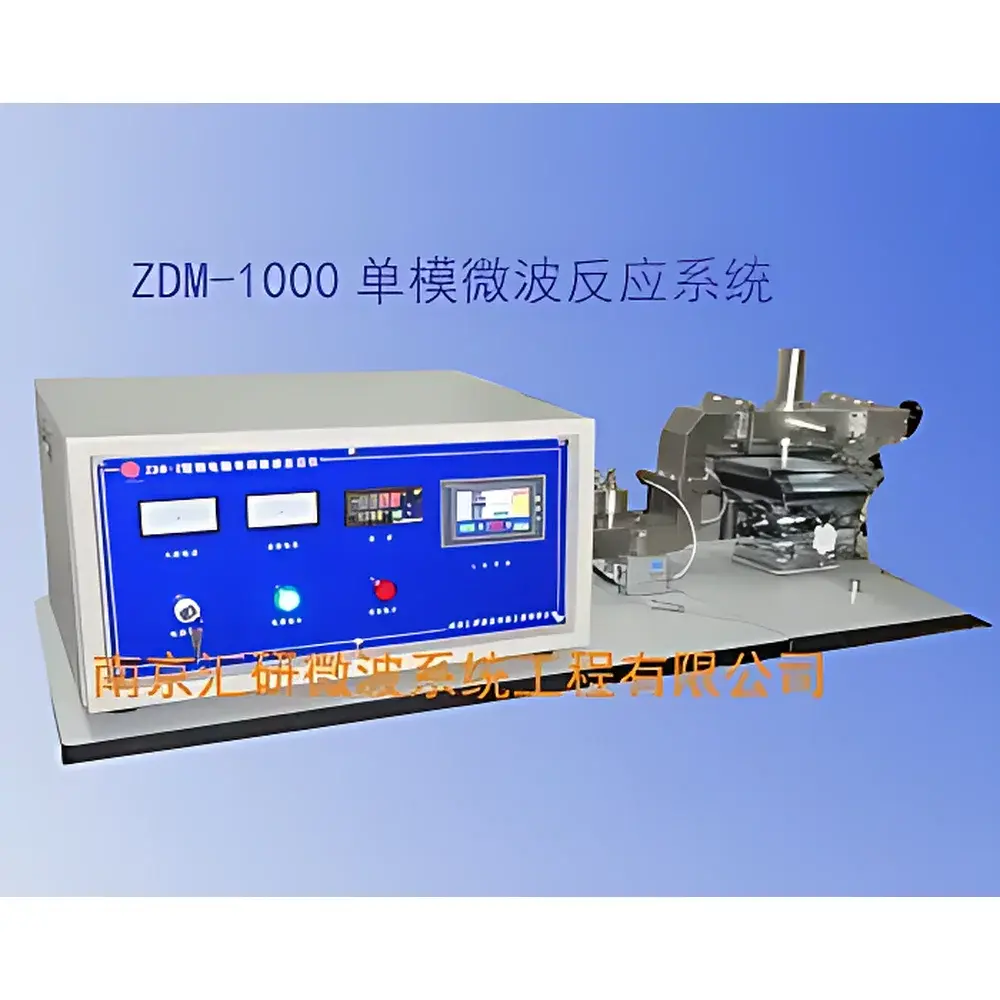
Hyeyan ZDM-1000 Single-Mode Microwave Reaction System
| Brand | Hyeyan |
|---|---|
| Model | ZDM-1000 |
| Microwave Power | 0–1000 W (continuously adjustable, linear control) |
| Frequency | 2450 MHz ± 50 MHz |
| Input Power | 220 V, 50 Hz |
| Temperature Monitoring Range | 0–500 °C |
| Temp. Control Accuracy | ±1 °C |
| Waveguide Interface | Standard WR-340 (or equivalent) |
| Safety Compliance | Meets GB 10436–2008 (China National Standard for Microwave Leakage Limits) |
| Control Interface | Industrial-grade color touchscreen HMI (Chinese-language UI) |
| Cooling | Forced-air magnetron cooling with thermal interlock |
| Protection Features | Circulator-based isolation, full-reflection tolerance, IR-based real-time temperature feedback, multi-level hardware safety interlocks |
Overview
The Hyeyan ZDM-1000 Single-Mode Microwave Reaction System is an engineered platform for precision-controlled microwave-assisted chemical synthesis and reaction optimization. Unlike multimode cavity systems—where microwave energy distributes non-uniformly—the ZDM-1000 employs a rigorously defined TE10 mode within a resonant waveguide structure, enabling spatially confined, high-power-density electromagnetic field delivery directly to the reaction volume. This single-mode architecture ensures reproducible energy coupling, minimal thermal gradients, and superior control over reaction kinetics—critical for mechanistic studies, catalyst screening, and scalable process development in academic and industrial R&D laboratories.
Key Features
- Modular waveguide architecture based on standardized WR-340 components, allowing flexible reconfiguration of the microwave transmission path—including optional integration with external plasma sources, UV lamps, or multimode cavities.
- Single-mode resonant cavity with adjustable terminal tuning, enabling precise field localization and optimization of electric field amplitude at the sample position.
- 0–1000 W microwave power output with closed-loop, fuzzy logic–based dynamic regulation—maintaining consistent power density despite load variations or dielectric property shifts during reaction progression.
- Dual-protection microwave isolation system: circulator-based reflection management combined with a dedicated microwave absorber assembly, ensuring operational stability even under near-zero-load or highly reflective conditions (e.g., low-volume, high-dielectric solvents).
- Real-time reaction monitoring via high-emissivity–calibrated infrared pyrometry (0–500 °C range, ±1 °C accuracy), integrated with PID temperature control and automatic power modulation to prevent thermal runaway.
- Comprehensive hardware safety layer: magnetron overtemperature cutoff, door-interlocked microwave suppression, waveguide arcing detection, and continuous leakage monitoring compliant with GB 10436–2008 (<0.5 mW/cm² at 5 cm distance).
Sample Compatibility & Compliance
The ZDM-1000 accommodates standard quartz, borosilicate, or specialized microwave-transparent reaction vessels (e.g., 5–50 mL capacity), compatible with sealed and open-vessel configurations. Its single-mode field geometry supports heterogeneous catalysis, solid-phase synthesis, solvent-free reactions, and gas–liquid–solid triphasic systems when coupled with auxiliary gas inlets or vacuum lines. The system adheres to fundamental electromagnetic compatibility (EMC) requirements per GB/T 18268.1–2010 (industrial equipment) and incorporates design elements aligned with GLP documentation practices—including timestamped temperature/power logs and configurable audit trails via optional data export protocols.
Software & Data Management
While the embedded HMI operates exclusively in Chinese, all operational parameters—including power ramp profiles, temperature setpoints, dwell times, and real-time IR readings—are timestamped and stored in non-volatile memory. Data export is supported via USB 2.0 to CSV format for post-acquisition analysis in MATLAB, Origin, or Python-based kinetic modeling environments. Though not natively 21 CFR Part 11–compliant, the system’s deterministic control logic, hardware-enforced interlocks, and immutable event logging provide a foundational architecture suitable for validation under internal SOPs or ISO/IEC 17025–accredited laboratory quality systems.
Applications
- Accelerated organic synthesis (e.g., Suzuki couplings, esterifications, cyclizations) with enhanced selectivity and reduced byproduct formation.
- Materials science workflows including MOF crystallization, nanoparticle nucleation, and ceramic precursor decomposition under controlled thermal–electromagnetic stress.
- Method development for pharmaceutical process chemistry, where reaction exotherm management and reproducible energy input are prerequisites for ICH Q5–Q7 alignment.
- Plasma-enhanced microwave chemistry: integration with microwave-sustained argon or nitrogen plasmas for surface functionalization or radical-mediated C–H activation.
- UV–microwave synergistic photochemistry using optional quartz-windowed cavities and broadband UV sources (254–365 nm).
FAQ
Is the ZDM-1000 compatible with international voltage standards (e.g., 110 V / 60 Hz)?
No—the system is configured for 220 V / 50 Hz operation only. Voltage conversion requires external industrial-grade transformers meeting IEC 61558–2–6 specifications.
Can third-party temperature probes (e.g., fiber-optic sensors) be integrated?
Yes—via the system’s analog input expansion port (0–10 V DC), provided signal conditioning and calibration are performed externally per NIST-traceable procedures.
Does the unit support remote operation or Ethernet connectivity?
Not natively; communication is limited to USB mass storage export. RS-485 or Ethernet modules may be added as OEM-configured options upon request.
What waveguide flange type is used?
Standard UG-39/U (WR-340) with choke grooves; all interconnections conform to IEEE Std 179–1982 dimensional tolerances.
Is service documentation available in English?
Technical schematics, waveguide layout diagrams, and safety interlock logic maps are provided in English upon commercial agreement and NDA execution.



