
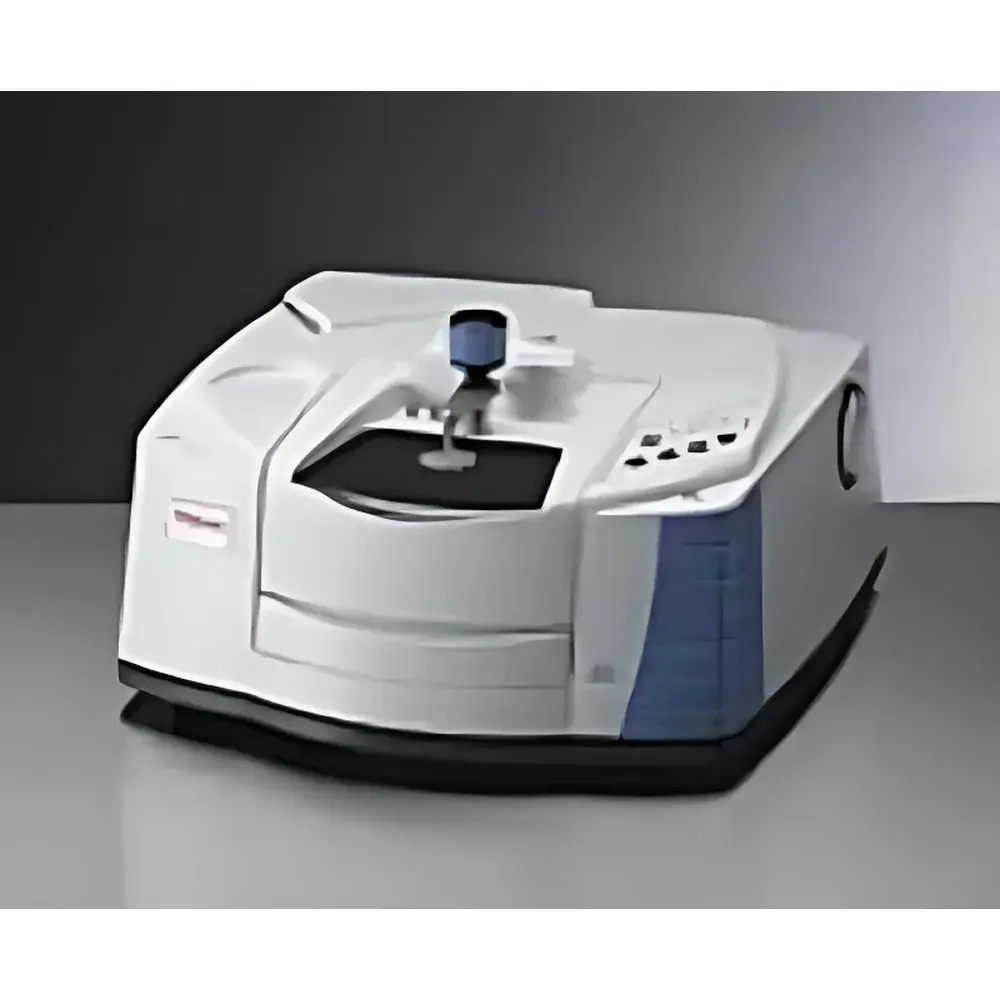
Thermo Scientific iS10 Fourier Transform Infrared (FT-IR) Spectrometer
| Origin | USA |
|---|---|
| Manufacturer Type | Authorized Distributor |
| Origin Category | Imported |
| Model | iS10 |
| Instrument Type | Fourier Transform |
| Optical Design | Sealed, Desiccated Interferometer with Dynamic Alignment |
| Detector | DTGS (Deuterated Triglycine Sulfate) |
| Scan Speed | Up to 5 scans/sec (standard mode) |
| Spectral Resolution | Adjustable down to 0.4 cm⁻¹ |
| Wavelength Range | 4000–400 cm⁻¹ |
| Beam Splitter | KBr |
| Compliance | ASTM E1421, ISO 18382, USP <1119>, GLP/GMP-ready data integrity architecture |
Overview
The Thermo Scientific iS10 Fourier Transform Infrared (FT-IR) Spectrometer is an engineered analytical platform designed for routine and research-grade molecular identification and quantitative analysis across pharmaceutical, polymer, chemical, and materials science laboratories. Based on Michelson interferometry, the iS10 acquires full-spectrum infrared absorption data by measuring the interference pattern (interferogram) generated from broadband IR radiation split and recombined after differential path-length modulation. This raw signal is mathematically transformed via Fast Fourier Transform (FFT) into a high-fidelity absorbance or transmittance spectrum—enabling precise functional group assignment, structural elucidation, and batch-to-batch comparability. Its robust optical architecture—featuring a permanently sealed, desiccated interferometer chamber—eliminates internal moisture ingress and protects critical optics from corrosive solvent vapors common in QC environments. The self-compensating, dynamically aligned interferometer continuously corrects for mechanical drift and tilt-induced phase errors, maintaining optimal throughput and photometric accuracy without manual realignment over extended operational cycles.
Key Features
- Sealed and desiccated optical bench: Prevents degradation of KBr beam splitter and DTGS detector performance due to ambient humidity or organic vapor exposure.
- Dynamic alignment interferometer: Actively compensates for mechanical perturbations in real time, ensuring consistent spectral reproducibility across temperature fluctuations and daily use.
- Diamond-turned, fixed-optic design: Eliminates user-adjustable mirrors and alignment screws—reducing maintenance intervals and operator-dependent variability.
- Modular accessory interface: Standardized dovetail mounts and electrical/data bus support rapid integration of ATR, transmission cells, gas cells, microscopes, and fiber-optic probes.
- Onboard diagnostics and validation tools: Includes automated alignment verification, energy monitoring, and spectral noise assessment—supporting IQ/OQ documentation per FDA 21 CFR Part 11 requirements.
Sample Compatibility & Compliance
The iS10 accommodates solid, liquid, paste, and gaseous samples through interchangeable sampling modules—including single-reflection diamond ATR, KBr pellet press kits, liquid transmission cells (0.1–100 mm pathlength), and sealed gas cells with CaF₂ windows. It meets essential regulatory benchmarks for analytical instrumentation: ASTM E1421 (Standard Practice for Describing and Measuring Performance of FT-IR Instruments), ISO 18382 (Molecular spectroscopy — Vocabulary), and USP (Infrared Absorption Spectrophotometry). Data acquisition and processing workflows are configurable to enforce audit trails, electronic signatures, and role-based access control—facilitating compliance with GLP and GMP quality systems during method validation and stability studies.
Software & Data Management
Operating under OMNIC™ Software v10.x, the iS10 provides intuitive spectral acquisition, library searching (including >25,000 reference spectra), peak integration, baseline correction, and multivariate analysis (PCA, PLS). All spectral files adhere to JCAMP-DX format for interoperability with LIMS and enterprise analytics platforms. Raw interferograms and processed spectra are stored with embedded metadata—including instrument ID, operator, date/time stamp, calibration status, and accessory configuration—ensuring full traceability. The software supports 21 CFR Part 11-compliant user authentication, session logging, and immutable record retention when deployed on validated Windows OS environments.
Applications
- Pharmaceutical raw material identification and counterfeit screening per ICH Q5C and Ph. Eur. 2.2.24.
- Polymer composition analysis, additive quantification, and degradation monitoring in packaging and medical device manufacturing.
- Quality control of solvents, excipients, and active pharmaceutical ingredients (APIs) using compendial IR methods.
- Failure analysis of coatings, adhesives, and composite materials via surface-sensitive ATR mapping.
- Teaching and method development in university chemistry and materials engineering curricula.
FAQ
Is the iS10 compatible with hyphenated techniques such as GC-FTIR?
No—the iS10 is a standalone benchtop FT-IR spectrometer. It does not include integrated gas chromatography coupling; however, its spectral library and quantitative tools support post-run analysis of GC-collected fractions via off-line ATR or transmission measurement.
What maintenance is required for long-term spectral stability?
Annual verification of wavenumber accuracy (using polystyrene film standard) and energy output calibration is recommended. The sealed interferometer requires no periodic purging or desiccant replacement under normal laboratory conditions.
Can OMNIC software generate reports compliant with regulatory submissions?
Yes—when configured with electronic signature enforcement and audit trail activation, OMNIC-generated PDF reports meet documentation standards for FDA, EMA, and PMDA submissions.
Does the iS10 support external triggering for time-resolved experiments?
Yes—via TTL-compatible trigger input, enabling synchronization with reaction initiation devices, thermal stages, or rheometers for kinetic IR studies.
What is the typical spectral signal-to-noise ratio (SNR) at 4 cm⁻¹ resolution?
With 32 co-added scans and DTGS detection, SNR exceeds 5,000:1 (peak-to-peak, 1000 cm⁻¹ region), meeting ASTM E1421 minimum performance criteria for routine analysis.




