
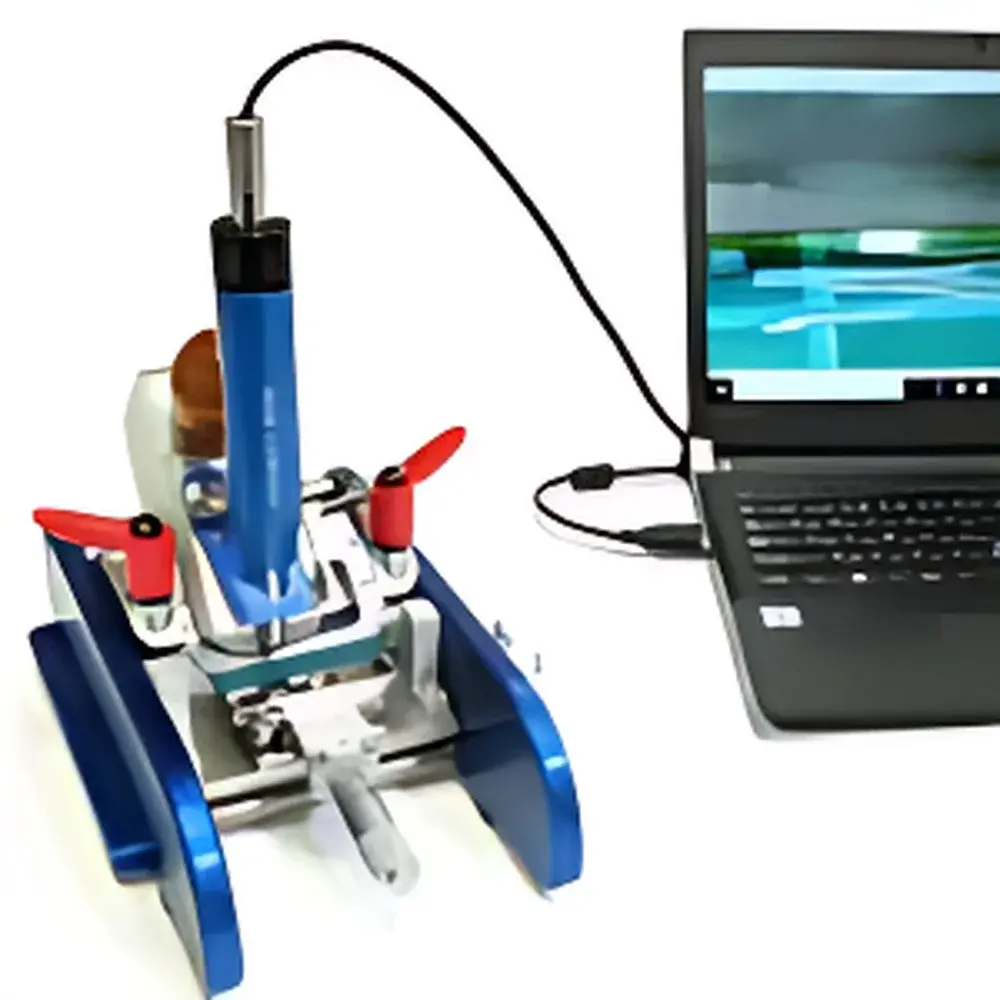
S.T. Japan EZSlicer Microtome for Spectroscopy Sample Preparation
| Brand | S.T. Japan |
|---|---|
| Origin | Japan |
| Manufacturer Type | Authorized Distributor |
| Import Status | Imported |
| Model | EZSlicer |
| Price Range | USD 2,800 – 7,000 |
Overview
The S.T. Japan EZSlicer is a precision manual microtome engineered specifically for spectroscopy sample preparation—particularly for cross-sectional analysis of multilayer thin films, polymer laminates, and coated substrates. Unlike conventional rotary or cryo-microtomes designed for biological tissue, the EZSlicer employs a fixed-angle, linear-motion cutting mechanism based on high-tolerance mechanical translation and adjustable blade geometry. It operates on the principle of controlled shear sectioning, where specimen deformation is minimized through optimized blade approach angle and micrometer-graduated feed advancement. This enables reproducible generation of flat, distortion-free sections in the 50–500 µm thickness range—critical for FTIR, Raman, and XRF depth profiling where interfacial integrity and layer fidelity directly impact spectral resolution and quantitative accuracy.
Key Features
- Adjustable cutting angle from 45° to 90° in fine increments—enabling optimization of section quality across diverse material hardnesses (e.g., soft polymer stacks vs. brittle inorganic coatings)
- Integrated micrometer-driven specimen stage with 1 µm resolution feed control for precise section thickness repeatability
- Dedicated mounting interface compatible with standard spectroscopy sample holders (e.g., KBr pellet mounts, ATR crystals, and transmission windows)
- Optical alignment port designed for coaxial integration with industrial-grade CCD cameras (C-mount or CS-mount), supporting real-time visualization of cutting plane and sampling region
- Stainless steel construction with vibration-damped base plate, ensuring mechanical stability during manual operation and minimizing edge chipping or delamination
- No consumables beyond disposable tungsten-carbide blades—reducing long-term operational cost and eliminating solvent-based embedding requirements
Sample Compatibility & Compliance
The EZSlicer accommodates rigid and semi-rigid planar specimens up to 30 mm × 30 mm × 10 mm (L × W × H), including spin-coated films, sputtered metal multilayers, printed electronics substrates, and encapsulated photovoltaic stacks. It does not require embedding media, thermal fixation, or cryogenic cooling—making it suitable for heat-sensitive or solvent-labile materials. While not certified as GLP/GMP-compliant hardware per se, its mechanical traceability (via engraved scale markings and non-electronic actuation) supports audit-ready documentation under ISO/IEC 17025-accredited laboratories. All components comply with RoHS Directive 2011/65/EU and meet CE marking requirements for laboratory equipment safety (EN 61010-1:2010).
Software & Data Management
The EZSlicer is a standalone mechanical instrument with no embedded firmware or digital control interface. However, its optical alignment port facilitates seamless integration into automated imaging workflows: when paired with third-party machine vision software (e.g., HALCON, OpenCV-based custom scripts, or LabVIEW-compatible drivers), users can log cutting coordinates, annotate frames, and export timestamped image metadata for traceable sample positioning. For regulated environments, documented procedures—including blade calibration logs, angle verification reports, and operator sign-off sheets—can be maintained in accordance with FDA 21 CFR Part 11 guidelines when used within validated SOPs.
Applications
- Cross-sectional FTIR mapping of OLED stack architecture to verify layer sequence and interfacial diffusion
- Raman depth profiling of anti-reflective coatings on silicon wafers to assess interlayer stress gradients
- EDS line-scan validation on PCB solder mask interfaces following controlled sectioning
- Quality control of barrier film lamination integrity in flexible packaging R&D
- Preparation of reference standards for LIBS calibration using stratified ceramic-polymer composites
FAQ
What is the minimum achievable section thickness?
The EZSlicer achieves consistent sections down to 50 µm; sub-50 µm performance depends on material homogeneity and blade sharpness, and is not guaranteed across all sample types.
Can the EZSlicer be used with conductive or magnetic samples?
Yes—its fully non-magnetic, non-electric mechanical design eliminates interference with SEM/EDS or magnetic force microscopy downstream workflows.
Is blade replacement standardized?
It accepts industry-standard 15 mm × 15 mm × 0.3 mm tungsten carbide microtome blades (e.g., Leica 1510, Fei 1510 equivalents); no proprietary tooling required.
Does it support automated section collection?
No—the EZSlicer is manually operated and lacks tape-transfer or ribbon-collection mechanisms; section handling requires external tools such as fine-tip tweezers or electrostatic lifters.
How is cutting angle calibrated and verified?
A precision protractor gauge (included) allows direct mechanical verification at 45°, 60°, and 90° positions; intermediate angles are set via engraved vernier scale with ±0.5° typical uncertainty.





