
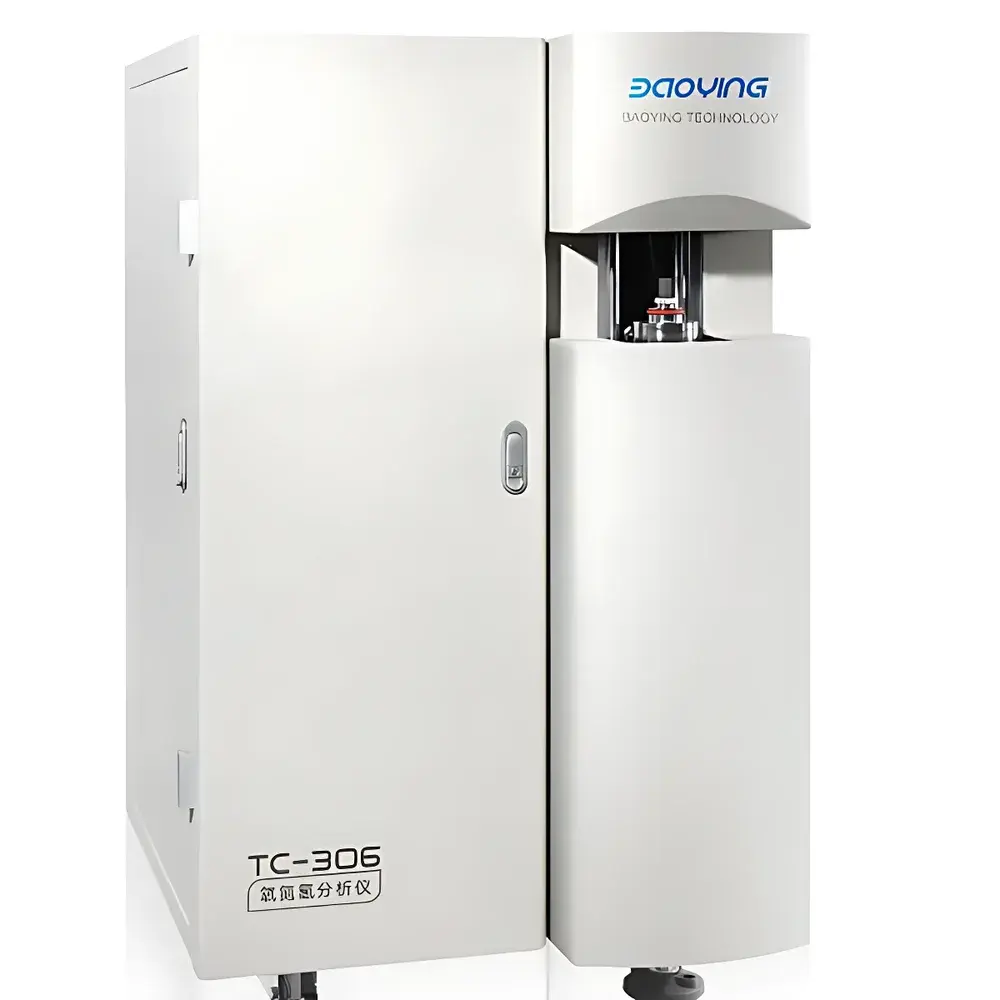
Baoying TC-306 Oxygen-Nitrogen-Hydrogen Analyzer
| Brand | Baoying Technology |
|---|---|
| Origin | Shanghai, China |
| Manufacturer Type | Direct Manufacturer |
| Product Line | TC-306 Series |
| Instrument Type | Oxygen-Nitrogen-Hydrogen Elemental Analyzer |
| Analytical Range | O: 0.1 ppm – 10 wt% |
| Low N | 0.1 ppm – 5000 ppm |
| High N | 0.5 – 30 wt% |
| H | 0.1 ppm – 5000 ppm |
| Analytical Precision | O & N: ±1 ppm or RSD ≤ 1.0% |
| H | ±0.2 ppm or RSD ≤ 2.0% |
| Sensitivity | 0.01 ppm |
| Analysis Time | O: 120–180 s |
| N | 120–240 s |
| H | 120–180 s |
| Pulse Furnace Power | 8.0 kW |
Overview
The Baoying TC-306 Oxygen-Nitrogen-Hydrogen Analyzer is a high-performance inert-gas fusion elemental analyzer engineered for precise, simultaneous quantification of oxygen (O), nitrogen (N), and hydrogen (H) in solid metallic and non-metallic materials. It operates on the fundamental principle of high-temperature inert-gas fusion: samples are thermally decomposed in a graphite crucible under ultra-pure helium or argon atmosphere within an 8.0 kW electrode pulse furnace. During fusion, oxygen reacts with carbon to form CO, nitrogen is liberated as N₂, and hydrogen is released as H₂. These gaseous species are swept through independent, parallel gas pathways into dedicated detection modules—non-dispersive infrared (NDIR) cells for O and H, and a high-sensitivity thermal conductivity detector (TCD) for N—enabling concurrent, interference-minimized measurement without chromatographic separation.
Key Features
- Simultaneous triple-element analysis (O, N, H) in a single run, eliminating sequential re-analysis and reducing total turnaround time.
- Dedicated, independently controlled gas flow paths for each element—ensuring optimal carrier gas velocity, residence time, and pressure stability for reproducible peak integration.
- NDIR detection system featuring long-life Pt-Rh alloy micro-infrared sources, precision metal reflective optics, and narrow-band interference filters (high transmission at target wavelengths, deep out-of-band rejection) for robust ppm-level O and H detection.
- High-stability TCD optimized for low-concentration nitrogen analysis—operating at ambient temperature with superior detectivity and extended linear dynamic range up to 30 wt% N.
- 8.0 kW high-power pulse furnace with rapid thermal ramping, precise temperature control, and integrated graphite crucible management—capable of complete decomposition of refractory alloys, ceramics, and intermetallics.
- Active water-cooling system with PID-controlled temperature regulation (±0.1 °C) to maintain thermal equilibrium across optical and electronic subsystems during extended operation.
- Floor-standing configuration with integrated gas purification, vacuum evacuation, and leak-check functionality—requiring no external bench mounting or auxiliary infrastructure.
Sample Compatibility & Compliance
The TC-306 accommodates a broad spectrum of solid samples—including ferrous and non-ferrous metals (steels, titanium alloys, nickel superalloys), carbides, nitrides, oxides, and ceramic matrix composites—with mass ranges from 0.1 g to 1.0 g (adjustable per matrix). Sample preparation follows ASTM E1019, ISO 14284, and GB/T 11261 standards for inert-gas fusion analysis. All detection modules meet IEC 61000-4 electromagnetic compatibility requirements. Data integrity protocols align with FDA 21 CFR Part 11 (when paired with compliant LIMS or optional audit-trail software), supporting GLP/GMP laboratory workflows. Optional remote diagnostic module enables secure, encrypted firmware-level troubleshooting via TLS-secured connection.
Software & Data Management
The TC-306 is operated via Baoying’s proprietary Windows-based analytical software suite, supporting method-driven acquisition, real-time signal visualization, automatic baseline correction, and multi-point calibration curve generation (linear, quadratic, or polynomial). Each analysis generates a timestamped raw data file (.raw) containing analog detector outputs, furnace temperature profiles, gas flow logs, and operator metadata. Export formats include CSV, PDF reports (with customizable templates), and XML for LIMS integration. Software enforces user role-based access control (administrator, analyst, reviewer), full electronic signature capability, and immutable audit trails—including parameter changes, calibration events, and result approvals.
Applications
This instrument serves critical quality control and R&D functions across aerospace, automotive, energy, and advanced materials sectors. Typical use cases include: verification of hydrogen embrittlement risk in high-strength steels and titanium forgings; oxygen content monitoring in silicon carbide and alumina ceramics for electronic substrate purity; nitrogen specification compliance in austenitic stainless steels and duplex alloys; trace hydrogen quantification in zirconium nuclear cladding; and process validation for powder metallurgy feedstocks and additive manufacturing powders. Its ability to resolve sub-ppm H in helium carrier gas makes it uniquely suited for applications where traditional TCD-only analyzers lack sufficient sensitivity.
FAQ
What sample types are compatible with the TC-306?
Solid metallic and non-metallic materials—including steels, titanium, aluminum, copper alloys, refractory metals, ceramics, and carbides—are routinely analyzed. Powders, chips, and turnings are accepted; homogeneous bulk samples yield highest precision.
Does the TC-306 require carrier gas purification?
Yes—integrated gas purifiers remove moisture, hydrocarbons, and CO₂ from helium or argon supply lines to prevent baseline drift and detector contamination. Purifier cartridges are field-replaceable with end-of-life indicators.
How is calibration performed?
Calibration uses certified reference materials (CRMs) traceable to NIST or BIPM standards. Multi-point calibration curves are generated for each element across its full dynamic range; drift correction is supported via daily standard checks.
Can the TC-306 be integrated into an automated lab environment?
Yes—RS-232, USB, and Ethernet interfaces support bidirectional communication with laboratory automation systems, robotic sample handlers, and centralized LIMS platforms.
Is maintenance training available for end users?
Baoying provides on-site installation qualification (IQ), operational qualification (OQ), and comprehensive operator/maintenance training—including furnace electrode replacement, detector alignment verification, and gas path leak diagnostics.





