
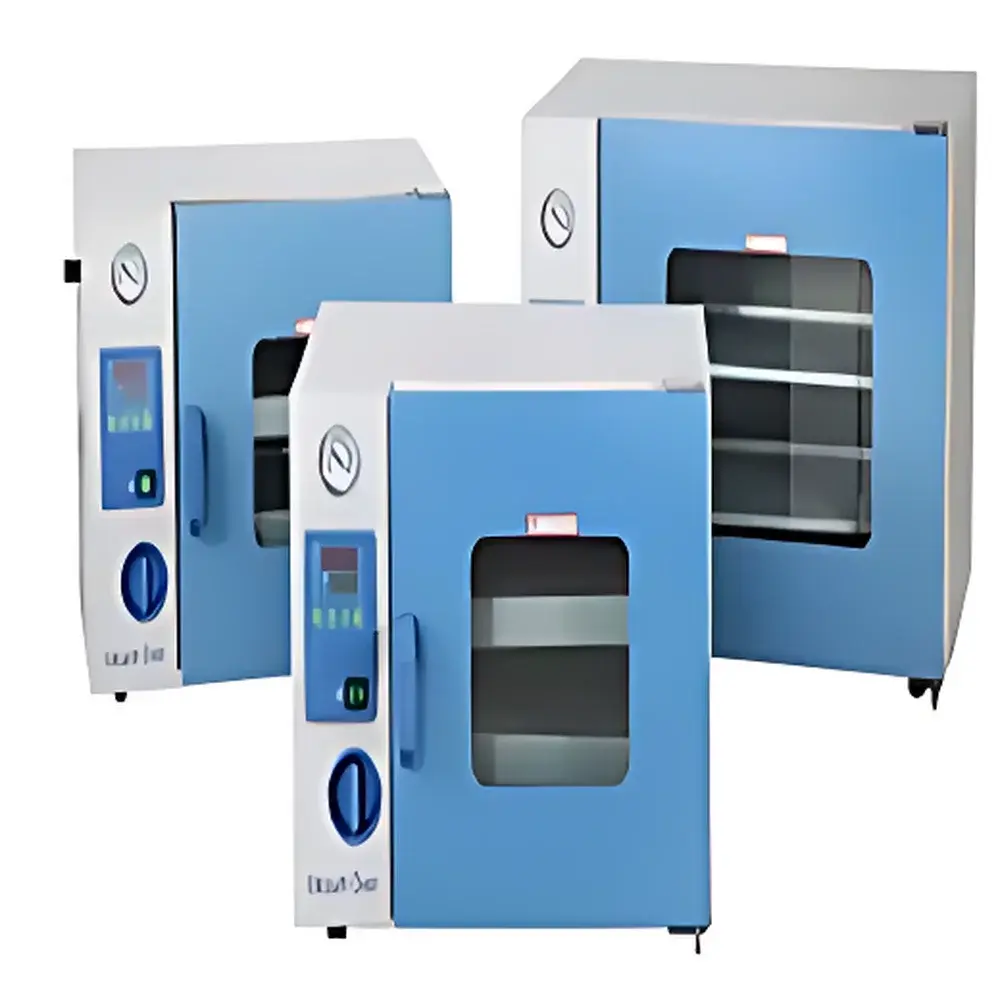
EMCN 9000 Series Vacuum Drying Oven
| Brand | EMCN |
|---|---|
| Model | 9000 Series |
| Type | Vacuum Oven |
| Temperature Range | RT+10°C to 200°C / RT+10°C to 250°C |
| Temperature Uniformity | ±1.0°C |
| Internal Chamber Dimensions | 340 × 320 × 320 mm (W×D×H) |
| External Dimensions | 620 × 440 × 490 mm (W×D×H) |
| Chamber Material | Stainless Steel or High-Quality Cold-Rolled Steel |
| Heating Method | Embedded Heated Plate |
| Power Supply | Standard Single-Phase AC (specification compliant with IEC 61000-4 series for EMC) |
Overview
The EMCN 9000 Series Vacuum Drying Oven is an engineered solution for controlled, low-pressure thermal processing in research laboratories, quality control environments, and production support settings. Designed around the fundamental principle of reducing ambient pressure to lower the boiling point of solvents and moisture—thereby enabling gentle, uniform drying of heat-sensitive, hygroscopic, or oxidation-prone samples—the system operates within a sealed, vacuum-tight chamber where temperature and pressure are independently regulated. Unlike conventional forced-air ovens, this vacuum configuration minimizes thermal degradation, prevents surface oxidation, and eliminates convective turbulence that may compromise sample integrity. Its dual-range temperature capability (RT+10°C to 200°C standard; optional extension to 250°C) supports applications ranging from polymer film conditioning and pharmaceutical active ingredient stabilization to ceramic precursor dehydration and electronic component outgassing.
Key Features
- Robust chamber construction using either electropolished stainless steel (grade 304) or high-grade cold-rolled steel with anti-corrosion passivation treatment—ensuring long-term structural stability under repeated vacuum cycling and thermal stress.
- Embedded heated plate design provides rapid thermal response and superior temperature homogeneity across the entire chamber volume, verified per ISO 17025-compliant calibration protocols.
- Double-glazed, tempered safety glass door with integrated vacuum-seal viewing window enables real-time visual monitoring without compromising chamber integrity or operator safety.
- Adjustable door-latching mechanism paired with high-temperature silicone rubber gasket (rated to 300°C) maintains vacuum levels down to ≤10 Pa (typical operating range: 10–100 Pa), validated via helium leak testing during factory acceptance.
- Microprocessor-based PID temperature controller with dual digital display: one channel for setpoint, the other for actual chamber temperature—supporting programmable ramp/soak profiles, over-temperature cut-off (adjustable threshold), and audible/visual alarm outputs.
Sample Compatibility & Compliance
The 9000 Series accommodates a broad spectrum of sample types—including powders, thin-film coatings, biological tissues, composite preforms, and solvent-containing slurries—without risk of splattering, foaming, or surface cracking. Its chamber geometry (340 × 320 × 320 mm internal volume) permits stacking of standard Petri dishes, crucibles, or custom trays while maintaining laminar thermal distribution. The system complies with general safety requirements outlined in IEC 61010-1 (Electrical Equipment for Laboratory Use) and meets mechanical design criteria referenced in ISO 8573-1 for vacuum system cleanliness classification. While not intrinsically rated for hazardous area use, it supports integration into GLP/GMP workflows through optional audit-trail-enabled controllers (compatible with FDA 21 CFR Part 11 data integrity frameworks when paired with certified software modules).
Software & Data Management
Standard operation requires no external PC interface; however, optional RS-485 or USB-to-serial adapters enable connection to laboratory information management systems (LIMS) or SCADA platforms. The embedded controller logs timestamped temperature and vacuum status at user-defined intervals (1–60 s), storing up to 1,000 data points internally. Exported CSV files include metadata such as batch ID, operator code, start/stop timestamps, and deviation flags—facilitating traceability in regulated environments. Firmware updates are performed via secure USB drive with SHA-256 signature verification, ensuring version control and cybersecurity compliance aligned with NIST SP 800-53 Rev. 5 guidelines.
Applications
- Moisture removal from pharmaceutical excipients prior to tablet compression (aligned with USP & Ph. Eur. drying validation protocols).
- Outgassing of optical components and vacuum-compatible sensors to minimize residual vapor pressure in ultra-high vacuum systems.
- Thermal curing of epoxy-based composites under inert atmosphere (when equipped with nitrogen purge port option).
- Drying of nanomaterial dispersions on substrates without agglomeration or layer delamination.
- Pre-conditioning of reference standards for gravimetric moisture analysis (ASTM E1868, ISO 5555).
FAQ
What vacuum level can the 9000 Series achieve?
Typical ultimate vacuum is ≤10 Pa with standard two-stage rotary vane pump; performance depends on pump selection, chamber loading, and ambient humidity.
Is the oven compatible with inert gas purging?
Yes—optional inlet/outlet ports support nitrogen or argon purging for oxygen-sensitive processes; requires external gas regulator and flowmeter.
Can temperature and vacuum be logged simultaneously?
Vacuum monitoring requires optional analog vacuum gauge module (e.g., Pirani or capacitance manometer); temperature logging is native.
Does the system support automated cycle programming?
Yes—up to 8-step ramp/soak programs with independent time/temperature/vacuum setpoints per segment.
What maintenance is required for long-term reliability?
Routine inspection of door seal integrity, periodic cleaning of heating plate surface, and annual calibration of temperature sensor and controller output.



