
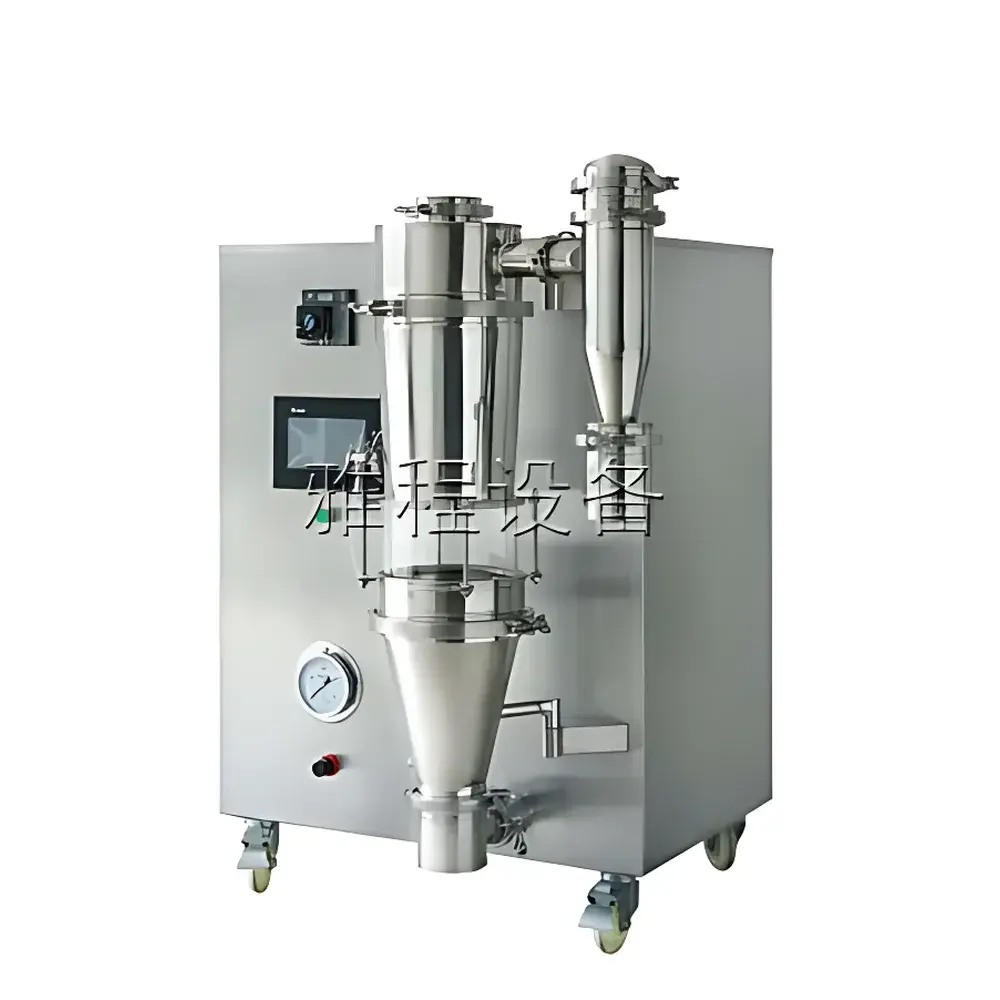
Yacheng YC-1800 Lab-Scale Low-Temperature Spray Dryer for Herbal Extracts and Thermosensitive Materials
| Brand | Yacheng / PILOTECH |
|---|---|
| Origin | Shanghai, China |
| Manufacturer | Yacheng Instrument Co., Ltd. |
| Model | YC-1800 |
| Heating Temperature Range | 110–150 °C |
| Max. Feed Rate | 1500 mL/h |
| Minimum Sample Volume | 50 mL |
| Nozzle Orifice Options | 0.5, 0.7, 1.0, 1.5, 2.0 mm |
| Temperature Control Accuracy | ±1 °C (PID) |
| Power Supply | 4 kW / 380 V |
| Construction | Full Stainless Steel |
| Atomization | Dual-Fluid Nozzle with Auto-Cleaning Needle |
| Display | Color LCD Touchscreen (Chinese Interface) |
Overview
The Yacheng YC-1800 Lab-Scale Low-Temperature Spray Dryer is an engineered solution for the gentle, reproducible drying of thermolabile natural product extracts—particularly traditional Chinese herbal extracts, fruit juice concentrates, polysaccharide-rich botanicals, and biopolymer solutions. Unlike conventional laboratory spray dryers operating at inlet temperatures ≥160 °C, the YC-1800 achieves complete droplet-to-powder conversion at a controlled inlet air temperature as low as 110 °C. This capability is grounded in optimized thermal energy transfer dynamics and precise dual-fluid atomization, enabling rapid solvent evaporation while minimizing thermal degradation, Maillard reactions, and sugar caramelization. The system employs co-current airflow and a compact cyclonic separation chamber to ensure high powder recovery (>85% typical for aqueous herbal extracts), reduced wall deposition, and consistent particle morphology—critical for downstream characterization, formulation development, and stability assessment under GLP-compliant research protocols.
Key Features
- Low-temperature operation (110–150 °C inlet air) mitigates thermal denaturation of enzymes, glycosides, flavonoids, and volatile terpenoids commonly found in TCM extracts.
- Dual-fluid stainless steel nozzle assembly with interchangeable orifices (0.5–2.0 mm) supports tailored droplet size distribution and scalable process development.
- Integrated auto-cleaning needle mechanism (programmable frequency) prevents nozzle clogging during high-solids or high-viscosity feed applications—essential for sticky, sugar-dense matrices.
- PID-controlled heating system maintains inlet temperature stability within ±1 °C across the full operating range, ensuring inter-experimental repeatability.
- Adjustable peristaltic feed pump (0–1500 mL/h) enables precise volumetric dosing and real-time feed rate modulation during drying trials.
- Full stainless steel construction (AISI 316 contact surfaces optional) complies with ISO 14644-1 Class 7 cleanroom compatibility and supports routine cleaning validation per FDA-recommended practices.
- Color LCD touchscreen interface provides intuitive access to all operational parameters, real-time trend logging, and password-protected method storage.
Sample Compatibility & Compliance
The YC-1800 is validated for aqueous and hydroalcoholic extracts containing up to 60% total solids (w/w), including viscous polysaccharide gels, pectin-rich fruit pulps, and decoction concentrates with high reducing sugar content. Its low-thermal-load architecture preserves redox-sensitive compounds (e.g., anthocyanins, catechins) and labile secondary metabolites without requiring bulking agents such as maltodextrin or β-cyclodextrin—reducing excipient interference in pharmacological assays. The system meets mechanical safety requirements per IEC 61010-1 and electromagnetic compatibility standards EN 61326-1. While not certified for GMP manufacturing, its design facilitates audit readiness for analytical method development, stability studies, and preformulation work aligned with ICH Q5C, USP , and Chinese Pharmacopoeia General Chapter 0991 (Spray Drying of Herbal Preparations).
Software & Data Management
The embedded control firmware records time-stamped data streams—including inlet/outlet temperature, feed rate, airflow, and chamber pressure—at 1-second intervals. All datasets are exportable via USB to CSV format for integration with LIMS or statistical analysis platforms (e.g., JMP, MATLAB). Audit trail functionality logs user actions (login/logout, parameter changes, method execution), satisfying basic ALCOA+ principles for non-GMP research environments. Though native software does not support 21 CFR Part 11 electronic signatures, the system’s deterministic behavior and traceable parameter history support retrospective validation when paired with institutional SOPs for instrument qualification (IQ/OQ/PQ).
Applications
- Rapid generation of free-flowing, low-hygroscopicity powders from concentrated herbal decoctions (e.g., Salvia miltiorrhiza, Ginkgo biloba, Scutellaria baicalensis) for dissolution testing and solid dosage form screening.
- Drying of probiotic supernatants and enzyme-containing fermentation broths without activity loss—enabling lyophilization-alternative stabilization strategies.
- Production of standardized reference materials for HPLC and LC-MS quantitative analysis of multi-component herbal formulations.
- Feasibility studies for continuous manufacturing of amorphous solid dispersions using thermally unstable polymers (e.g., HPMCAS, PVP-VA).
- Particle engineering of functional food ingredients (e.g., anthocyanin-loaded microparticles, citrus bioflavonoid powders) with preserved antioxidant capacity.
FAQ
What is the minimum sample volume required for a valid drying run?
A minimum of 50 mL is recommended; however, achievable yield depends on total solids content—samples with <10% w/w solids may require concentration prior to processing to ensure sufficient powder mass for characterization.
Can the YC-1800 handle ethanol-based extracts?
Yes—when operated with nitrogen inerting (optional accessory), it safely processes organic solvent feeds up to 30% v/v ethanol or methanol, complying with OSHA flammability thresholds for lab-scale operations.
Is the touchscreen interface available in English?
The standard configuration features a Chinese-language UI; English firmware localization is available upon request and requires factory reconfiguration prior to shipment.
How is wall deposition minimized during high-sugar drying?
Through synergistic optimization of inlet temperature (≤120 °C), atomization energy (adjustable air pressure), and residence time control—combined with the anti-adhesion geometry of the conical drying chamber and integrated air-sweep nozzles.
Does the system support automated method sequencing?
No built-in multi-step program scheduler is included; however, discrete methods can be saved and manually recalled, and external PLC integration is supported via RS-485 Modbus RTU protocol for custom automation workflows.



