
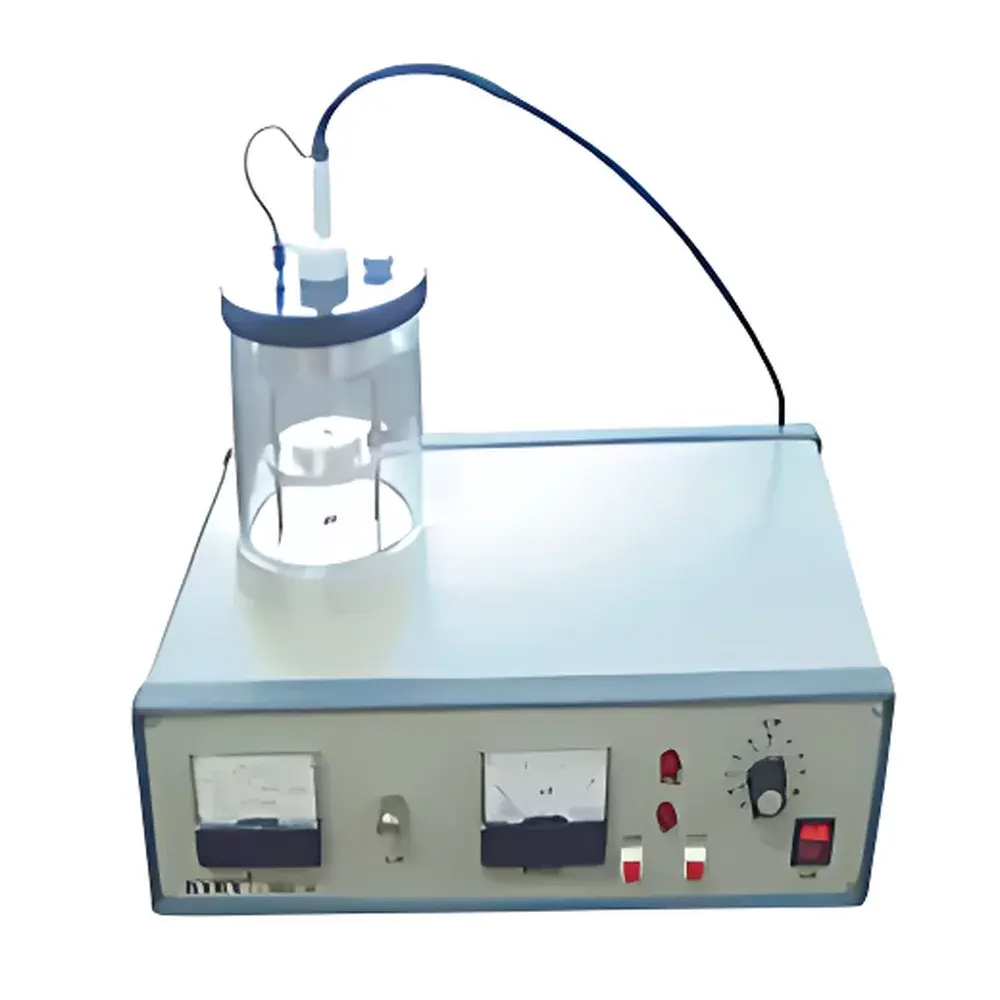
MSBC-12 Ion Sputter Coater by EMCN
| Brand | EMCN |
|---|---|
| Origin | Henan, China |
| Manufacturer Type | Authorized Distributor |
| Country of Manufacture | China |
| Model | MSBC-12 |
| Target Material | Pure Gold (Au) |
| Target Diameter | 58 mm |
| Control Mode | Fully Automatic |
| Chamber Dimensions | Ø100 mm × 130 mm (H) |
| Sample Stage Diameter | Ø40 mm (holds up to six standard specimen cups) |
| Sputtering Gas | Ambient Air or Argon (Ar) with dedicated Ar inlet and fine-flow needle valve |
| Vacuum System | Direct-coupled rotary vane pump (2 L/s) |
| Vacuum Gauge | Pirani gauge |
| Operating Pressure Range | Adjustable down to ~20 Pa via precision bleed valve |
| Gas Inlet | Dual-mode (air default |
Overview
The MSBC-12 Ion Sputter Coater is a compact, benchtop vacuum deposition system engineered for reproducible, high-fidelity conductive coating of non-conductive specimens prior to scanning electron microscopy (SEM) analysis. It operates on the principle of DC magnetron sputtering: under low-pressure inert (or ambient) gas conditions, argon ions—accelerated by a cathode potential—bombard a high-purity gold target, ejecting Au atoms that condense uniformly onto sample surfaces. This process forms a continuous, ultra-thin (typically 5–20 nm), electrically conductive film that mitigates charging artifacts, enhances secondary electron yield, and preserves surface topography during high-resolution SEM imaging. Designed specifically for integration with mid-range and entry-level SEM systems, the MSBC-12 delivers consistent coating performance without requiring cryogenic cooling, high-vacuum turbomolecular pumping, or complex plasma ignition protocols.
Key Features
- Fully automatic operation with integrated vacuum sequencing: initiation, pressure stabilization, sputtering time control, and venting—all executed via embedded microcontroller logic.
- Dual-gas compatibility: configurable for either ambient air (for rapid, cost-free routine coating) or high-purity argon (for improved film uniformity, reduced oxidation risk, and enhanced grain structure control).
- Precision-manufactured Ø58 mm gold target mounted on a water-cooled copper backing plate to ensure thermal stability and extended target lifetime.
- Optimized chamber geometry (Ø100 mm × 130 mm H) with symmetrical electrode layout and magnetic field confinement to maximize sputter efficiency and minimize shadowing effects.
- Rotatable Ø40 mm sample stage accommodating up to six standard 10-mm-diameter specimen cups—enabling parallel processing without manual repositioning.
- Integrated Pirani vacuum gauge with real-time digital readout and automatic interlock: sputtering initiates only when chamber pressure reaches user-defined setpoint (default 20 Pa, adjustable within 10–50 Pa range).
- Micro-adjustable needle valve for precise gas flow regulation, ensuring stable discharge conditions across varying pump speeds and chamber loads.
Sample Compatibility & Compliance
The MSBC-12 accommodates a broad range of non-conductive or semi-conductive specimens—including biological tissues, polymers, ceramics, geological sections, and nanomaterials—mounted on standard aluminum stubs or in disposable cup holders. Its compact chamber design supports flat, low-profile samples up to 10 mm in height. All internal wetted parts are electropolished stainless steel or anodized aluminum, minimizing outgassing and particulate generation. The system complies with general laboratory safety standards for low-voltage DC operation (<1.5 kV) and Class II vacuum equipment. While not certified to ISO 13485 or FDA 21 CFR Part 11 (as it is a non-regulated sample prep tool), its repeatable coating protocol supports GLP-aligned documentation workflows when paired with external logbooks or LIMS-integrated timestamped operating records.
Software & Data Management
The MSBC-12 employs an embedded firmware interface with no external PC dependency. All operational parameters—including sputtering time (0.1–300 s, 0.1 s resolution), preset pressure threshold, gas mode selection, and cycle counter—are stored in non-volatile memory. Cycle logs (date/time stamp, duration, gas type, pressure setpoint) are retained for ≥1,000 runs and accessible via front-panel navigation. No proprietary software is required; however, users may export logs manually via USB-to-serial adapter (optional accessory) for integration into QA/QC databases or audit trails. The system supports traceable operation under ISO/IEC 17025-compliant laboratories when combined with documented SOPs and periodic verification using certified thickness monitors (e.g., quartz crystal microbalance add-on).
Applications
- Routine SEM sample preparation for life science labs performing histology, microbiology, or plant tissue imaging.
- Quality control in materials science departments evaluating fracture surfaces, composite interfaces, or powder morphology.
- Forensic laboratories preparing trace evidence (e.g., fibers, paint chips, glass fragments) for morphological and elemental EDS analysis.
- Academic teaching labs where reliability, ease of use, and minimal maintenance overhead are critical for undergraduate instruction.
- Preparation of TEM grid support films (via shadowing mode with optional tilt stage) for low-dose imaging feasibility studies.
FAQ
What is the typical gold film thickness achieved with the MSBC-12?
Under standard conditions (20 Pa Ar, 30 s sputtering), average nominal thickness is 8–12 nm as verified by cross-sectional TEM or stylus profilometry. Thickness scales linearly with time and is inversely related to working distance.
Can I use targets other than gold?
The MSBC-12 is optimized for pure gold (99.99% Au) cathodes. While platinum or palladium targets of identical dimensions may be mechanically installed, no factory calibration or warranty coverage applies for non-gold materials.
Is a separate vacuum pump included?
Yes—the system ships with a CE-certified 2 L/s direct-coupled rotary vane pump, oil mist filter, and vibration-dampening mount. Pump oil and replacement filters are specified in the maintenance manual.
How often does the gold target require replacement?
Based on 30-second cycles at 20 mA, typical target service life exceeds 200 hours of cumulative sputtering time. Visual inspection for crater depth >0.8 mm indicates replacement threshold.
Does the system support automated recipe storage?
It stores one active user-defined protocol (time, pressure, gas mode). For multi-protocol environments, external scripting via RS-232 (optional) enables integration with lab automation platforms.



