
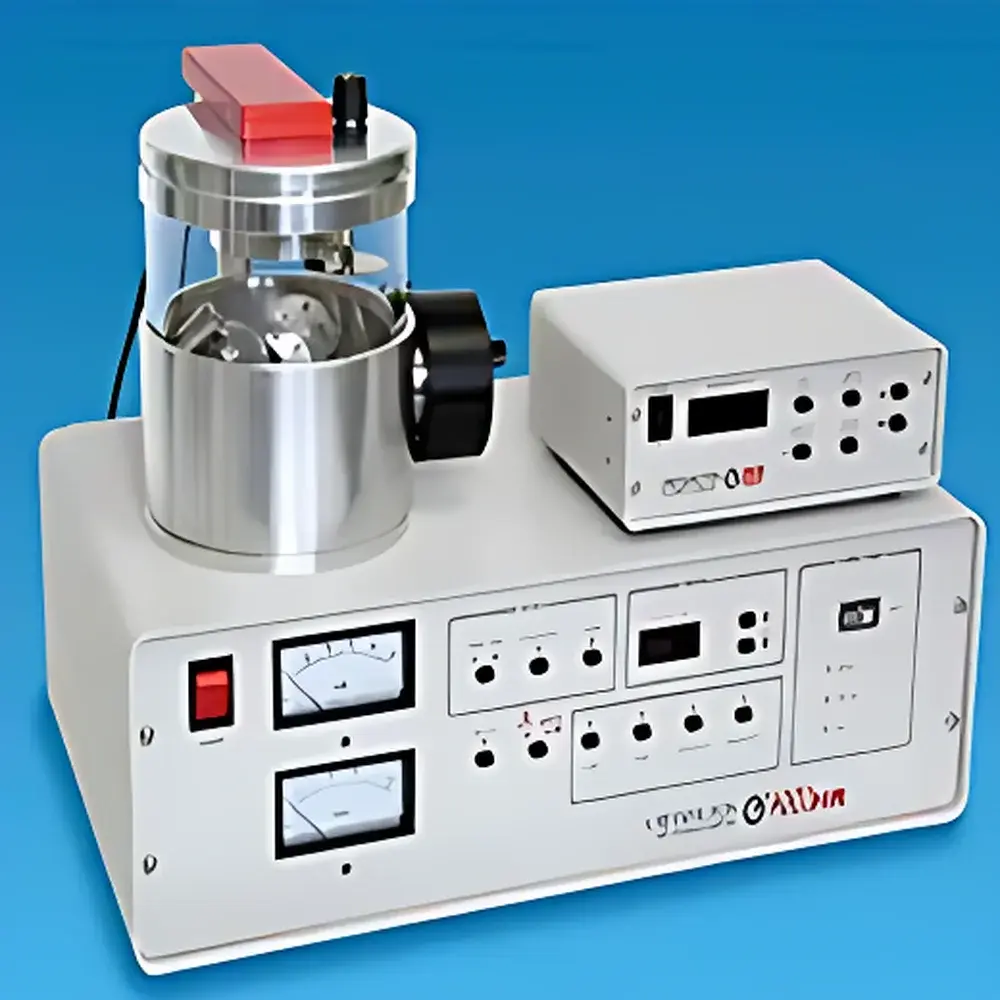
Ted Pella 208HR High-Resolution High-Vacuum Ion Sputter Coater
| Brand | Ted Pella |
|---|---|
| Origin | Imported |
| Manufacturer Type | Authorized Distributor |
| Model | 208HR |
| Target Material | Gold (Au) |
| Target Diameter | φ58 mm |
| Control Method | Programmable Digital Control |
| Chamber Dimensions | Ø120 mm × H120 mm |
| Sample Stage Capacity | 12 SEM stubs |
| Stage Height Adjustment Range | 50 mm |
| Sputtering Gas | Air or Argon |
| Base Pressure | 1 × 10⁻⁵ mbar |
| Pumping Speed | 300 L/min at 0.1 mbar |
| Pumpdown Time | ≤60 s to 1 × 10⁻³ mbar |
| Operating Pressure Range | 0.2–0.005 mbar |
| Deposition Rate Tunability | 0.002–1.0 nm/s |
| Current Selection | 20/40/60/80 mA (digitally selectable) |
| Magnetron Type | Low-Voltage Planar Magnetron |
| Safety Interlock | Yes |
| Vacuum Gauge | Analog + digital readout |
| Optional Thickness Monitor | MTM-20 Quartz Crystal Microbalance |
Overview
The Ted Pella 208HR High-Resolution High-Vacuum Ion Sputter Coater is engineered for precision conductive coating of non-conductive specimens prior to high-resolution field-emission scanning electron microscopy (FE-SEM). It employs DC magnetron sputtering—a physically vapor deposition technique in which energetic argon ions bombard a solid target material (e.g., Au, Pt/Pd, Cr, Ir), ejecting atoms that condense as a nanoscale, continuous, and electrically conductive film on the sample surface. Unlike thermal evaporation, magnetron sputtering enables superior control over grain size, film density, and compositional fidelity—critical for preserving sub-10 nm surface topography during FE-SEM imaging. The 208HR achieves this through a dual-stage vacuum architecture: a primary rotary vane or oil-free diaphragm pump paired with a high-speed turbo-molecular pump, enabling ultimate pressures down to 1 × 10⁻⁵ mbar. This ultra-low background pressure minimizes gas-phase scattering and promotes highly directional, low-energy atom flux—resulting in uniform, fine-grained (<2 nm average crystallite size), and pinhole-free metallic coatings.
Key Features
- Low-voltage planar magnetron head with wrap-around dark-space shield and integrated shutter for target conditioning—ensuring stable plasma ignition and reproducible deposition onset.
- Programmable digital control system with automatic sequence execution: vacuum pump-down → gas purging → sputtering initiation → timed deposition → controlled venting.
- Planetary sample stage with manual tilt (0–90°) and variable-speed rotation, accommodating up to 12 standard 12.7-mm SEM stubs; eliminates shadowing and enhances lateral film uniformity across complex topographies.
- Adjustable chamber height mechanism enabling precise tuning of target-to-substrate distance—directly modulating deposition rate from 0.002 nm/s (ultra-slow for ultra-thin, high-resolution coatings) to 1.0 nm/s (for rapid conductivity establishment).
- Digitally selectable sputtering current (20/40/60/80 mA) with constant-current regulation independent of vacuum fluctuation—maintaining consistent ion flux and stoichiometric stability across extended runs.
- Integrated analog vacuum and current meters, complemented by digital timer (0–300 s, with pause function) and safety interlock circuitry compliant with IEC 61010-1 for Class I electrical equipment.
Sample Compatibility & Compliance
The 208HR supports a broad spectrum of electron microscopy sample types—including biological tissues (freeze-dried or critical-point dried), ceramics, polymers, geological sections, and semiconductor wafers—without requiring conductive adhesives or carbon tabs in most cases. Its 120 mm diameter × 120 mm height chamber accommodates large-area cross-sections and multi-stub arrays. All sputtering processes are fully compatible with ISO 14644-1 Class 5 cleanroom environments when operated within enclosed gloveboxes. The instrument meets CE marking requirements under the EMC Directive 2014/30/EU and Low Voltage Directive 2014/35/EU. When equipped with the optional MTM-20 quartz crystal thickness monitor (QCM), deposition processes satisfy GLP audit trails per FDA 21 CFR Part 11 when paired with validated laboratory information management systems (LIMS).
Software & Data Management
While the 208HR operates via embedded microprocessor-based firmware (no external PC required), its digital interface supports full parameter logging—including real-time pressure, current, time, and vent status—to internal non-volatile memory. Logged sessions can be exported via RS-232 serial port for traceability in regulated QA/QC workflows. Optional MTM-20 integration provides real-time nanometer-scale thickness feedback with ±0.1 nm resolution and automatic endpoint triggering. All process parameters—including gas type, pressure setpoint, current level, and duration—are stored in user-defined protocols, enabling strict adherence to ASTM E1558–22 (Standard Guide for Preparation of Specimens for Scanning Electron Microscopy) and ISO/IEC 17025–2017 method validation requirements.
Applications
- Preparation of non-conductive specimens for high-magnification FE-SEM imaging (≤100 kV acceleration voltage) with minimal edge charging and optimal secondary electron yield.
- Deposition of ultra-thin (<5 nm) Ir or Cr films for backscattered electron (BSE) channel contrast enhancement in semiconductor failure analysis.
- Routine coating of TEM grid support films (e.g., carbon-on-copper grids) with conductive metal underlayers to reduce beam-induced drift.
- Multi-target sequential sputtering (e.g., Cr base layer + Pt/Pd top layer) for corrosion-resistant, multi-functional coatings in materials science research.
- Reproducible metallization of forensic evidence (e.g., textile fibers, paint chips) under chain-of-custody-compliant operating procedures.
FAQ
What vacuum level is required for optimal high-resolution sputtering?
The 208HR achieves an ultimate pressure of 1 × 10⁻⁵ mbar using its turbo-molecular pump; operation below 5 × 10⁻⁴ mbar is recommended for sub-5 nm grain size control.
Can the 208HR be used with reactive gases such as oxygen or nitrogen?
No—the system is configured exclusively for inert sputtering gases (Ar or air); reactive sputtering requires specialized RF power supplies and gas delivery modules not supported by this platform.
Is remote monitoring or Ethernet connectivity available?
The standard configuration includes RS-232 only; Ethernet or Wi-Fi interfaces are not offered, but third-party serial-to-Ethernet converters may be deployed for networked lab environments.
How often does the turbo-molecular pump require maintenance?
With proper foreline pressure management and regular inspection of the rotary pump oil, the turbo pump typically operates >15,000 hours before bearing service is required.
Does the 208HR comply with electromagnetic compatibility standards for shared laboratory spaces?
Yes—it conforms to EN 61326-1:2013 for laboratory-use EMC and carries full CE certification for use in EU-accredited testing facilities.
Related Products



