
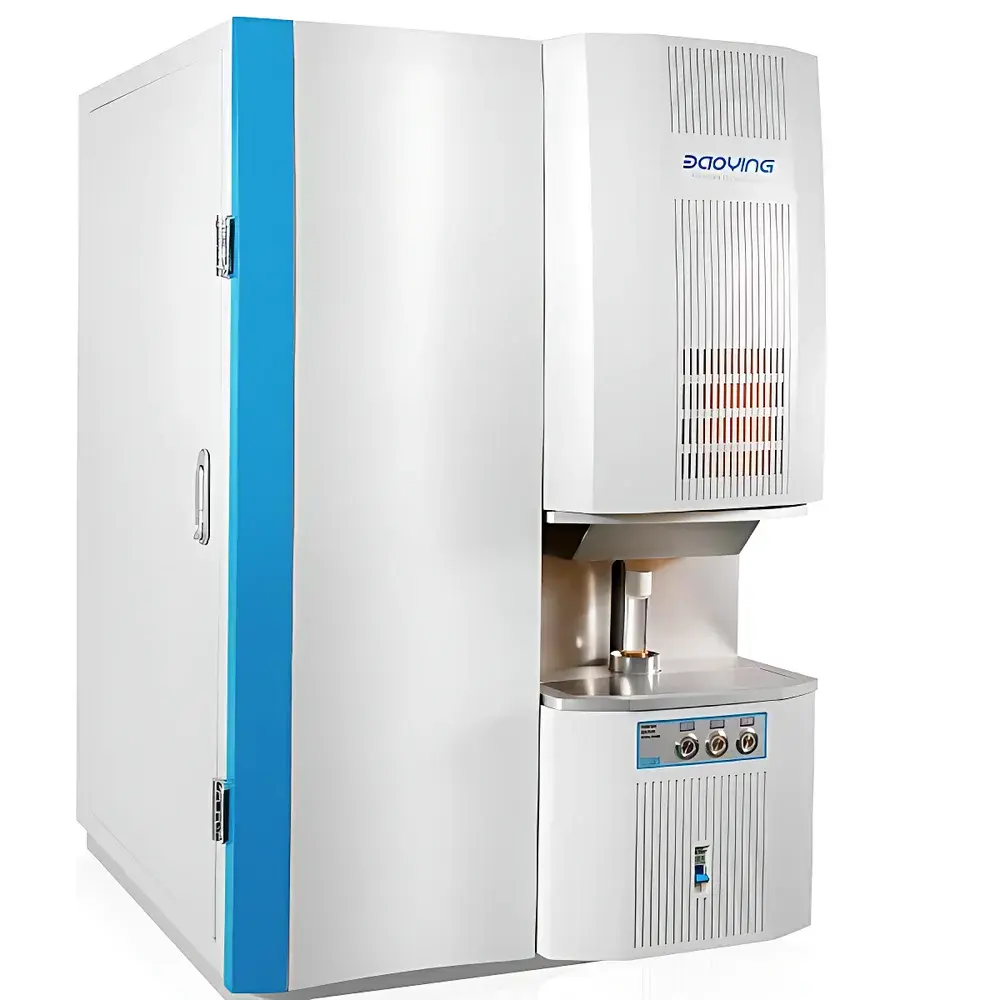
Raytech Ruiyi-5S High-Frequency Infrared Carbon-Sulfur Analyzer
| Brand | Raytech (Baoying Technology) |
|---|---|
| Origin | Shanghai, China |
| Manufacturer | Yes |
| Type | Domestic |
| Model | Ruiyi-5S |
| Price Range | USD 28,000–42,000 (FOB Shanghai) |
| Measurement Principle | Non-Dispersive Infrared (NDIR) Absorption |
| Heating System | High-Frequency Induction Furnace (3.5 kW output) |
| Measurement Range | C: 0.00001–99.99 wt% |
| S | 0.00001–99.99 wt% |
| Sensitivity | 0.01 ppm |
| Accuracy | C: ±1.0 ppm or RSD ≤ 0.4% |
| S | ±1.0 ppm or RSD ≤ 0.9% (per certified reference materials) |
| Analysis Time | 20–40 s |
| Gas Flow Control | Digital Electronic Pressure Control (EPC) with multi-channel independent regulation |
| Detection Configuration | Dual-band IR/UV detection for sulfur (SO₂) |
| Optical Source | Solid-state pulsed IR source & solid-state UV LED |
| Detector | High-stability solid-state IR/UV detectors |
| Thermal Management | Individual thermostatic control per gas cell |
| Safety | Integrated HF leakage shielding |
Overview
The Raytech Ruiyi-5S is a high-performance, laboratory-grade carbon-sulfur analyzer engineered for precision elemental quantification in metallurgical, geological, and advanced materials laboratories. It operates on the principle of non-dispersive infrared (NDIR) absorption spectroscopy—complemented by ultraviolet (UV) absorption for sulfur—enabling selective, interference-resistant detection of CO₂ and SO₂ gases generated during high-frequency induction combustion. The instrument integrates a 3.5 kW digitally regulated high-frequency furnace to ensure rapid, uniform, and reproducible sample oxidation under controlled oxygen-rich conditions. Following combustion, evolved gases pass through integrated particulate filtration, catalytic water removal, and CO-to-CO₂ conversion stages before entering thermally stabilized, independently controlled infrared and ultraviolet gas cells. This architecture ensures metrological traceability, minimal baseline drift, and compliance with fundamental requirements of ISO/IEC 17025-accredited testing environments.
Key Features
- Dual-band sulfur detection: Simultaneous NDIR (4.23 µm) and UV (214 nm) measurement of SO₂ eliminates spectral interference from residual moisture and high-concentration CO₂—critical for low-S steels, nickel alloys, and ultra-low-carbon ceramics.
- Multi-channel Electronic Pressure Control (EPC): Each gas flow path (carrier O₂, purge, detector reference) features dedicated solid-state EPC modules, compensating for ambient barometric fluctuations and ensuring stoichiometric consistency across analyses.
- Thermally isolated optical architecture: All IR/UV cells are housed in vacuum-insulated, individually PID-controlled thermostatic enclosures (±0.02 °C stability), eliminating thermal cross-talk and enabling sub-ppm detection limits.
- Zero-maintenance solid-state excitation: Pulsed solid-state IR source and UV LED replace traditional incandescent filaments and deuterium lamps—delivering >50,000-hour operational lifetime, no warm-up delay, and immunity to mechanical vibration.
- Automated system validation: Built-in self-diagnostic routines include real-time gas-tightness verification, optical path integrity checks, and furnace power calibration against internal reference standards—fully logged with timestamped audit trails.
- HF electromagnetic containment: Fully shielded induction chamber with grounded copper mesh and ferrite-damped RF feedthroughs meets IEC 61000-4-3 Class B immunity requirements and reduces operator exposure to <0.5 V/m at 30 cm distance.
Sample Compatibility & Compliance
The Ruiyi-5S accommodates solid metallic samples (ferrous/non-ferrous alloys, superalloys), inorganic powders (cement, ores, refractories), and ceramic precursors weighing 0.1–1.0 g. Sample introduction uses standardized ceramic crucibles with tungsten or tin additives as required. The system conforms to ASTM E1019 (Standard Test Methods for Determination of Carbon, Sulfur, Nitrogen, and Oxygen in Steel, Iron, Nickel, and Cobalt Alloys), ISO 15350 (Steels — Determination of Total Carbon Content — Infrared Absorption Method after Combustion in an Induction Furnace), and JIS G 1211. Data integrity protocols support 21 CFR Part 11-compliant electronic signatures, ALCOA+ data governance, and full GLP/GMP audit trail generation—including user action logs, method version history, and raw spectral metadata export.
Software & Data Management
Raytech AnalyzePro v4.2 software provides ISO/IEC 17025-aligned workflow control—from sample registration and method selection to calibration curve management and uncertainty propagation. All spectra, pressure transients, furnace power profiles, and detector baselines are stored in HDF5 format with embedded metadata (sample ID, operator, instrument state, environmental conditions). Batch reporting supports customizable templates compliant with EN ISO/IEC 17025 Clause 7.8.2. Remote diagnostics via TLS-encrypted SSH tunnel enables secure vendor-assisted troubleshooting without compromising network segmentation—fully auditable within ITAR/EAR-controlled environments.
Applications
- Quality control of high-purity specialty steels (e.g., nuclear-grade austenitic stainless, maraging steels) where sulfur segregation below 5 ppm must be verified.
- Research-grade analysis of rare-earth permanent magnets (NdFeB), where carbon contamination affects coercivity and thermal stability.
- Geochemical mapping of sulfide mineralization using rock powder digests—leveraging dual-band sulfur detection to resolve overlapping interferences in complex matrices.
- Process validation in additive manufacturing feedstock qualification, meeting ASTM F3049 requirements for elemental impurity profiling in Ti-6Al-4V and Inconel 718 powders.
- Regulatory testing for ASTM A1058-compliant high-strength fasteners, where carbon homogeneity across heat lots is critical to fatigue performance.
FAQ
What combustion atmosphere does the Ruiyi-5S use, and how is oxygen purity maintained?
High-purity oxygen (>99.995%) is delivered via integrated pressure-regulated gas manifold with dual-stage purification (catalytic moisture trap + molecular sieve). Oxygen flow is continuously monitored and adjusted via EPC to maintain stoichiometric excess throughout combustion.
Can the instrument analyze coated or surface-treated samples without matrix interference?
Yes—optimized high-frequency power ramping and dynamic oxygen flow modulation enable controlled ablation of thin coatings (e.g., Zn, Cr, Ni plating) prior to bulk combustion, minimizing surface carbon carryover effects.
Is method transfer supported between Ruiyi-5S units in multi-site laboratories?
Yes—calibration transfer is enabled via portable spectral reference libraries (.spc files) and embedded instrument-specific compensation coefficients, validated per ASTM E2917 guidelines for inter-instrument comparability.
Does the system meet cybersecurity requirements for networked deployment in regulated facilities?
All firmware and software comply with IEC 62443-3-3 SL2 controls, including secure boot, encrypted firmware updates, role-based access control, and configurable network lockdown modes (air-gapped operation supported).





