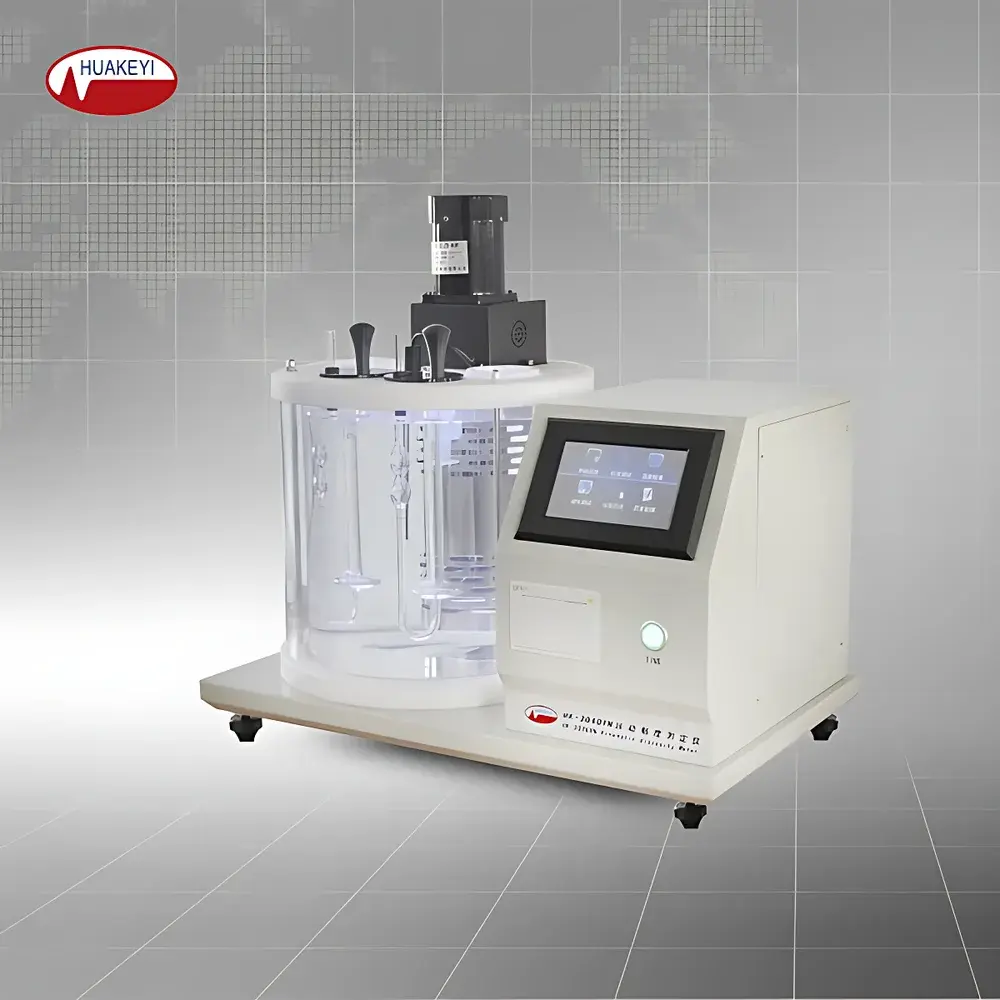
Huake Instrument HK-3040YN Kinematic Viscosity Tester
| Brand | Huake Instrument |
|---|---|
| Origin | Beijing, China |
| Manufacturer Type | Authorized Distributor |
| Product Category | Domestic |
| Model | HK-3040YN |
| Price Range | USD 1,400 – 4,200 |
| Temperature Control Range | Ambient to 100 °C |
| Bath Uniformity | ±0.1 °C |
| Temperature Resolution | 0.01 °C |
| Stirring Speed | 1250 rpm |
| Heating Power | Main 800 W + Auxiliary 300 W |
| Capillary Mounting Positions | 4 |
| Sample Trials per Run | 1–6 |
| Data Storage Capacity | 1000 test records |
| Display | Color LCD touchscreen (Chinese/English UI) |
| Connectivity | Standard USB + RJ-45 Ethernet (optional RS-232) |
| Dimensions (L×W×H) | 400 × 450 × 650 mm |
| Weight | 25 kg |
| Compliance | GB/T 265–1988 (equivalent to ASTM D445 & ISO 3104) |
Overview
The Huake Instrument HK-3040YN Kinematic Viscosity Tester is a precision laboratory instrument engineered for the standardized determination of kinematic viscosity in Newtonian liquid petroleum products—including lubricating oils, diesel fuels, transformer oils, and jet fuels—according to GB/T 265–1988, which is technically aligned with ASTM D445 and ISO 3104. The instrument employs the capillary viscometer method: a fixed-volume sample flows under gravity through a calibrated glass capillary tube immersed in a thermostatically controlled bath; kinematic viscosity (ν, in mm²/s or cSt) is calculated from the efflux time and the capillary constant. Its dual-layer cylindrical constant-temperature bath ensures exceptional thermal uniformity (±0.1 °C), critical for repeatability across multi-sample runs. The system integrates high-stability temperature control via PWM-driven solid-state relays (SSRs), eliminating mechanical wear and electromagnetic interference—essential for GLP-compliant environments where long-term operational integrity is mandated.
Key Features
- Dual-zone heating architecture: independent main (800 W) and auxiliary (300 W) heaters enable rapid thermal ramp-up and fine-grained stabilization at setpoints from ambient to 100 °C.
- Four-position capillary mounting station with stainless-steel guide sleeves and precision alignment fixtures—compatible with standard Ubbelohde-type capillaries (0.8, 1.0, 1.2, and 1.5 mm nominal bore diameters).
- Automated liquid-level detection with dry-run protection: optical sensors verify bath fluid level at power-on and during operation, preventing heater damage and ensuring measurement validity.
- High-intensity LED illumination integrated into the bath base improves optical clarity for manual timing verification and supports automated video-based efflux detection (when paired with optional digital timing modules).
- Color TFT touchscreen interface with bilingual (English/Chinese) menu navigation, real-time clock (non-volatile), and context-sensitive prompts—reducing operator training time and minimizing input errors.
- Embedded thermal printer and 1000-entry non-volatile memory: test records include date/time stamp, capillary ID, efflux time(s), calculated ν value, temperature reading, and operator ID (if configured via LIMS integration).
Sample Compatibility & Compliance
The HK-3040YN is validated for use with transparent, homogeneous Newtonian liquids meeting the scope of GB/T 265–1988, including mineral oils, synthetic lubricants, aviation turbine fuels (Jet A-1), and insulating oils used in power transformers. It supports optional immersion cooling units (e.g., model 05.03.236) for low-temperature testing down to 0 °C—enabling kinematic viscosity assessment of diesel fuel at 20 °C per EN 590 requirements. All thermal and timing subsystems are traceable to national metrological standards. The instrument’s firmware implements audit-trail functionality compliant with FDA 21 CFR Part 11 when connected to validated LIMS platforms via its RJ-45 Ethernet port. Electrical safety conforms to IEC 61010-1:2010; electromagnetic compatibility meets IEC 61326-1:2013 Class A requirements for laboratory environments.
Software & Data Management
Data export and remote supervision are enabled through three native interfaces: USB mass-storage mode (for direct CSV file transfer), RJ-45 Ethernet (supporting TCP/IP communication with enterprise LIMS or ELN systems), and optional RS-232 serial (for legacy SCADA integration). Test records store full metadata—including raw efflux times, bath temperature logs sampled every 2 seconds, capillary calibration coefficients, and user-defined batch IDs. Exported files follow ASTM E1382-compliant formatting, facilitating automated statistical process control (SPC) analysis in QA/QC workflows. Firmware updates are delivered via signed binary packages over HTTPS, preserving cryptographic integrity and version traceability—critical for regulated laboratories operating under ISO/IEC 17025 or API RP 1529 quality frameworks.
Applications
- Quality control of base oils and finished lubricants in refinery QC labs, verifying compliance with ASTM D445 specification limits prior to shipment.
- Routine monitoring of in-service transformer oil viscosity in utility substations—detecting thermal degradation or contamination-induced rheological changes.
- Research-grade characterization of biofuel blends (e.g., FAME-diesel mixtures) under standardized temperature conditions per EN 14214 Annex C.
- Third-party certification testing for marine fuel (ISO 8217) and aviation fuel (ASTM D1655) suppliers requiring auditable, repeatable viscosity data.
- Educational laboratories teaching fundamental rheological principles, where visual bath transparency and intuitive touchscreen operation enhance pedagogical effectiveness.
FAQ
What standards does the HK-3040YN comply with?
It is designed and verified per GB/T 265–1988, with technical equivalence to ASTM D445 and ISO 3104 for kinematic viscosity measurement of petroleum products.
Can it measure non-Newtonian fluids?
No—the instrument is strictly intended for Newtonian liquids as defined in GB/T 265–1988; non-Newtonian behavior (e.g., shear-thinning polymers) requires rotational rheometry.
Is external refrigeration required for 0 °C testing?
Yes—an optional immersion chiller (model 05.03.236) must be installed to achieve sub-ambient bath temperatures; the base unit operates from ambient to 100 °C only.
How is data integrity ensured during power interruption?
All test parameters and timestamps are written to non-volatile flash memory before thermal cycle completion; the real-time clock retains accuracy for ≥10 years without backup battery.
Does it support 21 CFR Part 11 electronic signatures?
The device itself does not generate electronic signatures, but its LIMS-integrated data stream—including operator ID, timestamp, and immutable record hash—fulfills predicate rule requirements when deployed within a validated Part 11 environment.