
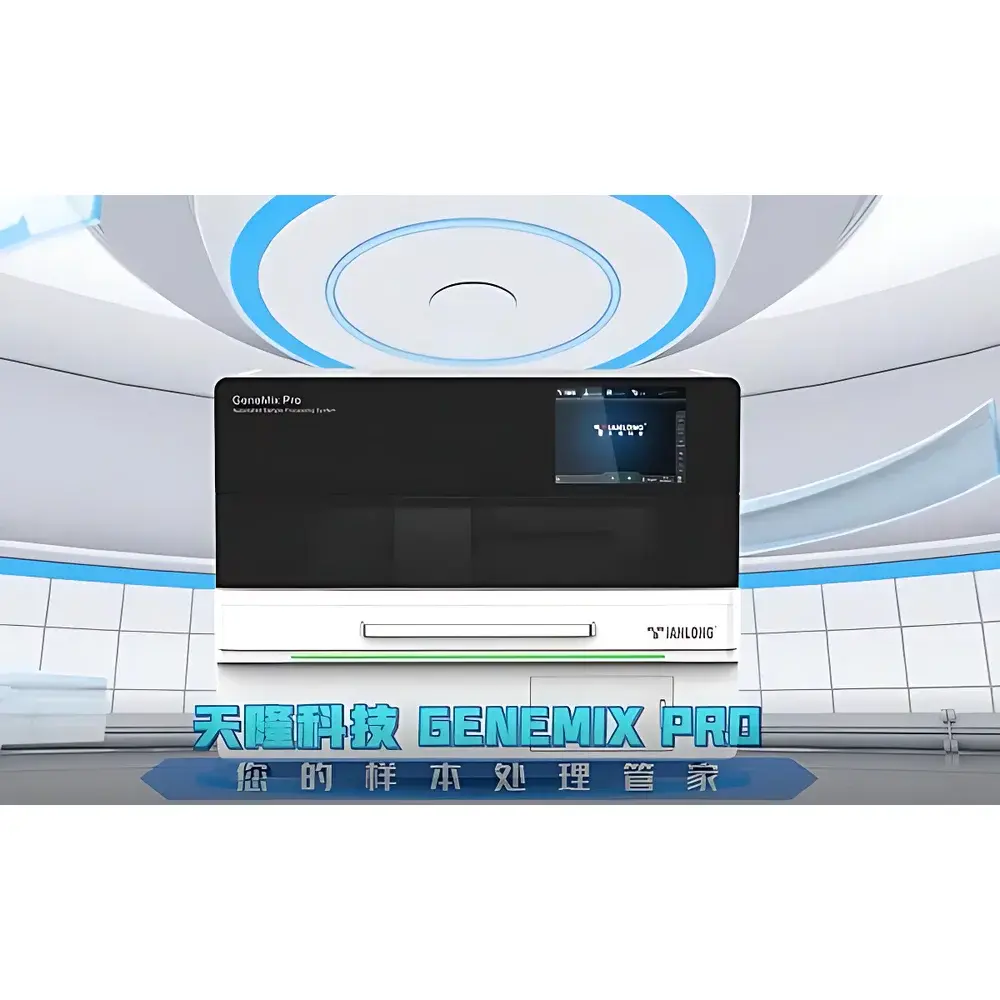
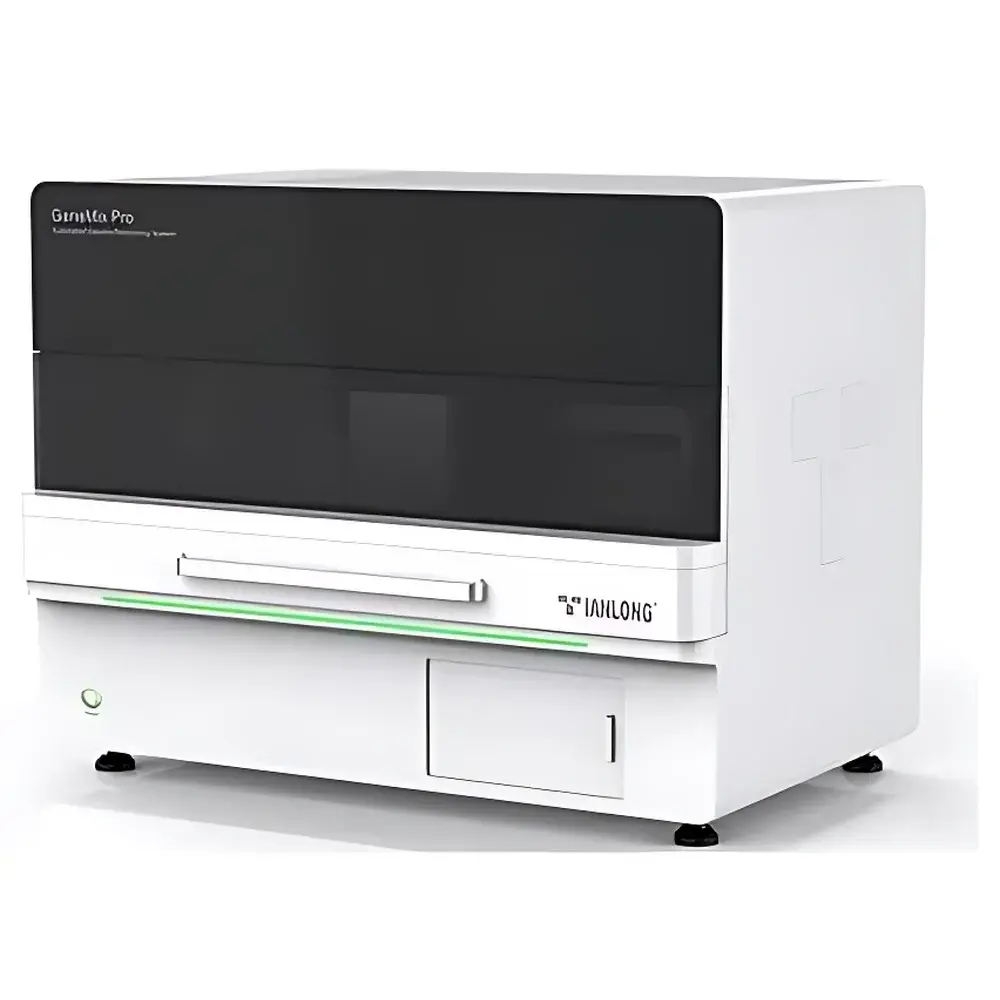
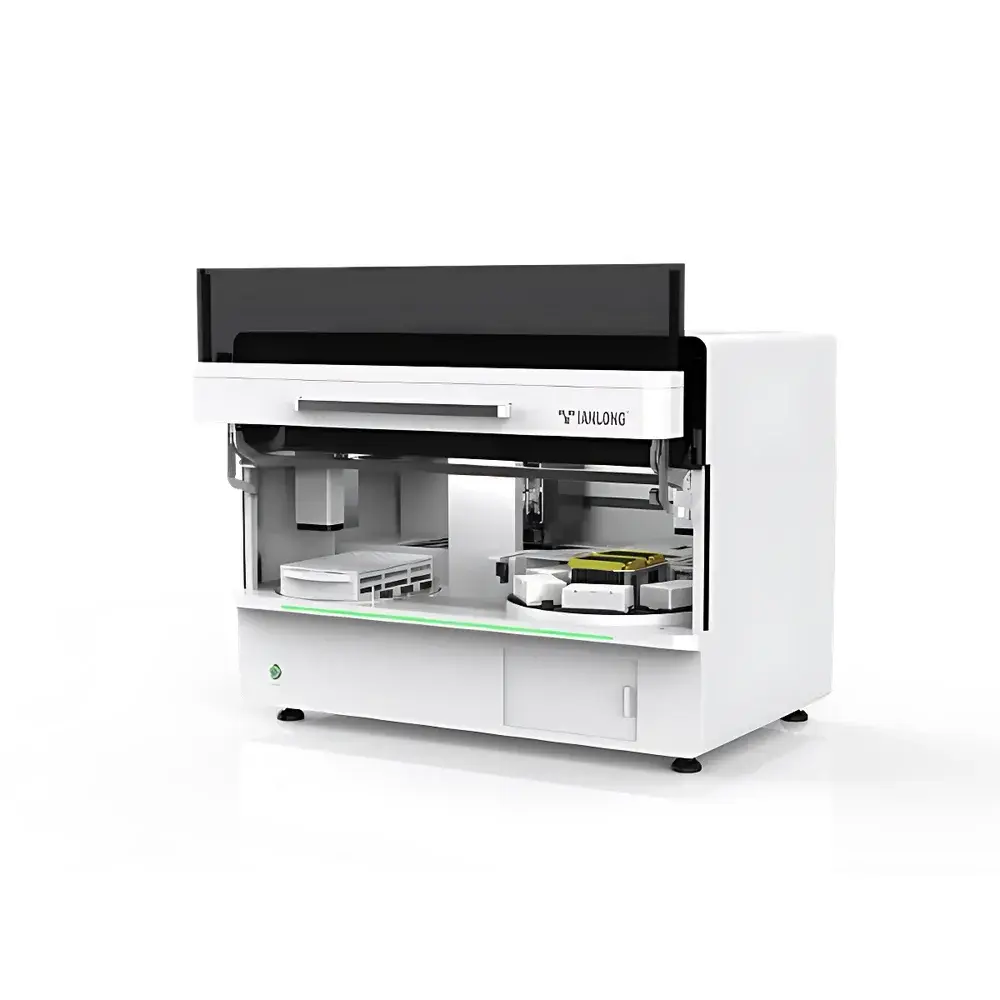
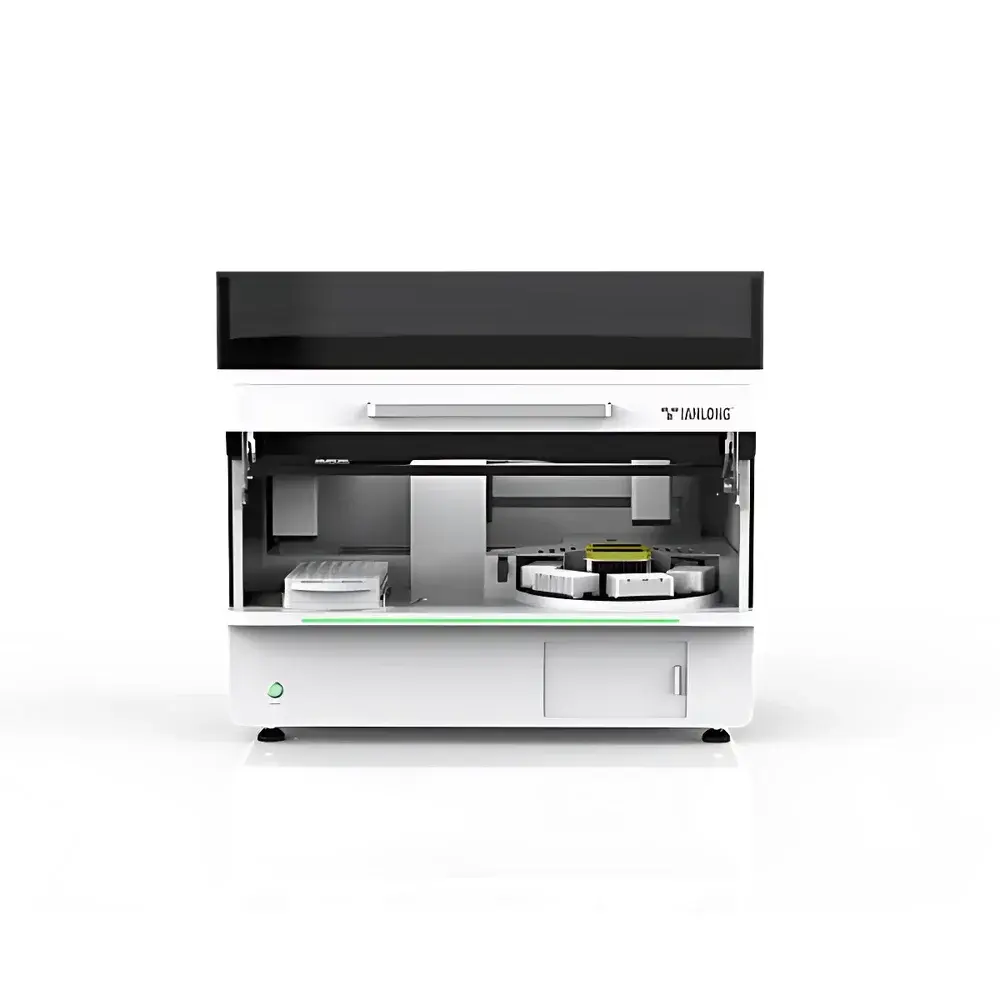
TIANLONG GeneMix Pro Nucleic Acid Extraction Sample Processing System
| Brand | TIANLONG |
|---|---|
| Origin | Shaanxi, China |
| Manufacturer Type | Original Equipment Manufacturer (OEM) |
| Country of Origin | China |
| Model | GeneMix Pro |
| Automation Level | Semi-Automated Assistant System |
| Batch Capacity | 96 samples |
| Sample Volume Range | 5–20 mL |
| Processing Time per Batch | ≤20 minutes |
| Pipetting Range | 5–1000 µL |
| Pipetting Accuracy | ≤3.5% (5–50 µL), ≤2.5% (50–200 µL), ≤2.0% (≥200 µL) |
| Pipetting Precision (CV) | ≤2.5% (5–50 µL), ≤1.5% (50–200 µL), ≤1.0% (≥200 µL) |
| UV Disinfection | Dual independent chambers (workstation & waste compartment) |
| HEPA Filtration | ≥99.999% at 0.3 µm |
| Negative Pressure | 5 Pa |
| Dimensions (L×W×H) | 1130 × 780 × 920 mm |
| Net Weight | 200 kg |
| Power Supply | 100–240 VAC, 50/60 Hz, 600 VA |
| Operating Environment | 15–35 °C, 35–70% RH (non-condensing), 56–106 kPa (≤4000 m altitude) |
Overview
The TIANLONG GeneMix Pro Nucleic Acid Extraction Sample Processing System is an integrated, semi-automated assistant platform engineered for high-integrity pre-analytical sample handling in molecular diagnostics laboratories. It implements a deterministic robotic workflow grounded in precision motion control, optical barcode recognition, and pressure-sensing liquid handling to execute critical upstream tasks—including tube scanning, cap actuation, reagent dispensing (Proteinase K and internal control), vortex-based homogenization, sample transfer, deep-well plate registration, and post-processing tube recovery—without manual intervention. Unlike fully automated extraction instruments, the GeneMix Pro functions as a dedicated sample preparation orchestrator: it prepares specimens for downstream nucleic acid isolation (e.g., magnetic bead-based or column-based kits) by standardizing input conditions and eliminating operator-dependent variability. Its design adheres to core principles of laboratory automation: traceability, containment, and reproducibility—making it suitable for clinical testing environments operating under ISO 15189, CLIA, or CAP-accredited frameworks.
Key Features
- High-throughput sample orchestration: Processes up to 96 samples per run in ≤20 minutes, covering tube identification, cap opening/closing, mixing, reagent addition, and transfer to SBS-compliant deep-well plates.
- Dual independent pipetting modules with adjustable inter-tip spacing and integrated air-pressure liquid level detection for adaptive aspiration across variable meniscus heights.
- Comprehensive compatibility: Accepts 5–20 mL screw-cap collection tubes (including single-tube, 5-in-1, 10-in-1, and 20-in-1 swab-containing configurations) without decapping or manual transfer; supports native tube-on-board loading.
- Flexible plate support: Accommodates standard SBS-format deep-well plates (6×16T, 1×96T, 1mL volume) and proprietary 3mL formats (3×8T), with user-configurable plate definitions stored in firmware.
- End-to-end traceability engine: Synchronizes one-dimensional and two-dimensional barcodes from sample tubes, racks, and destination plates to establish unbroken “sample-to-PCR” data lineage—enabling audit-ready chain-of-custody documentation.
- Integrated biosafety architecture: Features dual-zone UV-C irradiation (workstation + waste chamber), HEPA filtration (99.999% @ 0.3 µm), active negative pressure control (5 Pa differential), droplet capture surfaces, and triple-stage pressure sensing to detect swab interference during aspiration.
Sample Compatibility & Compliance
The GeneMix Pro is validated for direct processing of nasopharyngeal/oropharyngeal swab specimens collected in viral transport media (VTM) within 5–20 mL conical tubes sealed with polypropylene screw caps (diameter: 13–26 mm; height: 54–115 mm). It maintains compatibility with widely adopted commercial extraction kits requiring standardized input volumes and mechanical lysis initiation. From a regulatory perspective, its closed-system operation, real-time error logging, and barcode-driven sample tracking align with Good Laboratory Practice (GLP) requirements for data integrity. While not certified under FDA 21 CFR Part 11 out-of-the-box, the system’s audit trail capabilities—including timestamped event logs, operator ID association, and immutable action records—provide foundational infrastructure for laboratories pursuing Part 11 compliance via supplementary validation protocols.
Software & Data Management
The system runs on an embedded Linux-based control platform with a 12.1-inch capacitive touchscreen interface. All workflows are defined through a graphical method editor supporting parameterized steps (e.g., rotation speed, dwell time, aspiration volume, acceleration profiles). The built-in LIMS interface uses HL7 v2.x and ASTM E1384 standards for bidirectional data exchange, enabling automatic upload of sample metadata and instrument-generated status reports. Raw operational logs—including pipetting verification results, UV cycle completion timestamps, and fault resolution sequences—are stored locally on encrypted internal flash memory and exportable via USB 3.0. No cloud connectivity is enabled by default; all data remains on-device unless explicitly transferred by authorized personnel.
Applications
- Clinical virology labs performing large-scale SARS-CoV-2, influenza, RSV, or enterovirus screening where batched sample preprocessing must precede automated RNA extraction.
- Public health surveillance programs requiring strict chain-of-custody documentation and minimal hands-on time per batch.
- Reference laboratories validating extraction workflows across diverse specimen types (swabs, saliva, bronchoalveolar lavage) and container geometries.
- Research cores supporting multi-omics studies where consistent mechanical lysis initiation and reagent addition timing directly impact downstream library quality metrics (e.g., fragment size distribution, PCR duplication rates).
FAQ
Does the GeneMix Pro perform nucleic acid extraction itself?
No. It is a pre-extraction sample processing system—designed to prepare specimens for subsequent nucleic acid isolation using external kits or platforms.
Can it interface with third-party LIMS without custom development?
Yes. It supports standard HL7 v2.x and ASTM E1384 message formats; integration typically requires only configuration-level mapping of field identifiers.
What safety certifications does it hold?
It complies with IEC 61010-1 (Safety Requirements for Electrical Equipment for Measurement, Control, and Laboratory Use) and IEC 61326-1 (EMC requirements for laboratory equipment); CE marking is pending final EU MDR alignment.
Is remote monitoring or troubleshooting supported?
Remote access is disabled by default for security reasons. On-site diagnostics are performed via local USB log export and guided fault-tree navigation on the touchscreen interface.
How is calibration maintained over time?
Pipetting accuracy is verified using gravimetric methods per ISO 8655-6; users receive a factory-issued calibration certificate valid for 12 months, with optional annual recalibration services available through TIANLONG-authorized service centers.




