
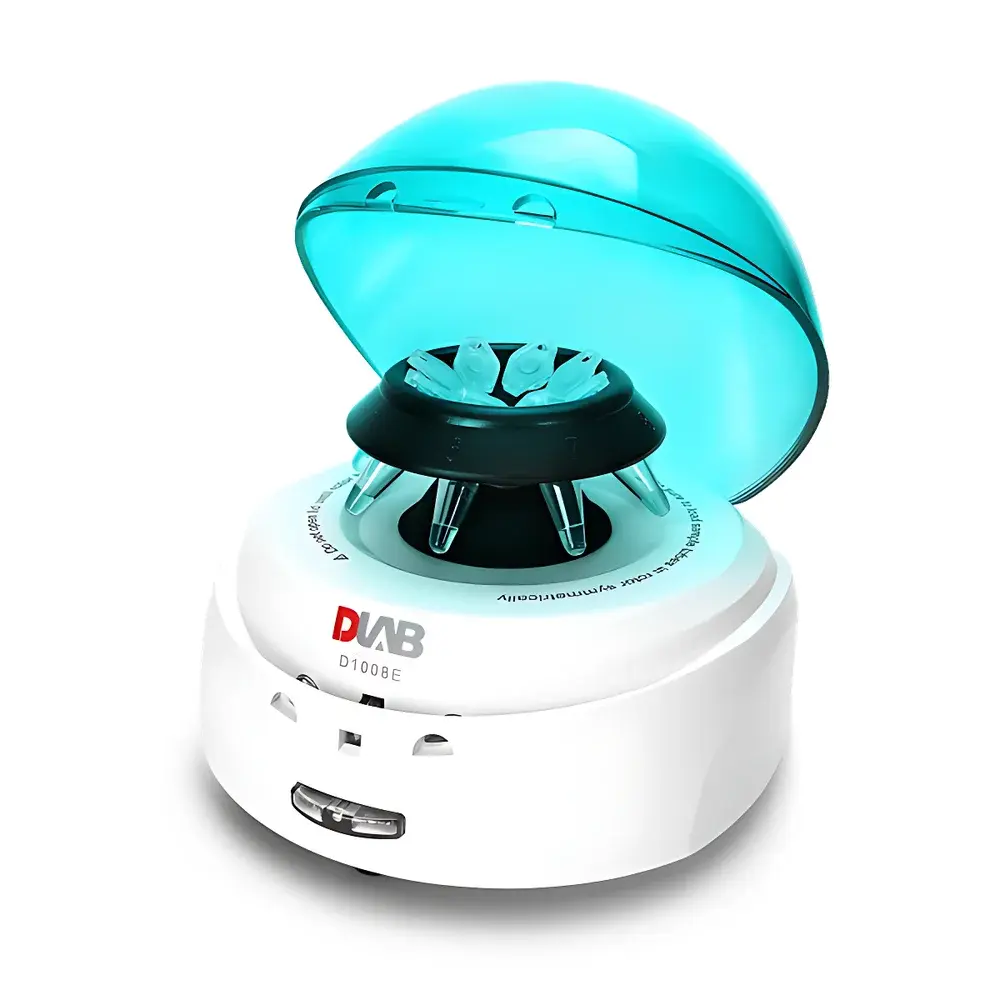
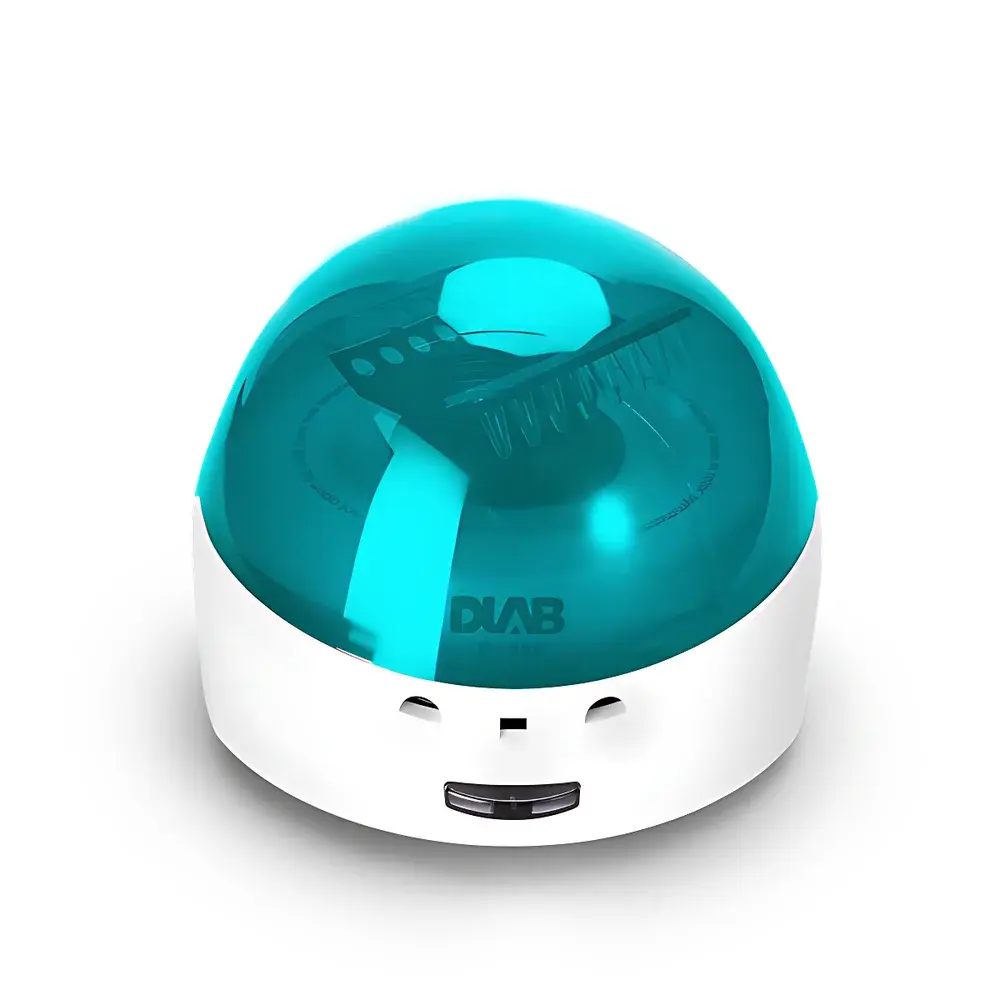
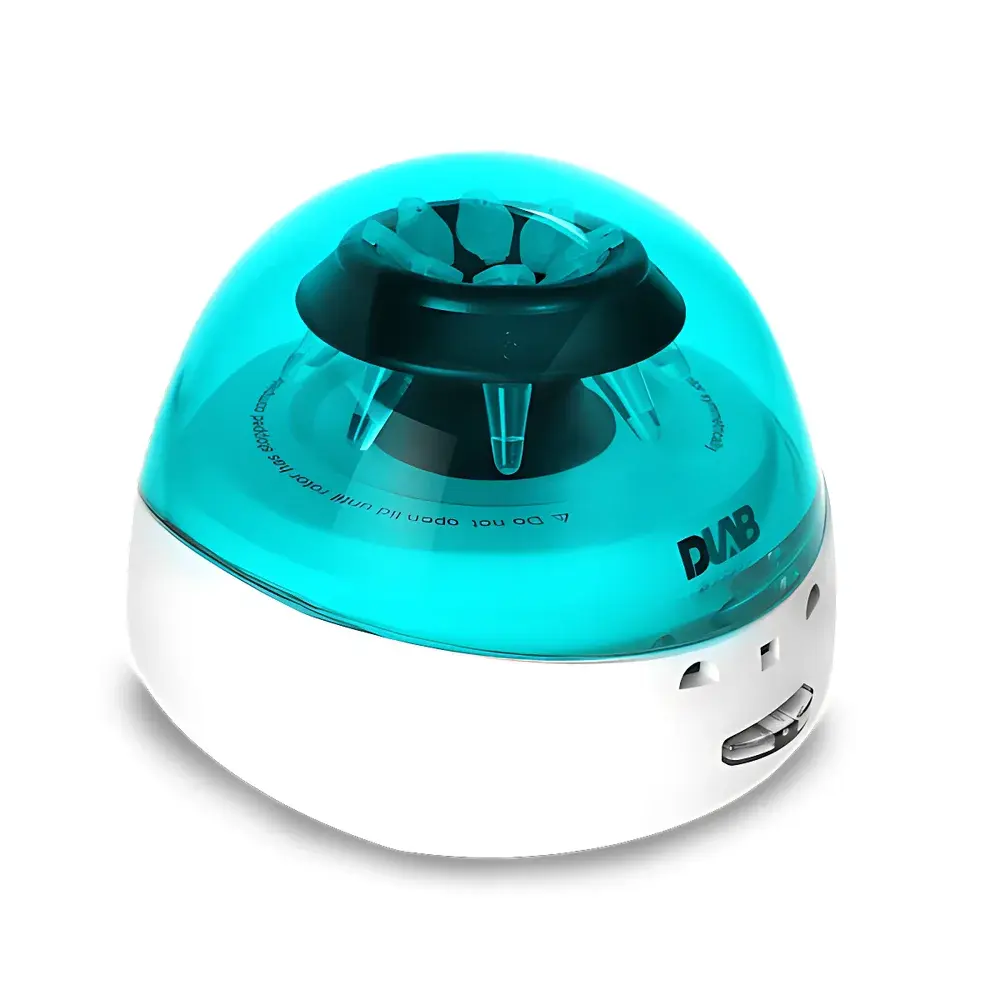
DLAB D1008E Benchtop Low-Speed Microcentrifuge
| Brand | DLAB |
|---|---|
| Origin | Beijing, China |
| Manufacturer Type | Direct Manufacturer |
| Instrument Type | Palm-Sized Centrifuge |
| Speed Range | 0–5000 rpm |
| Max RCF | 1360 × g |
| Capacity | 8 × 0.2/0.5/1.5/2 mL tubes |
| Motor | Brushed DC |
| Power Supply | AC 100–240 V, 50/60 Hz |
| Power Consumption | 20 W |
| Noise Level | ≤45 dB(A) |
| Dimensions (L×W×H) | 160 × 170 × 122 mm |
| Weight | 0.5 kg |
Overview
The DLAB D1008E is a compact, benchtop low-speed microcentrifuge engineered for precision and reliability in routine laboratory separation tasks. Utilizing brushless DC motor technology—though specified here as a brushed DC motor for continuous-duty operation—it delivers stable rotational performance across its full speed range of 0–5000 rpm, with a maximum relative centrifugal force (RCF) of 1360 × g. Its design adheres to fundamental centrifugation principles based on sedimentation kinetics under controlled angular velocity, making it suitable for pelleting cellular debris, precipitating nucleic acids or proteins, and clarifying low-viscosity aqueous solutions. Unlike high-speed or ultracentrifuges, the D1008E operates within the low-speed regime where thermal management and mechanical stability are prioritized over extreme g-forces—ideal for temperature-sensitive samples and applications requiring gentle yet effective phase separation.
Key Features
- Double-latch safety lid mechanism ensures secure rotor containment during operation and meets IEC 61010-1 requirements for laboratory equipment safety.
- Wide-input voltage regulation (AC 100–240 V, 50/60 Hz) maintains consistent rotational speed regardless of minor grid fluctuations—critical for reproducibility in multi-site or mobile lab environments.
- Ultra-quiet operation at ≤45 dB(A), achieved through optimized rotor balance, vibration-damping housing, and low-noise motor control—enabling use in shared workspaces without acoustic disturbance.
- Instant start/stop functionality: centrifugation initiates automatically upon lid closure and halts immediately upon lid opening, reducing procedural delay and enhancing user safety.
- Interchangeable snap-fit rotor system supports multiple tube formats—including standard microtubes (0.2, 0.5, 1.5, and 2.0 mL), 32-position 0.2 mL PCR tube racks, and 4-position PCR 8-tube strips—without tools or alignment aids.
- Compact footprint (160 × 170 × 122 mm) and lightweight construction (0.5 kg) allow flexible placement on biosafety cabinets, laminar flow hoods, or crowded benchtops without compromising accessibility.
Sample Compatibility & Compliance
The D1008E accommodates a broad spectrum of common laboratory consumables used in molecular biology, clinical diagnostics, and quality control workflows. It is compatible with polypropylene and polyethylene microcentrifuge tubes rated for ≤1360 × g, including filter-based spin columns for DNA clean-up kits. The rotor geometry supports both conical-bottom and round-bottom tubes, enabling efficient pellet formation across varying sample volumes. From a regulatory standpoint, the device complies with IEC 61010-1 (Safety Requirements for Electrical Equipment for Measurement, Control, and Laboratory Use) and carries CE marking for conformity with EU health, safety, and environmental protection standards. While not designed for GLP/GMP-critical validation out-of-the-box, its consistent speed accuracy and mechanical repeatability support documentation-ready operation when integrated into validated SOPs.
Software & Data Management
As a standalone analog-controlled instrument, the D1008E does not incorporate embedded firmware, touchscreen interface, or digital data logging capabilities. Operation is managed via a single rotary knob for speed adjustment and a mechanical toggle switch for power activation. This minimalist architecture eliminates software dependencies, reduces calibration complexity, and ensures long-term operational consistency without firmware updates or cybersecurity concerns. For laboratories requiring audit trails or electronic records, external timing devices or video-monitored protocols may be employed to satisfy 21 CFR Part 11 alignment in regulated environments—though such integration remains outside the device’s native scope.
Applications
- Routine pelleting of bacterial cells, yeast, and mammalian cell lysates prior to supernatant collection.
- Spin-down of PCR reaction mixtures to ensure complete reagent mixing and removal of air bubbles before thermal cycling.
- Clarification of serum, plasma, or urine samples prior to ELISA, HPLC, or mass spectrometry analysis.
- Recovery of precipitated nucleic acids following alcohol-based extraction protocols.
- Centrifugal filtration using spin columns for buffer exchange, desalting, or size-exclusion cleanup of oligonucleotides and peptides.
- Pre-analytical processing in point-of-care or field-deployable diagnostic setups where portability, low power draw (20 W), and robustness are essential.
FAQ
Is the D1008E suitable for use with radioactive or biohazardous samples?
Yes—when operated inside appropriate containment (e.g., sealed rotors within secondary containment vessels or biosafety cabinets), and following institutional biosafety protocols. Its sealed motor housing and non-porous exterior facilitate decontamination.
Can the rotor be autoclaved?
No—the rotor is constructed from high-impact polymer and is not autoclavable. Surface disinfection with 70% ethanol or isopropanol is recommended between uses.
Does the D1008E require routine maintenance beyond cleaning?
Minimal maintenance is required. Periodic inspection of lid latches and rotor seating is advised; no lubrication or bearing replacement is necessary under normal operating conditions.
What is the expected service life under continuous daily use?
Based on DLAB’s published reliability testing, the brushed DC motor and mechanical components are rated for ≥10,000 hours of cumulative operation under standard laboratory conditions.
Is a calibration certificate available for this model?
DLAB offers optional third-party speed verification services traceable to NIST standards; however, the unit ships without factory-issued calibration documentation by default.
Related Products



