
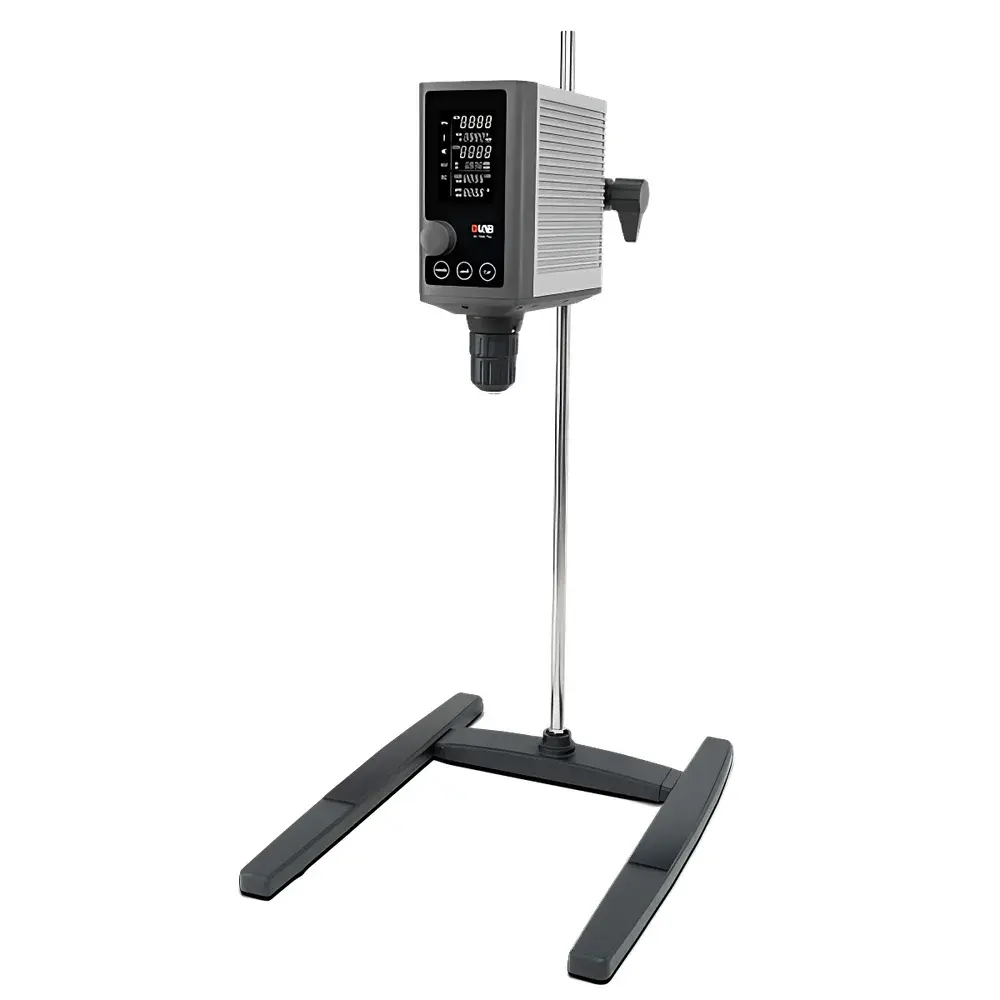
DLAB OS-T400-Plus LCD Digital Overhead Stirrer with Timer and External Temperature Monitoring
| Brand | DLAB |
|---|---|
| Origin | Beijing, China |
| Manufacturer Type | Direct Manufacturer |
| Product Category | Domestic |
| Model | OS-T400-Plus |
| Instrument Type | Overhead Stirrer |
| Max. Mixing Volume | 100 L (water) |
| Speed Range | A-range: 10–400 rpm, B-range: 20–2000 rpm |
| Temperature Control Range | 5–40 °C |
| Timer Range | 1 min – 99 h 59 min |
| Max. Torque | 400 N·cm |
| Max. Viscosity Handling | 150,000 mPa·s |
| Motor Type | Brushless DC |
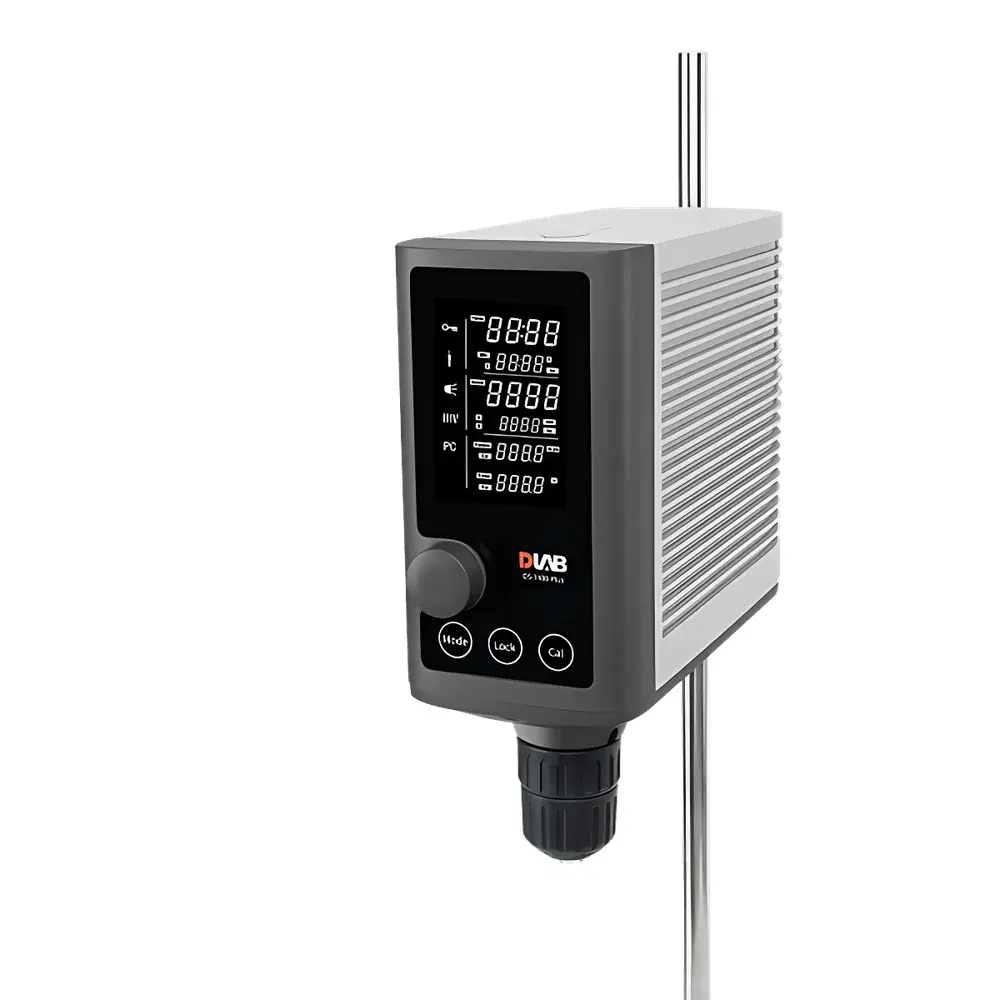
| Display | LCD (speed, torque, timer, temperature) |
| Temp. Sensor Input | Yes (0–100 °C, resolution 0.1 °C) |
| Safety Lock | Yes |
| Power Input | 100–240 V, 50/60 Hz |
| Output Power | 170 W (motor), 300 W (system) |
| Chuck Capacity | 0.5–10 mm |
| Interfaces | RS485 / USB-C / USB |
| Dimensions (L×W×H) | 101 × 270 × 264 mm |
| Net Weight | 5.2 kg |
| Operating Environment | 5–40 °C, ≤80% RH |
Overview
The DLAB OS-T400-Plus is a high-performance, microprocessor-controlled overhead stirrer engineered for precision mixing in demanding laboratory, pilot-scale, and industrial R&D environments. Utilizing brushless DC motor technology, it delivers exceptional torque stability and speed reproducibility across wide viscosity ranges — from low-viscosity aqueous solutions to highly structured non-Newtonian systems up to 150,000 mPa·s. Its core operational principle relies on closed-loop speed regulation: real-time torque feedback enables automatic power modulation to maintain the user-defined rotational speed despite dynamic changes in fluid resistance — a critical requirement for consistent dispersion, dissolution, emulsification, and suspension processes. Designed for reliability under continuous operation, the unit integrates thermal management, overload protection, and electromagnetic compatibility compliant with IEC 61326-1 for laboratory instrumentation.
Key Features
- Two-speed operating ranges: A-range (10–400 rpm) optimized for high-torque, low-speed applications (e.g., polymer blending, slurry homogenization); B-range (20–2000 rpm) supporting rapid dispersion and fine particle deagglomeration.
- LCD interface displaying real-time values for rotational speed, instantaneous torque (N·cm), elapsed/remaining timer, and external sample temperature (via optional Pt100 or thermistor probe).
- Precision temperature monitoring: Integrated sensor input accepts standard 2-/3-wire RTD or thermistor probes (0–100 °C range, ±0.1 °C display resolution); temperature data is logged synchronously with speed/torque during timed runs.
- Dual calibration capability: Independent user-accessible calibration routines for torque (N·cm) and temperature (°C) ensure long-term measurement traceability without service intervention.
- Mechanical safety lock prevents unintended parameter modification during active operation; “top-entry” impeller shaft design allows rapid vessel exchange without disassembling the drive head.
- Integrated acoustic alert system: Audible beeping signals fault conditions (e.g., stall, overtemperature, communication timeout) and end-of-timer completion.
- Multi-protocol digital connectivity: RS485 (Modbus RTU), USB-C, and legacy USB interfaces support remote control, data streaming, and integration into centralized lab automation platforms.
Sample Compatibility & Compliance
The OS-T400-Plus accommodates vessels from 50 mL beakers to 100 L jacketed reactors via adjustable clamping arms and universal chuck (0.5–10 mm shank diameter). It supports common stirring geometries including propellers, anchors, and dissolving blades. The unit complies with IEC 61010-1 (Safety Requirements for Electrical Equipment for Measurement, Control, and Laboratory Use) and meets EMC requirements per IEC 61326-1. While not a regulated medical device, its audit-ready features — including timestamped event logging, parameter change history, and electronic signature-capable software integration — align with GLP and GMP documentation expectations for method validation and process consistency reporting.
Software & Data Management
DLAB provides optional PC-based control software compatible with Windows 10/11 that enables full parameter scripting, real-time graphing of speed/torque/temperature profiles, and CSV export of time-stamped datasets. All communication adheres to open Modbus RTU protocol over RS485, permitting seamless integration with SCADA systems or LIMS. Audit trail functionality records operator ID (when configured), timestamped parameter changes, alarm events, and calibration actions — supporting compliance with FDA 21 CFR Part 11 where electronic records are subject to regulatory review.
Applications
- R&D formulation development: Polymer solution preparation, pharmaceutical suspension stabilization, battery electrolyte mixing.
- Quality control laboratories: Standardized dissolution testing per USP , viscosity benchmarking of coatings and adhesives.
- Biotechnology: Cell culture media conditioning, buffer blending, and reagent preparation requiring strict temperature and shear control.
- Chemical engineering: Kinetic reaction studies under controlled agitation, crystallization seeding protocols, and heterogeneous catalysis support.
- Food & cosmetics: Emulsion formation, thickener hydration, and sensory sample homogenization prior to analytical testing.
FAQ
Does the OS-T400-Plus support external temperature feedback for closed-loop thermal control?
No — the external temperature sensor provides monitoring only; the unit does not regulate bath or jacket temperature. It is designed for use with externally temperature-controlled vessels.
Can torque data be exported in real time during operation?
Yes — via USB-C or RS485, torque, speed, temperature, and timer status are streamed at configurable intervals (default 1 Hz) and can be captured by third-party DAQ or custom Python/Node-RED scripts.
Is the chuck self-centering, and what is the runout tolerance?
The dual-jaw chuck achieves ≤0.15 mm radial runout at 1000 rpm when properly tightened; centering is mechanical, not active.
What is the recommended maintenance interval for the brushless motor?
No scheduled motor maintenance is required; the sealed motor assembly is rated for >20,000 hours MTBF under typical laboratory duty cycles.
How is overload protection implemented?
Hardware-based current sensing triggers immediate shutdown and LCD error code display (e.g., “ERR 03”) if torque demand exceeds 400 N·cm for >500 ms, preventing mechanical stress on the gear train.



