
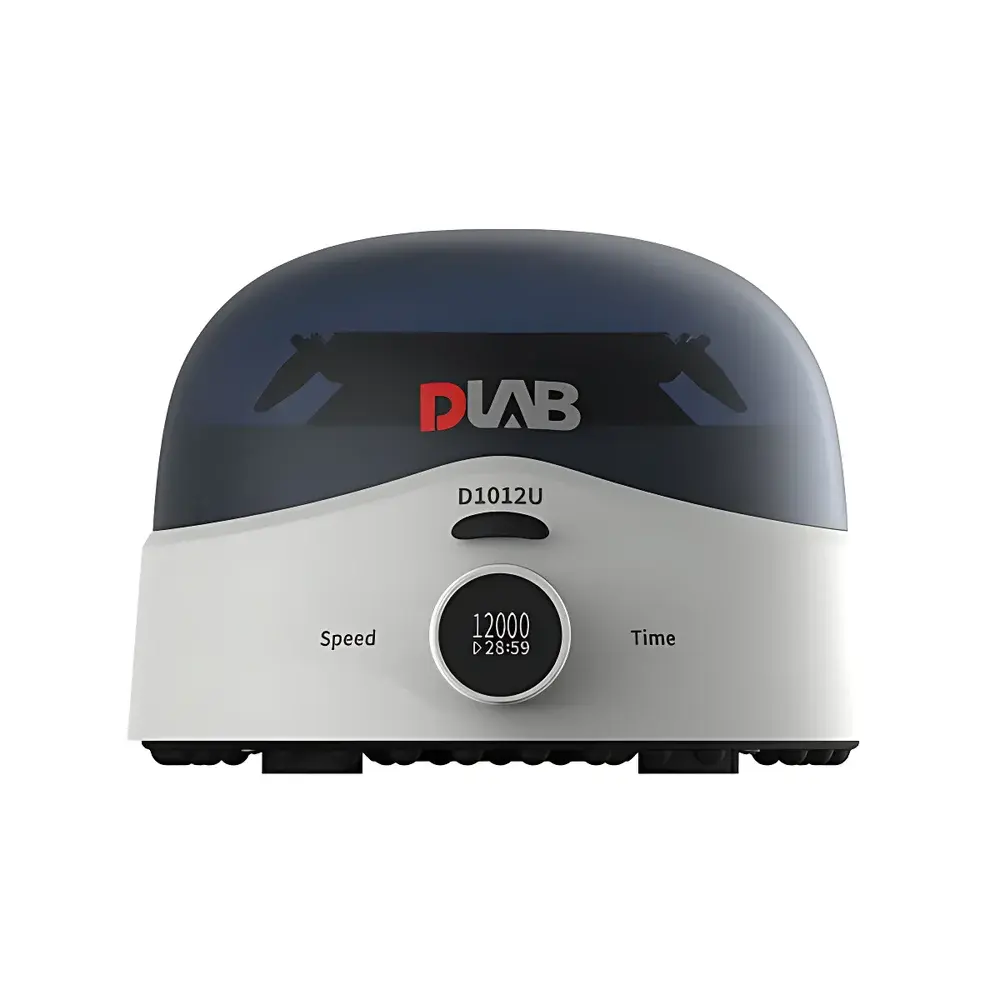
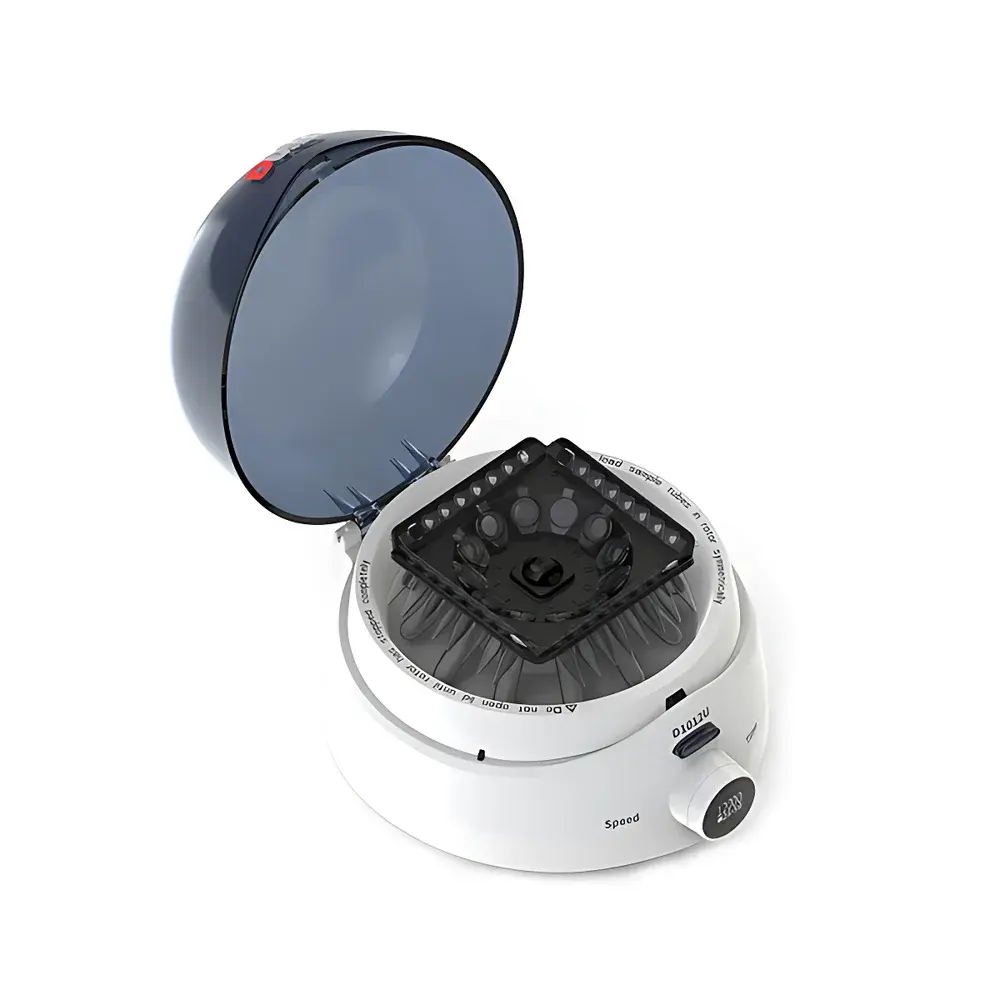
DLAB D1012U High-Speed Microcentrifuge
| Brand | DLAB |
|---|---|
| Origin | Beijing, China |
| Manufacturer Type | Original Equipment Manufacturer (OEM) |
| Product Category | Domestic |
| Model | D1012U |
| Instrument Type | Palm-Sized Centrifuge |
| Speed Range | 1,000–12,000 rpm (100 rpm increments) |
| Time Setting | 10 s–20 min (10 s increments) |
| Max. Rotor Capacity | 12 × 0.5/1.5/2 mL tubes + 4 × PCR 8-tube strips |
| Max. Speed | 12,000 rpm |
| Max. RCF | 6,708 × g (for 1.5/2 mL tubes) |
| Rotor Type | Snap-fit composite rotor |
| Display | OLED touch screen with dual-parameter display (speed/time) |
| Motor | Brushless DC motor |
| Power Input | AC 100–240 V, 50/60 Hz |
| Power Consumption | 30 W |
| Noise Level | ≤58 dB(A) |
| Dimensions (L×W×H) | 210 × 180 × 130 mm |
| Weight | 1.5 kg |
Overview
The DLAB D1012U High-Speed Microcentrifuge is an engineered solution for rapid, precise micro-volume sample separation in molecular biology, clinical diagnostics, and analytical chemistry laboratories. Designed around a brushless DC motor and precision-engineered snap-fit composite rotor, it delivers consistent rotational stability across its operational range of 1,000–12,000 rpm. Its centrifugal force output—up to 6,708 × g for standard 1.5/2 mL microtubes and up to 7,490 × g for PCR 8-tube strips—is optimized for nucleic acid precipitation, protein pellet recovery, column-based purification, and small-volume phase separation. The instrument operates on a wide-input voltage architecture (AC 100–240 V, 50/60 Hz), ensuring stable speed performance independent of local power fluctuations—a critical feature in multi-site or mobile lab environments where electrical infrastructure varies.
Key Features
- Brushless DC motor enabling continuous operation mode with low thermal drift and extended service life
- Snap-fit composite rotor with integrated balancing design—no tools required for installation; reduces mechanical wear and improves long-term run-to-run reproducibility
- OLED touch interface with dual-display capability: simultaneously shows set speed (rpm) and remaining time (s/min), with intuitive soft-key controls for start/pause/stop functions
- Multi-format rotor compatibility: accommodates 12 × 0.5/1.5/2 mL conical tubes, 44 × 0.2 mL PCR singles, and 4 × 0.2 mL PCR 8-tube strips—including filter-type spin columns used in DNA/RNA cleanup kits
- Low-noise enclosure (<58 dB[A]) suitable for benchtop use in shared laboratory spaces without acoustic shielding
- Compact footprint (210 × 180 × 130 mm) and lightweight chassis (1.5 kg) support portability between workstations, biosafety cabinets, or field-deployable setups
Sample Compatibility & Compliance
The D1012U supports routine handling of standard polypropylene microcentrifuge tubes (0.5–2 mL), thin-walled PCR tubes, and commercially available spin-column cartridges from major vendors (e.g., QIAGEN, Thermo Fisher, Zymo Research). Its rotor geometry maintains safe clearance during high-speed rotation, minimizing tube deformation risk—even with partially filled or asymmetrically loaded configurations. While the device does not include built-in audit trail or electronic signature capabilities, its mechanical and electrical design complies with IEC 61010-1:2010 safety standards for laboratory equipment. For GLP/GMP environments requiring traceability, users may integrate external logging via timer-controlled power relays or third-party data acquisition systems.
Software & Data Management
The D1012U operates as a standalone instrument with no embedded firmware-based data storage or network connectivity. All parameter settings—including speed, time, and run status—are managed locally through the OLED interface. No proprietary software is required for operation. However, the unit’s consistent timing resolution (10-second increments) and repeatable speed accuracy (±100 rpm at full scale) enable manual protocol documentation compatible with ISO/IEC 17025-compliant record-keeping practices. For labs implementing digital SOPs, the device can be referenced in electronic lab notebooks (ELNs) such as LabArchives or Benchling using standardized metadata fields (e.g., “Centrifugation: DLAB D1012U, 12,000 rpm, 5 min, 4°C”).
Applications
- Routine pelleting of nucleic acids following ethanol precipitation or silica-membrane binding steps
- Clarification of lysates prior to electrophoresis or mass spectrometry analysis
- Spin-down of enzymatic reaction mixtures to remove insoluble debris before downstream detection
- High-throughput preparation of template DNA for PCR/qPCR workflows using 8-tube strip formats
- Micro-volume solvent extraction in environmental or forensic sample prep protocols
- Preparative isolation of exosomes or extracellular vesicles when paired with size-exclusion or density-gradient media
FAQ
What is the maximum relative centrifugal force (RCF) achievable with 0.2 mL PCR tubes?
The D1012U achieves up to 7,490 × g when spinning 0.2 mL PCR 8-tube strips at 12,000 rpm. For individual 0.2 mL tubes, RCF is calculated based on radius and rotational speed; typical values fall within 6,596–7,000 × g depending on tube positioning.
Can this centrifuge accommodate spin-column filtration kits?
Yes—the composite rotor includes recessed grooves designed to hold standard 2 mL collection tubes beneath 0.5/1.5 mL spin columns, supporting common RNA/DNA purification workflows without adapter modification.
Is the instrument suitable for refrigerated operation?
No—this model lacks active temperature control and is rated for ambient operation only (10–30°C). For cold-sensitive applications, pre-chill samples and tubes prior to centrifugation.
Does the D1012U meet FDA 21 CFR Part 11 requirements?
No—it does not incorporate electronic records, audit trails, or user authentication features. It is intended for research-use-only (RUO) applications unless validated in-house per organizational quality system requirements.
How is rotor imbalance compensated during operation?
The snap-fit rotor employs symmetrical mass distribution and precision-machined bearing interfaces to maintain dynamic balance across all speed ranges. No manual balancing weights or calibration routines are required.



