
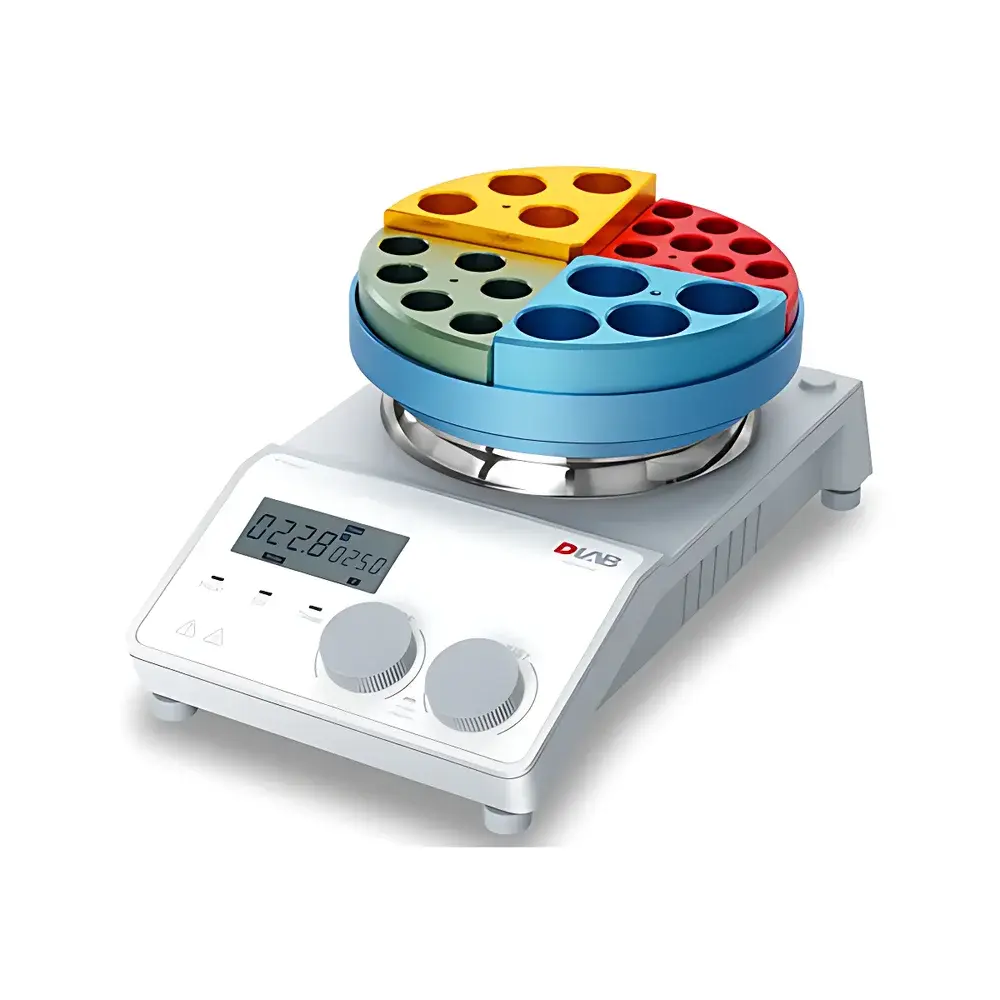
DLAB MS-H-Pro(T) LCD Digital Programmable Heating Magnetic Stirrer
| Brand | DLAB |
|---|---|
| Origin | Beijing, China |
| Manufacturer Type | Manufacturer |
| Product Category | Domestic |
| Model | MS-H-Pro(T) |
| Instrument Type | Magnetic Stirrer |
| Max. Stirring Volume | 20 L (H₂O) |
| Speed Range | 100–1500 rpm |
| Temperature Control Range | Ambient to 340 °C |
| Display | High-Resolution LCD (simultaneous real-time display of speed, temperature, and timer) |
| Timer Range | 1 min – 99 h 59 min (MS-H-Pro(T) only) |
| External Temperature Sensor Support | PT1000 (±0.2 °C accuracy) |
| Heating Plate Material | Stainless Steel with Ceramic Coating |
| Overheat Protection Threshold | 360 °C (automatic cut-off), 420 °C (safety fuse) |
| Residual Heat Warning | Activates at >50 °C on plate surface (even after power-off) |
| Enclosure Rating | IP42 |
| Dimensions (L×W×H) | 280 × 160 × 85 mm |
| Weight | 2.8 kg |
| Operating Environment | 5–40 °C, ≤80% RH |
| Power Input | 100–120 V / 200–240 V, 50/60 Hz |
| Motor Type | Brushless DC |
| Motor Output Power | 10 W |
| Max. Heating Power | 500 W |
| Speed Control Accuracy | ±1 rpm |
| Temp. Control Accuracy | ±1 °C (<100 °C), ±1% (>100 °C) |
| Temp. Display Resolution | 0.1 °C |
| Max. Stir Bar Length | 80 mm |
| Data Interface | RS232 |
Overview
The DLAB MS-H-Pro(T) LCD Digital Programmable Heating Magnetic Stirrer is an engineered solution for precise, reproducible, and safe thermal stirring in research laboratories, quality control environments, and production-scale R&D settings. Based on the principle of magnetic coupling—where a rotating permanent magnet beneath the heated ceramic-coated plate induces rotational motion in a magnetic stir bar immersed in the sample—the instrument delivers consistent agitation across viscous and low-viscosity media while maintaining accurate, programmable temperature profiles. Designed for applications requiring extended unattended operation, the MS-H-Pro(T) integrates dual digital control loops for independent regulation of rotational speed and heating output, enabling simultaneous optimization of mixing efficiency and thermal reaction kinetics. Its robust architecture meets fundamental safety expectations aligned with IEC 61010-1 for laboratory electrical equipment, including thermal runaway prevention, residual heat indication, and redundant overtemperature cutoff.
Key Features
- Brushless DC motor: Eliminates carbon brush wear, ensures spark-free operation (ATEX-compatible ambient suitability), and guarantees long-term speed stability without maintenance.
- Dual-parameter LCD interface: Simultaneously displays real-time speed (rpm), plate temperature (°C), and elapsed/remaining timer value—critical for GLP-compliant documentation and process traceability.
- Extended programmable timer: Supports durations from 1 minute to 99 hours and 59 minutes, enabling overnight or multi-day synthesis protocols without manual intervention.
- Ceramic-coated stainless steel heating plate (Ø135 mm): Resists corrosion from acids, bases, and organic solvents; maintains uniform thermal distribution and mechanical durability under repeated thermal cycling.
- Two-tier thermal safety system: Independent hardware-based cutoff at 360 °C prevents overheating during controller failure; secondary thermal fuse activates at 420 °C as fail-safe redundancy.
- Residual heat warning: Persistent visual alert triggers when plate surface exceeds 50 °C—even after shutdown and while mains power remains connected—reducing burn risk during post-run handling.
- External PT1000 probe compatibility: Enables closed-loop sample temperature control (not just plate temperature), achieving ±0.2 °C accuracy for exothermic/endothermic reaction monitoring per ASTM E2847 guidelines.
- RS232 serial interface: Allows bidirectional communication with host PCs for automated data logging, remote parameter adjustment, and integration into centralized lab management systems compliant with FDA 21 CFR Part 11 requirements (when paired with validated software).
Sample Compatibility & Compliance
The MS-H-Pro(T) accommodates a wide range of sample containers—including glass beakers (up to 20 L capacity with water-equivalent viscosity), round-bottom flasks, and jacketed reactors—provided appropriate stir bar geometry and size (max. 80 mm length) are selected. Its chemical-resistant plate surface supports use with aggressive reagents common in synthetic organic chemistry (e.g., concentrated HNO₃, aqua regia, anhydrous AlCl₃ suspensions) and biopharmaceutical buffer preparation. The unit conforms to IEC 61010-1:2010 (Safety Requirements for Electrical Equipment for Measurement, Control, and Laboratory Use) and carries CE marking for EMC and Low Voltage Directive compliance. While not intrinsically rated for hazardous area deployment, its brushless motor and thermal safeguards make it suitable for general-purpose fume hood or controlled environment use under ISO/IEC 17025-accredited testing laboratories.
Software & Data Management
Equipped with an RS232 port, the MS-H-Pro(T) supports ASCII protocol-based command sets for integration with custom or third-party laboratory information management systems (LIMS) and electronic lab notebooks (ELN). Time-stamped speed and temperature logs can be streamed continuously or polled on demand, supporting audit-ready records for ISO 9001, ISO 13485, or GMP-aligned workflows. When used with DLAB’s optional PC control software (v3.2+), users gain access to scheduled ramp-soak profiles, deviation alarms, and exportable CSV reports—with configurable metadata fields (operator ID, batch number, experiment ID) to satisfy ALCOA+ data integrity principles.
Applications
- Controlled-temperature synthesis: Suzuki couplings, esterifications, and hydrolysis reactions requiring stable thermal input and homogeneous mixing.
- Buffer and media preparation: Accurate dissolution and pH equilibration of phosphate-buffered saline (PBS), Tris-HCl, and microbial growth media.
- Material dispersion: Uniform suspension of nanoparticles, catalysts, or polymer precursors in solvent matrices prior to characterization (DLS, SEM, XRD).
- Quality assurance testing: Viscosity standardization, dissolution testing per USP <711>, and extractables/leachables sample conditioning.
- Educational laboratories: Demonstrating Arrhenius kinetics, heat transfer coefficients, and mass transfer limitations in undergraduate physical chemistry curricula.
FAQ
Does the MS-H-Pro(T) support external temperature feedback during operation?
Yes—when connected to a calibrated PT1000 sensor immersed in the sample, the unit performs active closed-loop temperature regulation, decoupling setpoint accuracy from ambient drafts or vessel wall thermal lag.
Can the timer function operate independently of heating or stirring?
No—the timer governs total device runtime; however, users may disable heating or stirring individually via front-panel controls while the timer continues counting.
Is the RS232 interface optically isolated?
No—it is a standard non-isolated serial interface; for electrically noisy environments, a galvanically isolated USB-to-RS232 adapter is recommended.
What is the maximum allowable ambient temperature for continuous operation?
The specified operating range is 5–40 °C at ≤80% relative humidity; sustained use above 35 °C may reduce thermal headroom and extend time-to-setpoint.
How frequently should the unit be verified for calibration traceability?
Per ISO/IEC 17025 recommendations, annual verification using NIST-traceable thermocouple and tachometer standards is advised, with additional checks after any physical impact or exposure to corrosive vapors.
Related Products



