
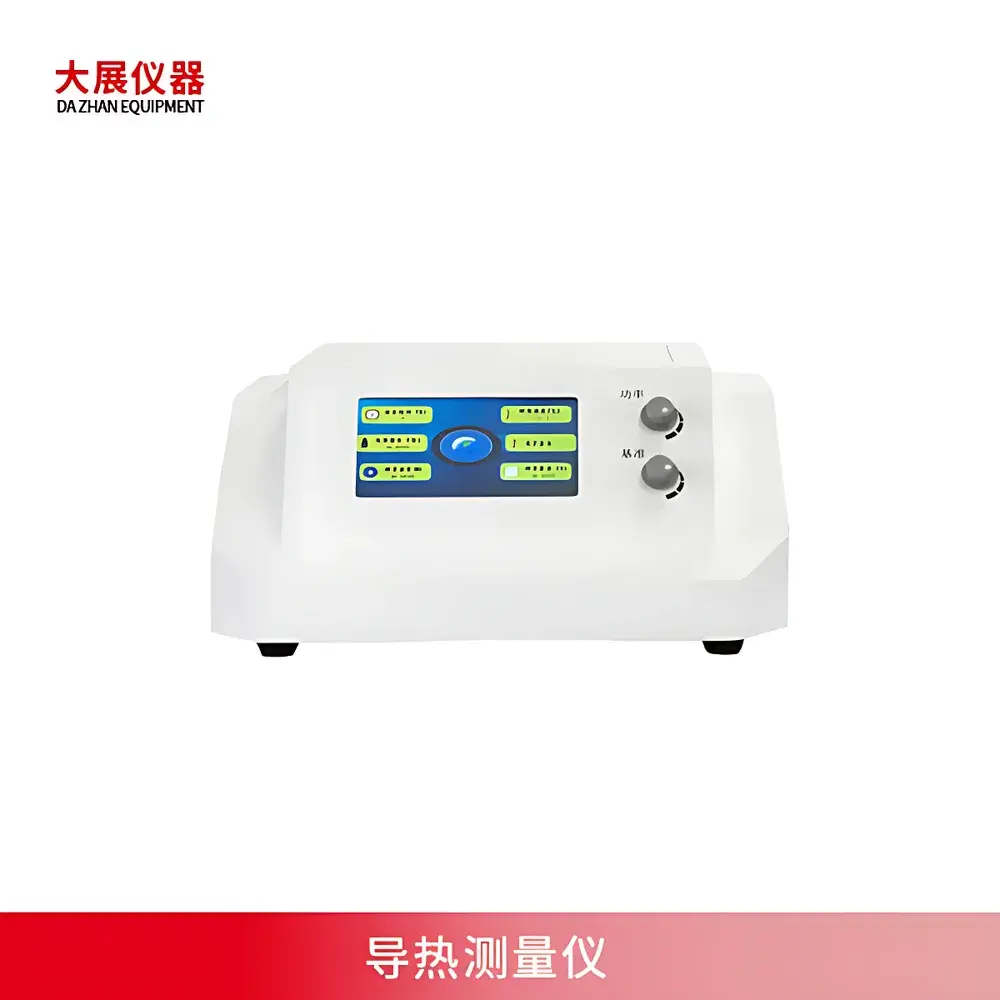
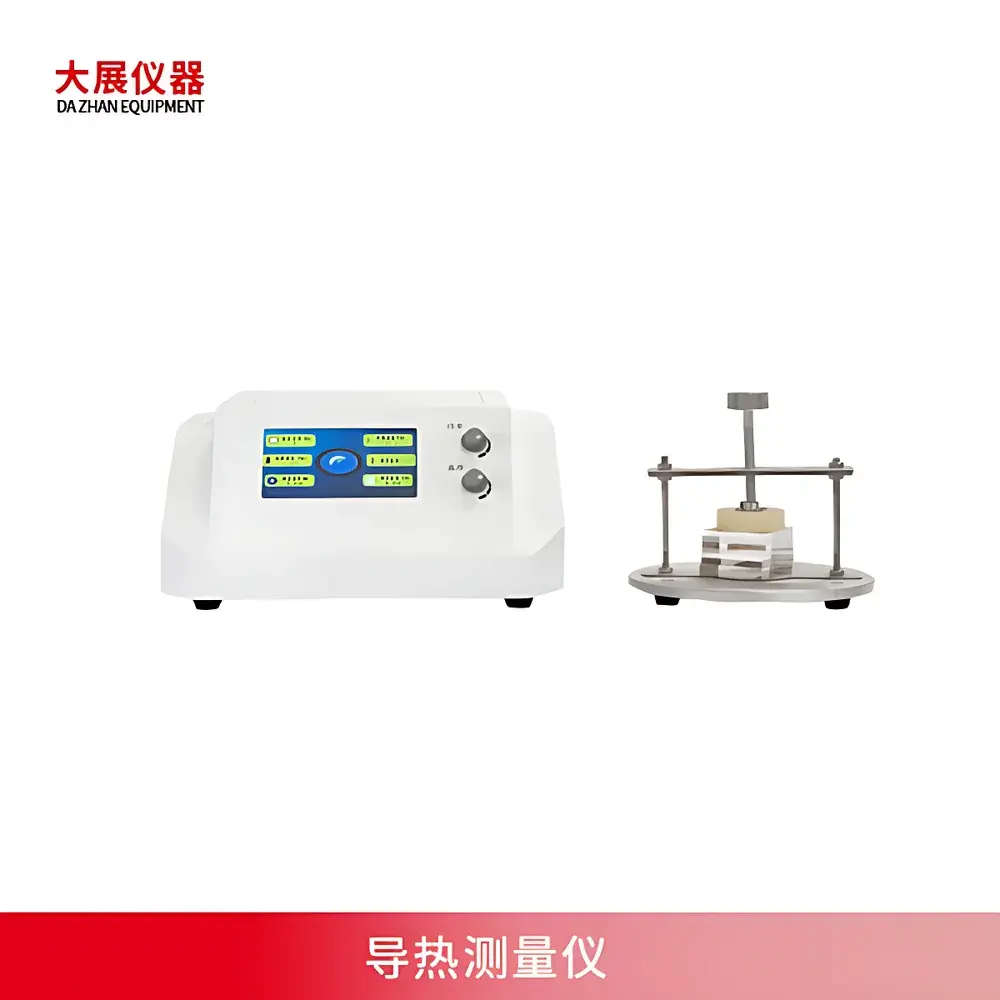
Nanjing Dazhan DZDR-S Transient Plane Source (TPS) Thermal Conductivity Analyzer
| Brand | Nanjing Dazhan |
|---|---|
| Origin | Jiangsu, China |
| Manufacturer Type | Manufacturer |
| Instrument Type | Transient Plane Source (TPS) Method |
| Sample Throughput | Single sample per test |
| Test Environment | Ambient temperature (RT–130 °C) |
| Thermal Conductivity Range | 0.0001–300 W/(m·K) |
| Accuracy | ±3% |
| Repeatability | ≤3% |
| Sample Forms | Solids (bulk, film, coating), powders, liquids, pastes, gels, metals, and thin films |
| Probe Options | 7.5 mm, 15 mm, and 50 mm diameter (standard and customizable) |
| Measurement Time | 5–160 s (user-configurable) |
| Power Supply | AC 220 V, <500 W |
Overview
The Nanjing Dazhan DZDR-S Transient Plane Source (TPS) Thermal Conductivity Analyzer is an engineered solution for rapid, contact-based measurement of thermal conductivity across a broad spectrum of materials—from insulating polymers and aerogels to high-conductivity metals and phase-change composites. Based on the ISO 22007-2 standard for transient plane source methods, the instrument applies a known amount of heat via a symmetrically wound double-helix sensor embedded in a thin Kapton film. This probe acts simultaneously as both heater and temperature sensor. During measurement, a constant current pulse generates transient heating; the resulting temperature rise over time is recorded with microsecond resolution. Thermal conductivity (λ) is derived from the slope of the ln(t)–T curve in the mid-time region, where heat diffusion is predominantly one-dimensional and governed by Fourier’s law. Unlike steady-state or guarded-hot-plate techniques, the TPS method eliminates errors associated with interfacial contact resistance, requires no thermal equilibrium, and delivers results within seconds—making it ideal for R&D labs, QC environments, and material screening workflows demanding high throughput without sacrificing metrological integrity.
Key Features
- Triple-probe configuration (7.5 mm, 15 mm, 50 mm) enables scalable testing—from microliter liquid volumes to large-area insulation panels—without recalibration.
- ARM-based embedded control system ensures deterministic real-time data acquisition, low-latency signal processing, and stable thermal pulse generation.
- High-resolution analog-to-digital conversion (≥18-bit) captures subtle thermal transients, supporting reliable λ determination down to 0.0001 W/(m·K) for aerogels and foams.
- Touch-enabled color LCD interface with intuitive navigation supports fully autonomous operation—no external PC required for basic measurements.
- Non-destructive, non-invasive testing preserves sample integrity; solids, powders, and viscous pastes can be reused post-analysis.
- No specialized sample preparation: flat-surface requirement is minimal (sample lateral dimension ≥2× probe diameter); thickness tolerance accommodates irregular geometries.
- Integrated thermal shielding and ambient temperature compensation minimize drift during extended operation at RT–130 °C.
- Modular sample stage design accepts custom fixtures—including powder containment cells and thin-film clamping kits—for application-specific adaptability.
Sample Compatibility & Compliance
The DZDR-S accommodates heterogeneous material classes under standardized test conditions compliant with ISO 22007-2 and ASTM D5470 (for comparative thermal transmission measurements). Validated sample forms include isotropic and anisotropic solids (e.g., graphite, ceramics, composites), dispersions (nanofluids, slurries), semi-crystalline polymers, metallic alloys, elastomeric gels, and layered structures such as thermal interface materials (TIMs) and battery electrode coatings. Powder testing utilizes a dedicated compression cell to ensure consistent density and interfacial contact. For regulatory environments, the instrument supports audit-ready data logging (timestamped, user-ID tagged) and optional export to CSV/Excel formats compatible with LIMS integration. While not 21 CFR Part 11–certified out-of-the-box, its deterministic firmware architecture and immutable raw-data storage facilitate validation under GLP/GMP frameworks when deployed with documented SOPs.
Software & Data Management
Onboard firmware handles full signal conditioning, baseline correction, curve-fitting (using proprietary multi-parameter TPS inversion algorithms), and uncertainty propagation per ISO/IEC Guide 98-3 (GUM). All raw voltage-vs.-time traces, processed thermal curves, and final λ values are stored locally with metadata (operator ID, date/time, probe ID, sample ID, ambient T). Export options include USB flash drive transfer and RS-232 serial output for legacy SCADA systems. Optional PC software (Windows-compatible) provides advanced analysis: anisotropy estimation via dual-axis probing, time-domain residual diagnostics, batch reporting, and comparative trend analysis across material families. Calibration verification routines include NIST-traceable reference material checks (e.g., Pyroceram 9606, glycerol) with automated deviation alerts.
Applications
- Thermal management R&D: TIM selection for power electronics, battery pack thermal design, heat sink material qualification.
- Insulation performance validation: aerogel blankets, vacuum insulation panels (VIPs), mineral wool, phenolic foams.
- Pharmaceutical solid dosage forms: thermal diffusivity mapping of tablet compacts and lyophilized cakes.
- Advanced manufacturing: in-line QC of additive-manufactured metal parts, polymer extrusion batches, and composite layups.
- Academic research: structure–property relationships in nanocomposites, phase-change materials (PCMs), and thermoelectric candidates.
- Coating & thin-film development: thermal resistance quantification of ALD-deposited dielectrics or spray-applied ceramic barriers.
FAQ
What standards does the DZDR-S comply with?
The instrument implements the transient plane source method per ISO 22007-2 and aligns with technical principles referenced in ASTM D5470 and DIN EN 12667.
Can it measure anisotropic materials?
Yes—by orienting the probe normal to principal axes and comparing λ⊥ vs. λ∥, directional conductivity can be assessed; dual-probe configurations support orthogonal measurement protocols.
Is sample contact pressure controlled?
No active force regulation is built-in, but the modular stage includes calibrated spring-loaded holders for repeatable light-contact loading (typically 0.1–0.5 kPa), minimizing interfacial air gaps without deforming soft samples.
How is calibration verified?
Users perform periodic verification using certified reference materials (CRMs) supplied with NIST-traceable λ values at specified temperatures; onboard software flags deviations exceeding ±2% of certified value.
Does it support automated batch testing?
Manual single-sample mode is standard; automation requires external robotic sample handling and RS-232/Modbus TCP integration—documented in the OEM API guide.



