
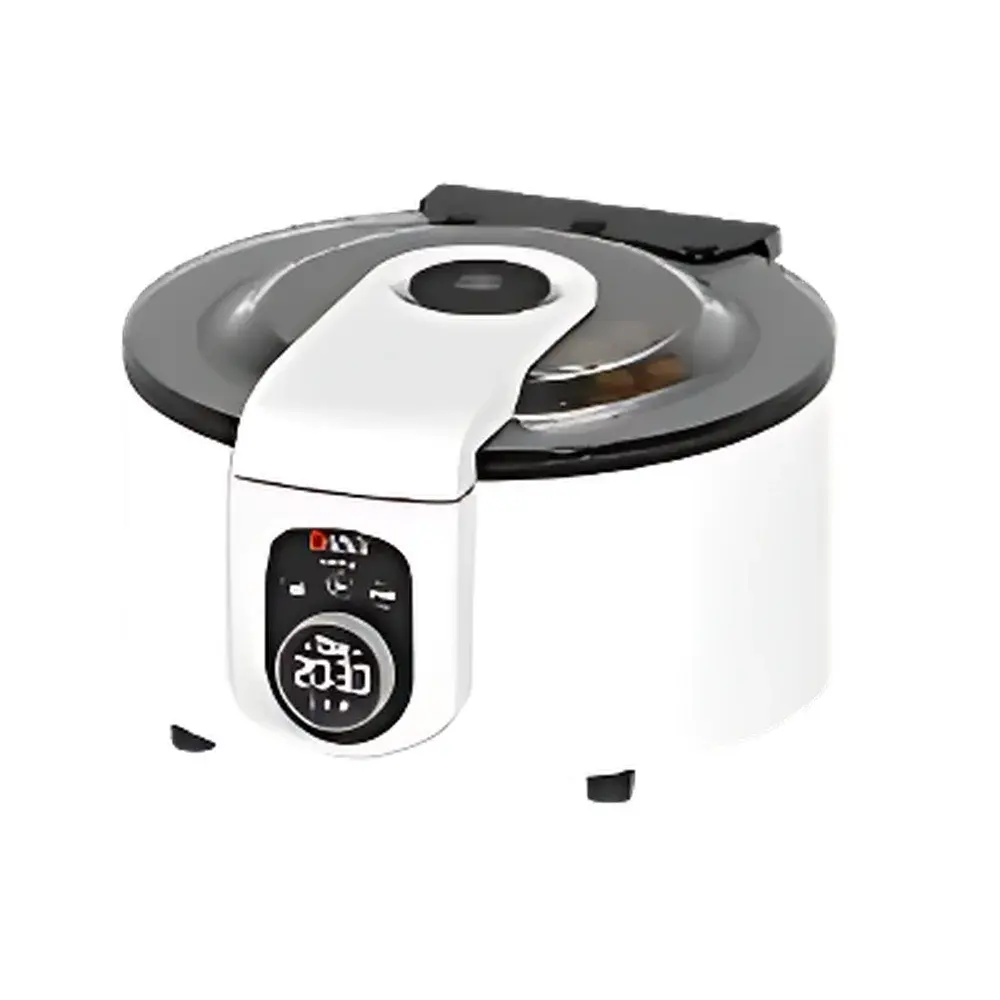
DLAB DM0436E Benchtop Low-Speed Centrifuge
| Brand | DLAB |
|---|---|
| Origin | Beijing, China |
| Manufacturer | DLAB |
| Type | Benchtop Centrifuge |
| Max. Speed | 3500 rpm |
| Max. RCF | 2260 × g |
| Rotor Capacity | 12 × 15 mL (outer ring) + 12 × 12 mL (inner ring) |
| Speed Range | 100–3500 rpm (100 rpm increments) |
| Speed Accuracy | ±20 rpm |
| Timer Range | 30 s – 99 min 59 s or continuous mode |
| Deceleration Profiles | 6 adjustable braking levels |
| Noise Level | ≤55 dB(A) |
| Motor | Brushless DC motor |
| Power Supply | 100–240 V, 50/60 Hz |
| Power Consumption | 170 W |
| Dimensions (L×W×H) | 481.5 × 414 × 253.5 mm |
| Weight | 15 kg |
| Operating Environment | 5–40 °C, ≤80% RH |
| Enclosure Rating | IP21 |
Overview
The DLAB DM0436E is a precision-engineered benchtop low-speed centrifuge designed for routine separation tasks in clinical laboratories, academic research facilities, and quality control environments. Operating on the principle of sedimentation under controlled centrifugal force, the DM0436E delivers consistent, reproducible separations across a wide range of biological and chemical sample types—including whole blood, cell suspensions, serum, plasma, and particulate-laden solutions. With a maximum rotational speed of 3500 rpm and a corresponding relative centrifugal force (RCF) of 2260 × g, it is optimized for applications requiring gentle yet effective phase separation without compromising sample integrity—such as erythrocyte sedimentation rate (ESR) preparation, urine sediment analysis, or polymer precipitation. Its compact footprint (481.5 × 414 × 253.5 mm), brushless DC motor architecture, and IP21-rated enclosure ensure reliable performance in shared lab spaces while meeting international safety and electromagnetic compatibility (EMC) requirements.
Key Features
- Adjustable deceleration control: Six programmable braking profiles enable precise control over rotor slowdown, minimizing resuspension of pelleted material and preserving stratified layers—critical for diagnostic workflows requiring high sample fidelity.
- Dual-ring horizontal rotor configuration: Accommodates up to 24 tubes simultaneously: 12 × 15 mL conical tubes in the outer ring and 12 × 12 mL round-bottom tubes in the inner ring—maximizing throughput without sacrificing balance or RCF uniformity.
- Real-time operational feedback: Backlit LCD display continuously shows set and actual speed, elapsed time, remaining time, RCF, and system status; audible alerts confirm start, stop, and error conditions.
- Robust mechanical design: High-strength sheet metal housing combined with factory-calibrated dynamic balancing ensures vibration-free operation at all speeds, contributing to long-term bearing life and acoustic performance ≤55 dB(A).
- Comprehensive safety architecture: Integrated rotor recognition logic, lid interlock with automatic power cutoff, imbalance detection, and real-time diagnostics prevent unsafe operation and support GLP-compliant documentation practices.
Sample Compatibility & Compliance
The DM0436E supports standard polypropylene and polycarbonate centrifuge tubes (12–15 mL), including those certified for clinical use per ISO 13485. Its rotor geometry maintains uniform radial distribution across all positions, ensuring compliance with CLSI EP15-A3 guidelines for repeatability in clinical centrifugation. The device conforms to IEC 61010-1:2010 (Safety Requirements for Electrical Equipment for Measurement, Control, and Laboratory Use) and meets EMC standards per IEC 61326-1:2021. While not inherently 21 CFR Part 11 compliant, audit-trail-ready data export (via optional RS232 or USB interface) enables integration into validated laboratory information management systems (LIMS) supporting FDA-regulated workflows.
Software & Data Management
Equipped with embedded firmware supporting parameter recall, run history logging (up to 100 cycles), and user-defined protocol storage, the DM0436E facilitates standardized operating procedures (SOPs). Optional connectivity modules allow direct export of run metadata—including timestamp, speed, duration, RCF, and fault codes—to CSV or XML formats. This capability aligns with ISO/IEC 17025:2017 requirements for traceability and supports internal calibration verification logs required under GMP Annex 11.
Applications
- Clinical hematology: Separation of whole blood into serum/plasma and cellular components for subsequent immunoassay or hematocrit analysis.
- Microbiology: Pellet recovery of bacterial cultures prior to DNA extraction or antibiotic susceptibility testing.
- Environmental testing: Clarification of water or soil extracts prior to heavy metal quantification by ICP-OES.
- Pharmaceutical QC: Isolation of insoluble excipients or degradation products from suspension formulations.
- Academic teaching labs: Demonstrating sedimentation kinetics and density gradient principles using calibrated microcentrifuge tube arrays.
FAQ
What is the maximum tube capacity per run?
The DM0436E accommodates 12 × 15 mL tubes in the outer rotor ring and 12 × 12 mL tubes in the inner ring—totaling 24 tubes per run when balanced symmetrically.
Does the centrifuge support rotor auto-recognition?
Yes—the firmware verifies rotor identity upon lid closure and restricts operation if an incompatible or uncalibrated rotor is detected.
Can the timer be set for less than one minute?
Yes; minimum timer setting is 30 seconds, allowing precise short-duration spins for delicate samples such as platelet-rich plasma (PRP).
Is maintenance documentation available in English?
Full technical manuals, calibration checklists, and preventive maintenance schedules are provided in English and comply with ISO 9001 documentation structure.
What certifications does the DM0436E hold for international shipment?
It carries CE marking (EU Directive 2014/30/EU and 2014/35/EU), RoHS 2011/65/EU compliance, and UL/cUL recognition for North American markets.



