
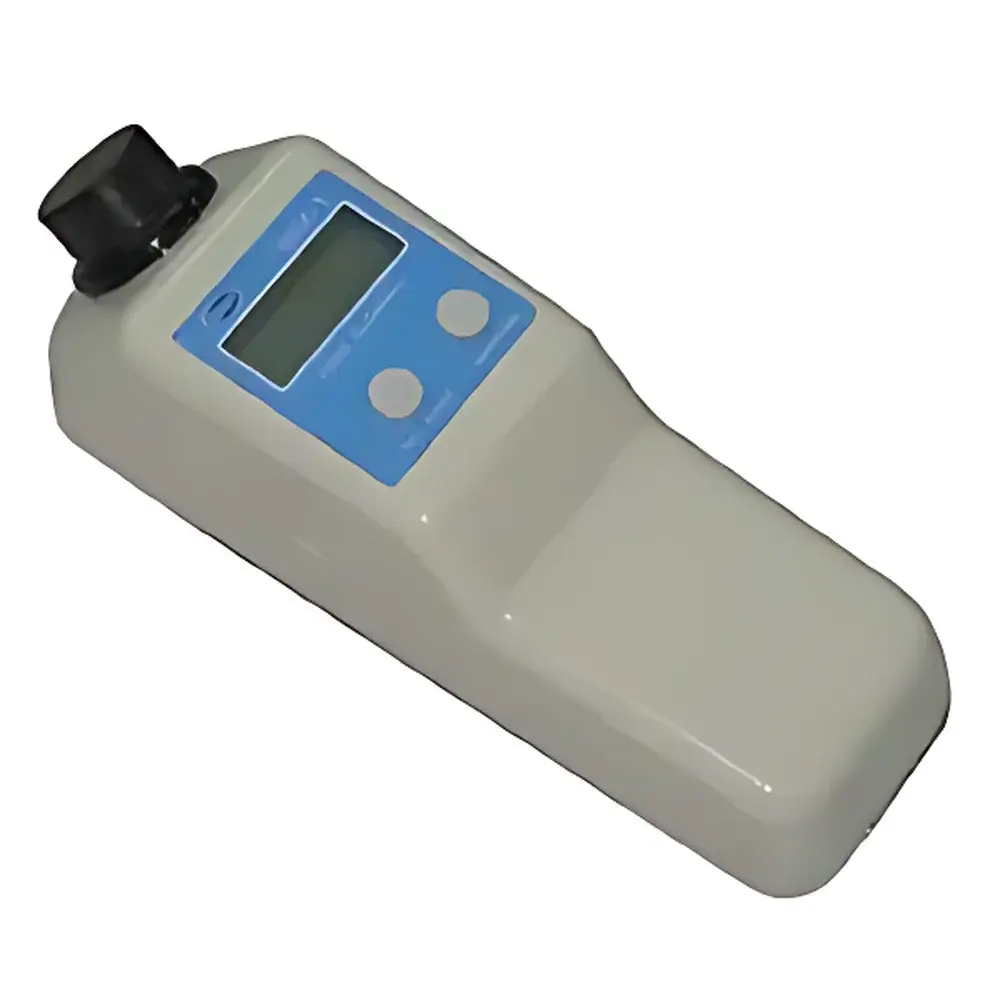
WGZ-20B / WGZ-1B / WGZ-200B Portable Turbidimeter
| Origin | Shanghai, China |
|---|---|
| Manufacturer Type | Distributor |
| Origin Category | Domestic (China) |
| Models | WGZ-20B, WGZ-1B, WGZ-200B |
| Pricing | Upon Request |
| Measurement Principle | 90° Nephelometric Scattering |
| Minimum Readout | 0.01 NTU (WGZ-20B & WGZ-200B), 0.1 NTU (WGZ-1B) |
| Measuring Range | 0–20 NTU (WGZ-20B) |
| Basic Error | ±8% or ±2.5% FS |
| Repeatability | ≤1% |
| Zero Drift | ±1% FS |
| Power Supply | 5×1.5 V AA alkaline batteries (DC) or AC 220 V / 50 Hz → DC 7.5 V / 0.2 A adapter |
| Dimensions | 235 × 75 × 65 mm |
| Display | LCD with low-power backlight |
| Light Source | Long-life LED (90° scattering geometry, color-stable, no warm-up drift beyond 30 s) |
| Auto Power-Off | Yes |
| Data Output Interface | Standard analog/digital output port (RS-232 or TTL-level serial, configurable) |
Overview
The WGZ-20B, WGZ-1B, and WGZ-200B portable turbidimeters are compact, field-deployable nephelometric instruments engineered for rapid, reliable quantification of suspended particulate matter in clear liquids—primarily water and aqueous process streams. Based on the ISO 7027:2016 standard principle of 90° scattered light detection, these devices measure turbidity in Nephelometric Turbidity Units (NTU) by illuminating the sample with a stable, monochromatic LED source and detecting orthogonal scatter intensity via a calibrated photodetector. Unlike absorption-based methods, this geometry minimizes interference from sample coloration and dissolved chromophores, ensuring robustness across diverse matrices—including potable water, wastewater effluents, pharmaceutical rinse solutions, and beverage production lines. The instruments are designed for routine compliance monitoring under regulatory frameworks such as EPA Method 180.1, ISO 7027, and USP , supporting laboratories and field technicians requiring traceable, repeatable measurements without benchtop infrastructure.
Key Features
- True portable architecture: Handheld form factor (235 × 75 × 65 mm), lightweight construction (100 hours runtime) or optional AC/DC adapter (7.5 V / 0.2 A)
- Optimized optical design: High-stability LED light source with narrow spectral bandwidth (850 ± 30 nm), engineered to eliminate colorimetric bias and reduce warm-up dependency—functional within 30 seconds of power-on
- Multi-range flexibility: WGZ-200B supports automatic or manual range switching between 0–20 NTU (high-resolution mode) and 0–200 NTU (broad-range mode); WGZ-20B and WGZ-1B provide dedicated low- and high-range configurations respectively
- Intelligent power management: LCD display with low-voltage warning, programmable auto-shutdown (default: 10 min idle), and real-time battery status indicator
- Calibration-ready interface: Integrated data output port compliant with RS-232 physical layer specifications, enabling direct connection to PCs, data loggers, or LIMS systems for audit-trail-capable recordkeeping
Sample Compatibility & Compliance
These turbidimeters accept standard 25-mm round glass or disposable plastic cuvettes (10–15 mL volume), accommodating both filtered and raw samples with minimal pretreatment. They meet the optical performance criteria defined in ISO 7027:2016 for ratio-metric 90° scattering instrumentation and are routinely deployed in environments governed by GLP and GMP requirements—particularly in pharmaceutical water system validation (PW, WFI), municipal drinking water QA/QC per WHO Guidelines, and environmental monitoring per Chinese HJ 1077-2019 and EU Directive 98/83/EC. While not FDA 21 CFR Part 11–certified out-of-the-box, the RS-232 interface supports integration with validated software platforms capable of electronic signature, audit trail, and user access control when configured per organizational SOPs.
Software & Data Management
The built-in firmware enables real-time measurement display, zero calibration, and span verification using primary standards (e.g., Formazin or AMCO AEPA polymer suspensions). Raw output via the serial interface is ASCII-formatted (e.g., “T=12.45 NTUrn”) and compatible with generic terminal emulators or custom Python/Matlab scripts. For regulated environments, third-party middleware (e.g., LabArchives ELN or Thermo Fisher SampleManager LIMS) may be configured to ingest, timestamp, and archive readings with full metadata—including operator ID, calibration date, and instrument serial number—satisfying ALCOA+ data integrity principles.
Applications
- Drinking water treatment: In-line verification of coagulation/flocculation efficiency and final filter performance
- Pharmaceutical manufacturing: Monitoring of purified water (PW) and water-for-injection (WFI) distribution loops per USP
- Food & beverage quality control: Turbidity screening of clarified juices, beer, wine, and dairy processing streams
- Environmental field testing: Rapid assessment of river, lake, and wastewater discharge compliance with national discharge limits
- Hospital and clinical labs: Sterility assurance of dialysis fluid and endoscope reprocessing rinse water
FAQ
What turbidity standards are recommended for calibration?
Formazin standard solutions (e.g., 0.1, 10, 100 NTU) traceable to NIST SRM 2134 are preferred; AMCO AEPA polymer standards are acceptable alternatives per ISO 7027 Annex B.
Can the instrument measure colored samples accurately?
Yes—the 90° scattering geometry and 850-nm LED source minimize interference from yellow-to-brown chromophores common in natural waters and industrial effluents.
Is temperature compensation available?
No built-in temperature sensor or compensation algorithm is included; users should equilibrate samples to 25 °C prior to measurement per ISO 7027 protocol.
How often should zero calibration be performed?
Before each measurement session and after changing cuvettes or sample types; use deionized water filtered through a 0.1-µm membrane as zero reference.
Does the device support GLP-compliant data export?
The RS-232 interface provides raw values only; full GLP compliance requires external software with audit trail, electronic signatures, and secure storage—configured separately per site validation protocols.





