
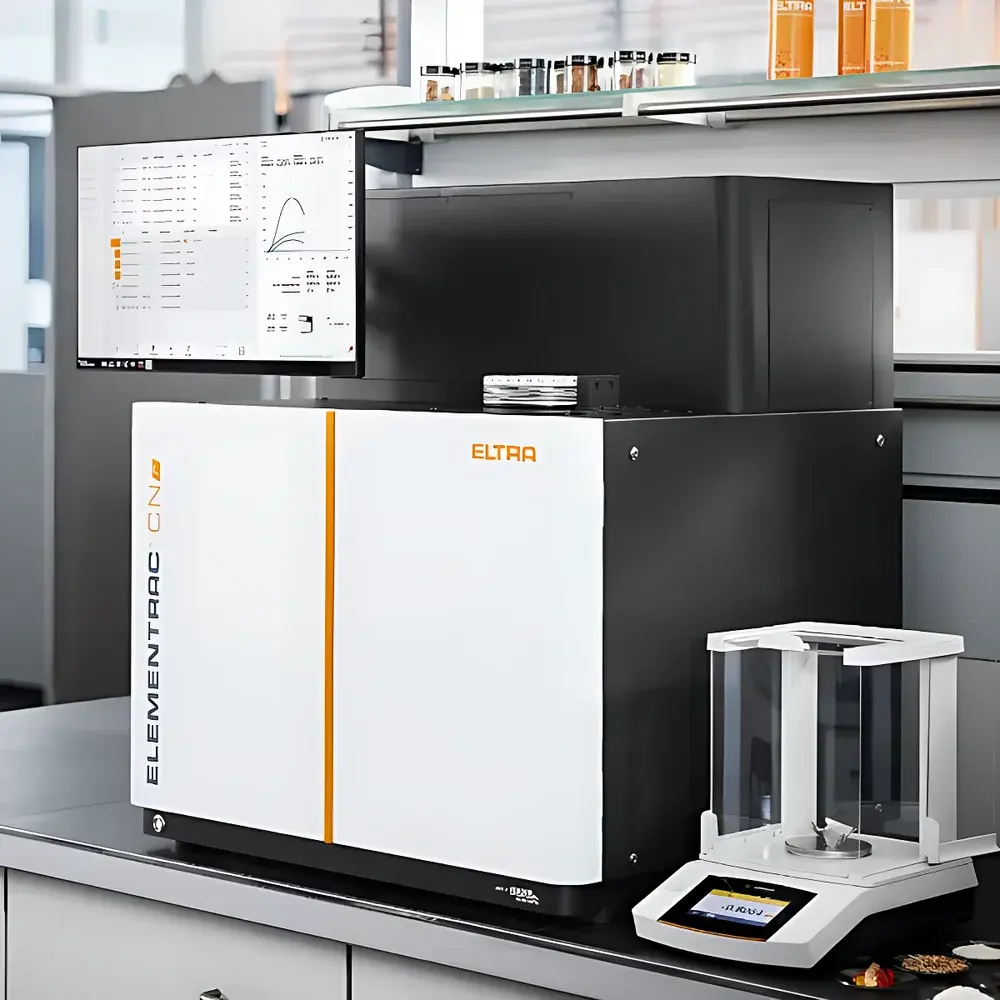
ELTRA ELEMENTRAC CN-r Dumas Combustion Carbon and Nitrogen Analyzer
| Brand | ELTRA |
|---|---|
| Origin | Germany |
| Model | ELEMENTRAC CN-r |
| Analysis Principle | Dumas Combustion Method |
| Sample Throughput | <3 min per sample |
| Detection | Total Carbon (C) and Total Nitrogen (N), Protein Calculation (N × conversion factor) |
| Automation | Integrated Autosampler with RFID/Barcode Sample Recognition |
| Control System | Built-in Industrial PC with Touchscreen Interface |
| Gas Supply | High-Purity Oxygen Flow |
| Catalyst | Chromium-Free Oxidation Catalyst |
| Compliance | Designed for GLP/GMP environments |
| Sample Forms | Solids, Powders, Liquids, Pastes |
| Maintenance | Full consumables replacement in <20 min |
Overview
The ELTRA ELEMENTRAC CN-r is a high-precision, fully automated Dumas combustion analyzer engineered for the simultaneous quantification of total carbon (C) and total nitrogen (N) in organic matrices. Operating on the internationally standardized Dumas combustion principle (ISO 16634-1, AOAC 992.15, EN ISO 16634-2), the instrument thermally oxidizes samples at temperatures up to 1,150 °C in a controlled oxygen-rich environment. This ensures complete conversion of organic C and N into CO₂ and N₂ (or NOₓ subsequently reduced to N₂), which are then separated and quantified via high-stability thermal conductivity detection (TCD). Unlike Kjeldahl digestion—requiring hazardous acids, extended digestion times, and manual distillation—the ELEMENTRAC CN-r eliminates corrosive reagents, reduces operator exposure risk, and delivers traceable, reproducible data without matrix-specific method adjustments. Its compact footprint (W × D × H: 700 × 650 × 550 mm) and integrated architecture make it suitable for regulated QC laboratories, food safety testing centers, agricultural research facilities, and contract analytical service providers requiring >100 samples/day throughput.
Key Features
- Sub-3-minute analysis cycle per sample—enabled by interleaved combustion and gas separation logic, where combustion of the next sample begins before detection of the prior sample concludes.
- Chromium-free catalytic oxidation system prevents chromium contamination, complies with RoHS and REACH directives, and ensures long-term catalyst stability across heterogeneous sample types.
- Intelligent oxygen flow regulation dynamically adjusts O₂ delivery based on sample mass and organic load—reducing gas consumption by up to 40% versus fixed-flow systems.
- RFID- and barcode-enabled autosampler (up to 120 positions) supports unattended overnight operation and priority override for urgent samples without disrupting queue integrity.
- Integrated industrial PC with 10.1″ capacitive touchscreen provides real-time monitoring of furnace temperature, oxygen pressure, detector baseline, and combustion efficiency metrics (e.g., CO₂/N₂ peak symmetry, retention time stability).
- Modular consumables design—including ceramic combustion tube, quartz liner, and alkali trap cartridges—allows full replacement in under 20 minutes with no tools or calibration recalibration required.
Sample Compatibility & Compliance
The ELEMENTRAC CN-r accommodates a broad spectrum of organic sample forms: cereals, feedstuffs, meat products, dairy powders, botanicals, soil extracts, pharmaceutical excipients, and liquid formulations (via sealed tin capsules or microcrucibles). It meets method validation requirements under ISO/IEC 17025:2017 for accredited testing laboratories. When operated with ELTRA’s optional compliance-ready software package, the system supports audit trails, electronic signatures, user access levels, and raw data archiving aligned with FDA 21 CFR Part 11 and EU Annex 11 expectations. Routine performance verification follows ASTM D5142 (for coal and coke) and AOAC Official Method 992.15 (for protein in food), with documented precision ≤0.5% RSD for nitrogen and ≤1.0% RSD for carbon across certified reference materials (CRMs) such as NIST SRM 1547, 1577c, and BCR-63.
Software & Data Management
Control and evaluation are executed via ELTRA’s proprietary WinELEMENTS software—installed locally on the embedded PC and accessible remotely via secure VNC or RDP protocols. The interface supports customizable method templates, automatic protein calculation using configurable conversion factors (e.g., 6.25 for general food, 5.70 for wheat, 6.38 for dairy), and batch reporting compliant with LIMS export formats (CSV, XML, PDF/A-1b). All raw chromatograms, integration parameters, calibration curves, and system logs are timestamped and digitally signed. Data integrity safeguards include write-once storage options, immutable audit trails covering user logins, parameter changes, and result approvals, and optional integration with enterprise LDAP/Active Directory authentication.
Applications
- Food & Feed: Rapid protein content certification in flour, soy meal, pet food, and infant formula—supporting labeling compliance (EU Regulation 1169/2011, FDA 21 CFR 101.9).
- Agriculture: Soil organic carbon (SOC) and total nitrogen assessment for sustainability reporting and carbon credit verification programs.
- Pharmaceuticals: Excipient purity screening (e.g., lactose, microcrystalline cellulose) and nitrogen balance studies in API synthesis.
- Environmental: Monitoring C/N ratios in compost, biosolids, and wastewater sludge to assess biodegradability and nutrient availability.
- Research: High-throughput screening of plant genotypes for nitrogen use efficiency (NUE) and carbon sequestration traits.
FAQ
What regulatory standards does the ELEMENTRAC CN-r support?
It is validated for ISO 16634-1 (food protein), AOAC 992.15, ASTM D5142, and EN ISO 16634-2. Optional software modules enable 21 CFR Part 11 and Annex 11 compliance.
Can the instrument analyze liquid samples directly?
Yes—liquids are loaded into sealed tin capsules with inert absorbent (e.g., Celite), enabling precise volumetric dosing and complete combustion without splashing or carryover.
Is method transfer from Kjeldahl possible?
Method correlation studies show strong linear agreement (r² > 0.998) between Dumas and Kjeldahl results across diverse matrices; ELTRA provides application notes and CRM-based validation protocols.
How often must the catalyst be replaced?
Under typical usage (8 h/day, 5 days/week), the chromium-free catalyst lasts ≥10,000 analyses—monitored automatically via combustion efficiency diagnostics.
Does the system require external cooling water or compressed air?
No—it operates with ambient air cooling and only requires a single 99.995% pure oxygen supply (≤1.5 L/min); no auxiliary utilities are needed.




