
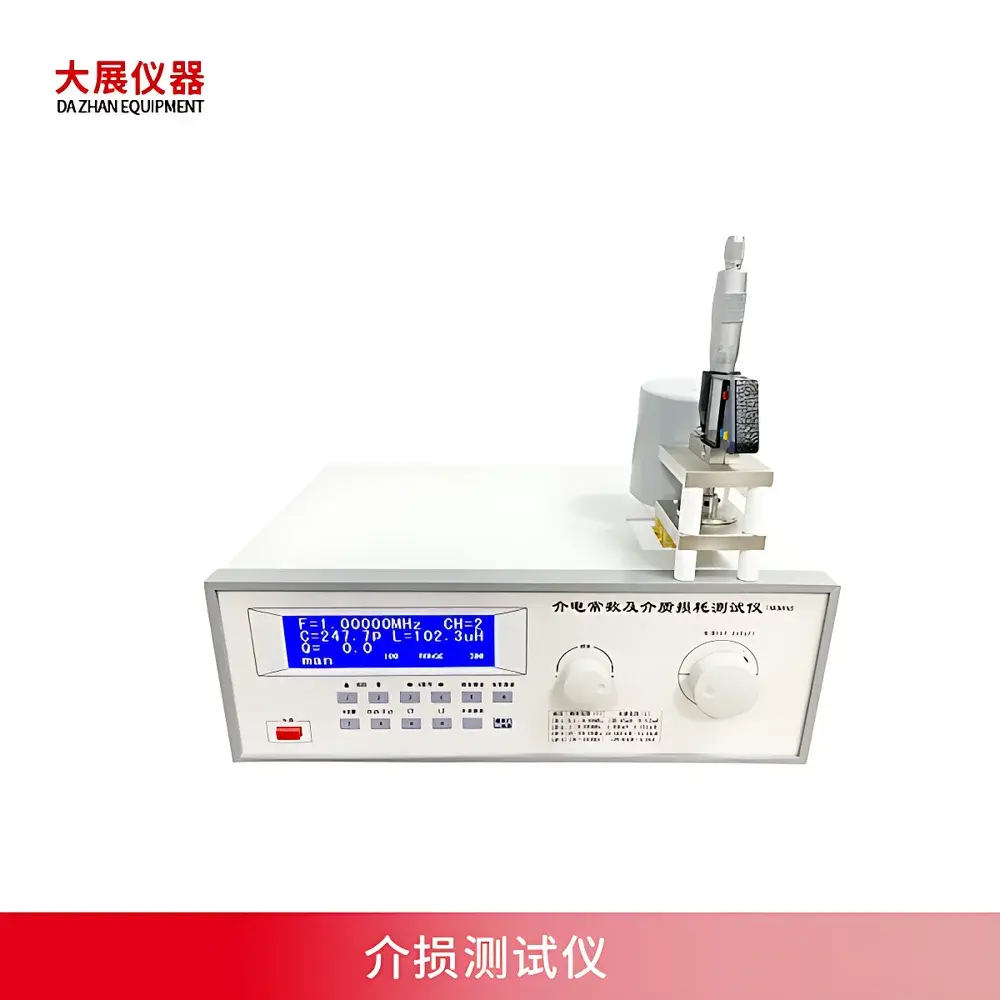
DZ5001 DAZHAN Dielectric Loss and Permittivity Analyzer
| Brand | DAZHAN (Nanjing Dazhan Instrument Co., Ltd.) |
|---|---|
| Model | DZ5001 |
| Measurement Principle | High-Frequency Resonance Method (Q-factor based) |
| Frequency Range | 10 kHz – 100 MHz (DDS Digital Synthesis, 7000:1 coverage ratio) |
| Frequency Accuracy | ±3×10⁻⁵ (6-digit resolution) |
| Q Factor Range | 1–1000 (auto/manual range, 4-digit resolution, 0.1 Q step) |
| Q Measurement Error | <5% |
| Inductance Range | 1 nH – 140 mH (0.1 nH resolution, <3% error) |
| Main Tuning Capacitance | 17–240 pF (silver-plated monolithic capacitor) |
| Capacitance Direct Measurement Range | 1 pF – 25 nF (±1 pF or <1% error, 0.1 pF resolution) |
| Automatic Capacitance Search | Stepper-motor-driven |
| Residual & Lead Inductance Compensation | Yes (automated subtraction) |
| Display | LCD showing F, L, C, Q, Lₜ, Cₜ, εᵣ, Tₙ, etc. |
| AD Sampling | 12-bit high-precision ADC |
| Q Pre-set Pass/Fail Threshold | 5–1000 with audible/visual alert |
| Operating Mode | Auto-resonance sweep or manual tuning |
Overview
The DZ5001 DAZHAN Dielectric Loss and Permittivity Analyzer is a precision benchtop instrument engineered for the quantitative determination of dielectric loss tangent (tan δ) and relative permittivity (εr) of solid and ceramic insulating materials. It operates on the principle of high-frequency series resonance, leveraging a digitally synthesized signal source (10 kHz–100 MHz) to excite a calibrated LC resonant circuit containing the test specimen as a variable capacitive element. By measuring the resonant frequency (f0), quality factor (Q), and associated inductance (L) and capacitance (C), the system calculates tan δ = 1/Q and εr using standardized relationships derived from ASTM D150 and IEC 60250. This method ensures high reproducibility for low-loss dielectrics—particularly critical for R&D and QC workflows involving metal oxides, porcelain, glass, polymer laminates, and high-purity ceramics used in high-voltage insulation, RF substrates, and biomedical device packaging.
Key Features
- Automated residual and lead inductance compensation—eliminates systematic errors inherent in fixture parasitics without manual nulling procedures.
- Dedicated stepper-motor-driven tuning capacitor (17–240 pF) with silver-plated monolithic construction, enabling stable, repeatable resonance tracking across wide frequency spans.
- Direct digital readout of absolute capacitance (1 pF–25 nF) and inductance (1 nH–140 mH) with 0.1 pF / 0.1 nH resolution—no external LCR meter required for calibration verification.
- 12-bit high-fidelity ADC sampling ensures Q-value stability during long-duration measurements, especially essential for characterizing ultra-low-loss materials (tan δ < 10−4).
- Integrated resonance search algorithm with real-time spectral sweep; auto-identifies f0 and Q within user-defined bands, reducing operator dependency and measurement variability.
- LCD interface displays synchronized parameters: resonant frequency (F), measured inductance (L), tuning capacitance (Ct), loaded Q, calculated εr, and temperature-normalized values (Tn) where applicable.
Sample Compatibility & Compliance
The DZ5001 supports standardized electrode configurations per ASTM D150 Annex A3 (parallel-plate) and IEC 60250 Clause 6 (guard-ring). Compatible specimens include rigid discs (diameter ≥25 mm, thickness 1–10 mm), sintered ceramics, anodized aluminum oxide layers, and sheet-form polymers (e.g., polyimide, PTFE, PET). Electrode contact is maintained via spring-loaded brass probes or optional guarded electrodes to minimize fringing field effects. The analyzer’s traceable frequency synthesis and Q calibration align with ISO/IEC 17025 requirements for accredited dielectric testing laboratories. While not FDA 21 CFR Part 11–compliant out-of-the-box, audit-ready data export (CSV/ASCII) supports GLP/GMP documentation when paired with controlled lab information management systems (LIMS).
Software & Data Management
The DZ5001 operates as a standalone instrument with embedded firmware—no PC dependency for basic operation. All measurements are timestamped and stored internally (up to 500 records). Data export is supported via USB port in plain-text CSV format, including raw F, L, C, Q, and computed εr/tan δ columns. Exported files conform to ASTM E1447 conventions for dielectric database interoperability. Optional LabVIEW-compatible SCPI command set (via RS-232) enables integration into automated test sequences for material qualification batches or accelerated aging studies. Firmware updates are delivered via encrypted USB key to maintain configuration integrity in regulated environments.
Applications
- Power Systems Engineering: Quality control of transformer bushing materials, SF6 spacer discs, and composite insulators—verifying tan δ stability under thermal cycling per IEEE Std 930.
- Advanced Ceramics R&D: Correlating sintering temperature and grain boundary chemistry with εr dispersion in BaTiO3-based multilayer capacitors (MLCCs).
- Medical Device Packaging: Validating barrier film permittivity consistency for RF-sterilizable pouches (ISO 11607-1 compliance support).
- Automotive Electronics: Screening dielectric uniformity in PCB substrate laminates (e.g., Rogers RO4000® series) prior to high-frequency radar module assembly.
- Environmental Monitoring Sensors: Characterizing humidity-dependent εr drift in polymer-based capacitive moisture sensors for industrial HVAC applications.
FAQ
What standard test methods does the DZ5001 implement?
It conforms to the core measurement methodology of ASTM D150 (Standard Test Methods for Dielectric and Resistive Properties of Solid Electrical Insulating Materials) and IEC 60250 (Measurement of the Relative Permittivity and Dissipation Factor of Electrical Insulating Materials at Power, Audio and Radio Frequencies).
Can the DZ5001 measure liquids or powders?
No—it is optimized for solid, self-supporting dielectric specimens with planar geometry. Liquid or powder characterization requires complementary techniques such as coaxial probe or cavity perturbation methods.
Is calibration traceable to national standards?
Yes; factory calibration uses NIST-traceable RF impedance standards (capacitance and Q) at 1 MHz, 10 MHz, and 50 MHz. A full calibration certificate (ISO/IEC 17025–accredited lab optional) is provided with each unit.
How is temperature dependence addressed?
The instrument supports external PT100 input (optional accessory) for concurrent temperature logging. εr and tan δ values can be normalized to reference temperature (e.g., 23 °C) using built-in Arrhenius-type correction algorithms.
Does the system support pass/fail screening for production QA?
Yes—Q threshold limits (5–1000) trigger simultaneous visual LED and audible alerts, enabling rapid go/no-go decisions on manufacturing floors without post-processing.



