
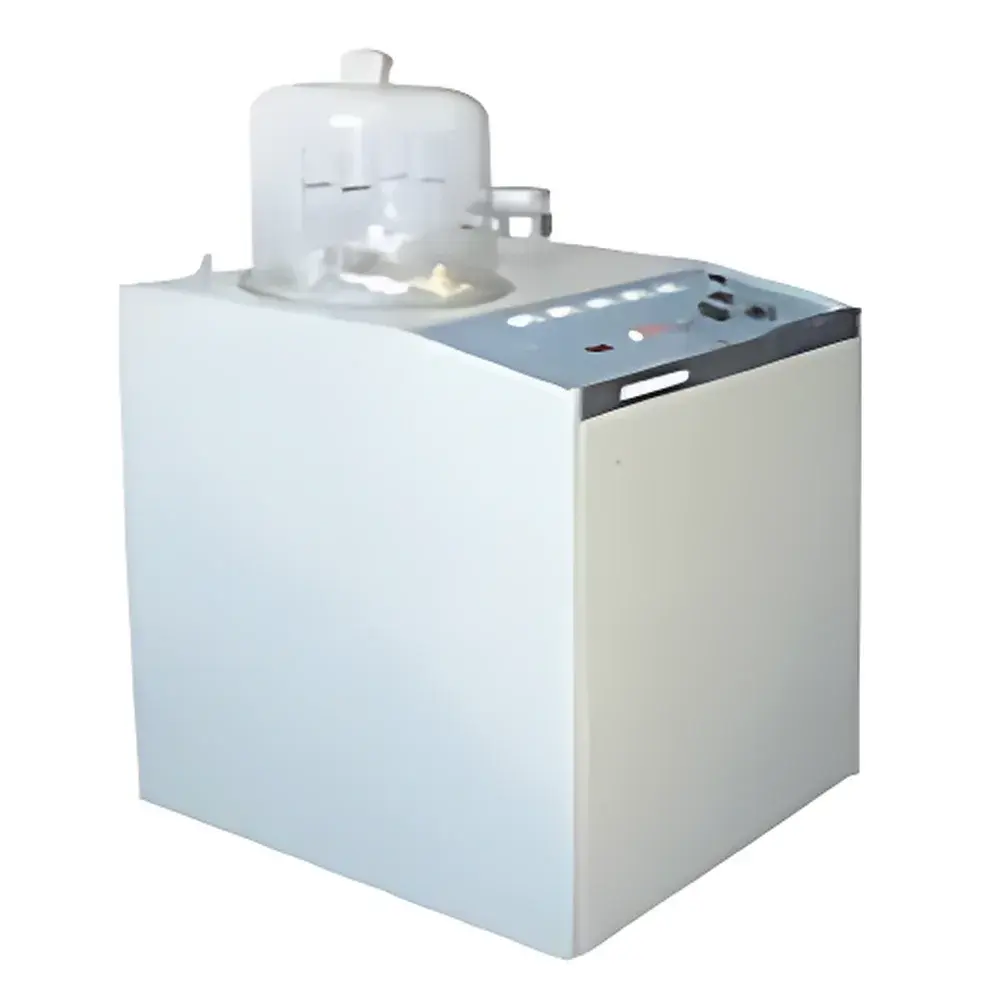
MSBC-2 Multi-Function Plasma Surface Treater by EMCN
| Brand | EMCN |
|---|---|
| Origin | Henan, China |
| Manufacturer Type | Authorized Distributor |
| Equipment Type | Domestic RF Plasma Surface Treater |
| Model | MSBC-2 |
| RF Frequency | 2.54 GHz |
| Total System Power | < 2000 W (including vacuum pump) |
| Overall Dimensions | 100 cm (H × W × D, approximate) |
| Sample Chamber Volume | Φ88 mm × 140 mm (ID × height) |
| Chamber Material | Borosilicate Glass |
| Process Gas | Argon (high-purity) |
| Control Mode | Fully Automated |
| Vacuum System | Dual-stage — turbo-molecular pump + rotary vane mechanical pump |
| Base Pressure | ≤ 2 × 10⁻³ Pa |
| Vacuum Gauges | Thermocouple Gauge + Cold Cathode Ionization Gauge |
| Sample Stage Motion | Planar rotation, tilt rotation, and tilt precession |
| Maximum Sample Diameter | Φ40 mm |
| Gold Target Diameter | Φ38 mm |
| Bell Jar Dimensions | Φ250 mm × 340 mm (ID × height) |
| Internal Coating Zone (for evaporation) | Φ88 mm × 57 mm (ID × height) |
Overview
The MSBC-2 Multi-Function Plasma Surface Treater by EMCN is a compact, high-vacuum laboratory system engineered for precision surface modification of non-conductive or beam-sensitive specimens prior to electron microscopy analysis. Operating on the principle of radio-frequency (RF) capacitively coupled plasma (CCP) generation at 2.54 GHz, the instrument enables controlled ion bombardment, sputter coating, and thermal evaporation under inert argon atmosphere. Its dual-function architecture integrates both low-energy plasma treatment (e.g., cleaning, activation, hydrophilization) and high-fidelity conductive coating (e.g., carbon or metal evaporation), making it especially suitable for SEM, EPMA, and micro-XRF sample preparation where surface integrity, elemental fidelity, and charge dissipation are critical. The all-glass processing chamber—constructed from borosilicate glass—ensures optical transparency for real-time process monitoring and eliminates metallic outgassing, supporting ultra-clean vacuum conditions down to ≤ 2 × 10⁻³ Pa.
Key Features
- RF plasma source operating at 2.54 GHz with stable power delivery (< 2000 W total system load), enabling uniform plasma density and minimized substrate heating
- High-vacuum architecture combining a turbo-molecular pump and rotary vane mechanical pump, achieving base pressures ≤ 2 × 10⁻³ Pa—essential for minimizing hydrocarbon contamination during carbon evaporation
- Multi-axis sample stage with three synchronized motions: planar rotation (360° continuous), tilt rotation (±30°), and tilt precession—ensuring conformal, shadow-free coating on irregular or topographically complex specimens
- Modular chamber design with interchangeable components: Φ88 mm × 140 mm glass treatment zone for plasma exposure; dedicated Φ88 mm × 57 mm evaporation zone optimized for uniform carbon/metal film deposition
- Integrated dual vacuum measurement: thermocouple gauge for rough vacuum range (10⁰–10⁻¹ Pa) and cold cathode ionization gauge for high-vacuum verification (10⁻¹–10⁻³ Pa), meeting ISO 27893-2 calibration traceability requirements
- Automated process control via embedded PLC-based interface, supporting programmable sequences for plasma duration, gas flow stabilization, coating thickness estimation (via time-based deposition modeling), and safety interlocks
Sample Compatibility & Compliance
The MSBC-2 accommodates specimens up to Φ40 mm in diameter and 15 mm in height, including brittle ceramics, polymers, biological tissues (critical-point dried or freeze-dried), geological thin sections, and nanomaterials on TEM grids. Its argon-only operation avoids reactive species that could oxidize or etch sensitive phases—aligning with ASTM E1508-22 guidelines for non-destructive surface conditioning prior to compositional analysis. All vacuum components comply with ISO 10121-1 for cleanroom-compatible material outgassing rates. The system supports GLP-compliant documentation through optional RS-232/USB data logging (time-stamped pressure, power, and process step records), facilitating audit readiness per FDA 21 CFR Part 11 when integrated into regulated QC laboratories.
Software & Data Management
While the base MSBC-2 operates via front-panel automation, optional firmware upgrade enables PC connectivity via USB or RS-232 for remote parameter configuration and event logging. Process logs include timestamped entries for vacuum ramp rate, plasma ignition confirmation, argon flow stabilization time, and stage motion synchronization status. Raw data export (CSV format) supports post-run correlation with SEM image quality metrics (e.g., charging artifacts, edge resolution). No proprietary cloud platform is required; local storage on Windows/Linux hosts satisfies internal SOPs for data sovereignty and long-term archiving per ISO/IEC 17025:2017 Clause 7.5.2.
Applications
- Charge mitigation for non-conductive SEM samples via ultra-thin (2–5 nm) carbon or Au/Pd sputter coatings
- Surface activation of polymer substrates (e.g., PET, PDMS) prior to metallization or adhesive bonding
- In-situ plasma cleaning of TEM grids to remove hydrocarbon monolayers without altering crystallinity
- Controlled surface functionalization of bio-scaffolds for XPS or ToF-SIMS depth profiling
- Preparation of quantitative EPMA standards via uniform carbon replication of polished reference materials
- Low-damage removal of organic residues from semiconductor cross-sections prior to FIB-SEM tomography
FAQ
What vacuum level is required before initiating plasma treatment?
A stable base pressure ≤ 5 × 10⁻³ Pa must be achieved and maintained for ≥ 60 seconds prior to argon introduction and RF ignition, as verified by the cold cathode gauge.
Can the system operate with gases other than argon?
The standard configuration is validated exclusively for high-purity argon (≥ 99.999%). Nitrogen or oxygen use is not supported due to absence of corrosion-resistant electrode coatings and lack of reactive gas safety interlocks.
Is the glass chamber resistant to thermal shock during evaporation cycles?
Yes—the borosilicate chamber is rated for ΔT ≤ 120°C; maximum substrate temperature during carbon evaporation remains below 60°C due to pulsed current control and stage rotation.
How is coating thickness estimated without in-situ QCM monitoring?
Thickness is calculated empirically using calibrated time–thickness curves derived from quartz crystal microbalance validation runs under identical power, distance, and geometry conditions.
Does the system meet electromagnetic compatibility (EMC) standards for lab integration?
It complies with CISPR 11 Group 1, Class B emission limits and IEC 61326-1:2023 for laboratory electrical equipment, verified via third-party test report EMCN-PLS-2024-089.



