
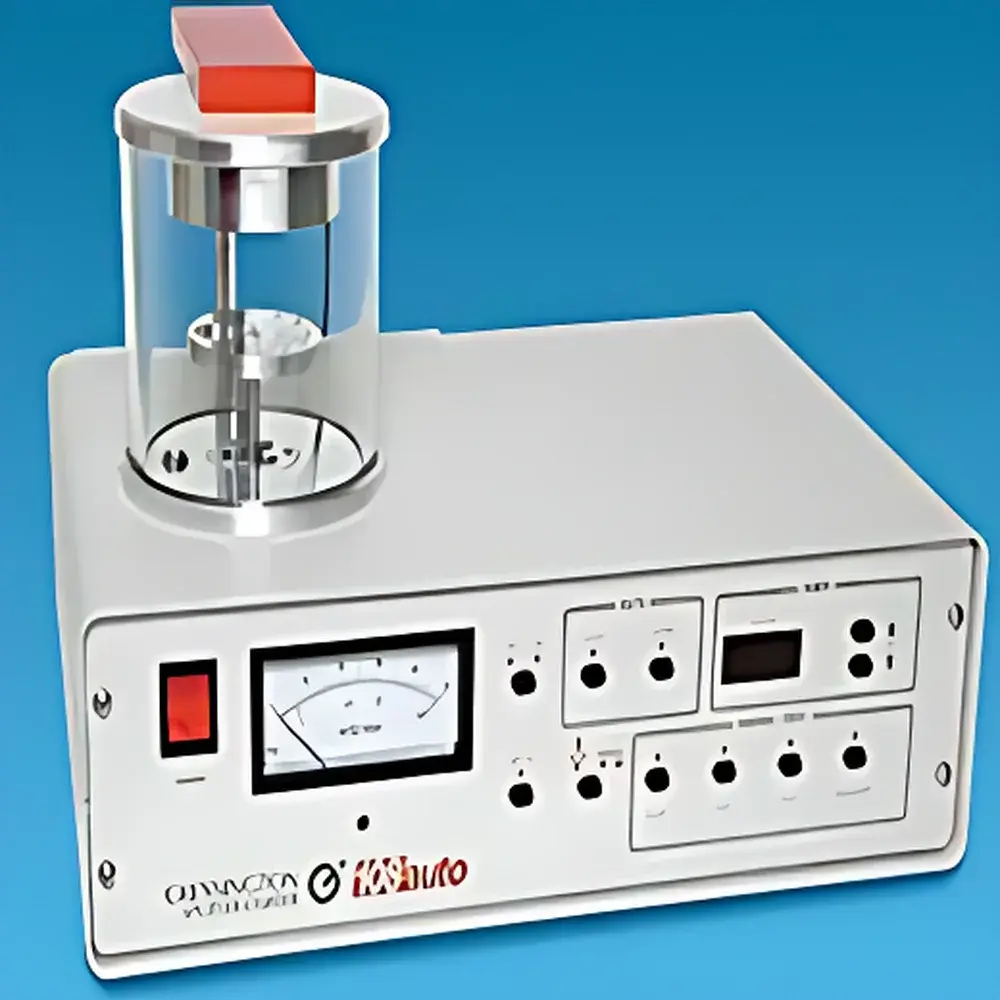
EMCN 108A Automatic High-Vacuum DC Magnetron Sputter Coater
| Brand | EMCN |
|---|---|
| Origin | Imported |
| Model | 108A |
| Target Material | Pure Gold (Au) |
| Target Diameter | 58 mm |
| Chamber Dimensions | 120 mm OD × 120 mm H (4.75″ × 4.75″) |
| Sample Stage | 12-position SEM pin-type holder, height adjustable from 0–60 mm |
| Sputtering Gas | Argon (Ar) or compressed dry air |
| Control Mode | Fully automatic with programmable time/pressure/current logic |
| Vacuum Range | Atmospheric pressure down to ≤1 × 10⁻³ mbar |
| Operating Voltage | 200–240 VAC, 50 Hz |
| Power Consumption | 300 W |
| Cooling | Passive (low-heat “cold” sputtering design) |
| Optional Thickness Monitoring | MTM-20 quartz crystal microbalance (QCM) interface supported |
Overview
The EMCN 108A Automatic High-Vacuum DC Magnetron Sputter Coater is a precision-engineered instrument designed for reproducible, low-damage metallization of non-conductive specimens prior to high-resolution surface characterization. It employs DC magnetron sputtering—a physical vapor deposition (PVD) technique in which energetic argon ions bombard a conductive target (e.g., Au, Au:Pd, Pt), ejecting atoms that condense uniformly onto sample surfaces under controlled vacuum conditions. Unlike thermal evaporation, this process operates at near-ambient substrate temperatures due to its “cold” sputtering architecture—critical for preserving delicate biological, polymeric, or beam-sensitive materials during SEM, EDS, WDS, or XPS sample preparation. The system achieves stable base pressures below 1 × 10⁻³ mbar and integrates real-time regulation of discharge current, gas flow, and chamber pressure to maintain consistent film nucleation density and grain morphology across repeated runs.
Key Features
- Fully automated operation with dual-mode control: pre-programmed sequence execution (including auto-pump-down, gas introduction, sputtering, venting) or manual step-by-step intervention.
- DC magnetron source with optimized magnetic confinement ensures high plasma density at low operating voltages (≤1.2 kV), minimizing substrate heating and arcing risks.
- Integrated electronic mass flow controller and fine-adjustment needle valve enable precise, repeatable argon dosing—critical for achieving uniform film thickness and low resistivity on insulating substrates.
- Modular target mounting mechanism allows rapid, tool-free replacement of 58 mm diameter targets (standard Au; optional Au:Pd, Pt, Pt:Pd) without breaking vacuum or recalibrating alignment.
- 12-position SEM pin-stage with 0–60 mm vertical adjustability accommodates diverse specimen geometries while maintaining optimal target-to-substrate distance (typically 40–55 mm) for shadow-free coverage.
- Robust stainless-steel chamber (120 mm OD × 120 mm H) features electropolished interior, Viton O-ring seals, and ISO-KF 25 vacuum porting—compatible with standard two-stage rotary vane pumps and optional turbomolecular backing.
Sample Compatibility & Compliance
The 108A supports a broad spectrum of electron microscopy specimens—including biological tissues, ceramics, polymers, geological thin sections, and nanomaterials—without requiring conductive adhesives or carbon-stripping steps. Its low-energy sputtering protocol complies with ASTM E1508-22 (Standard Guide for Quantitative Analysis by Energy Dispersive Spectroscopy) and ISO 22309:2021 (Scanning electron microscopes — Specifications and guidelines for performance testing), ensuring coating integrity does not interfere with subsequent compositional quantification. All operational parameters (time, current, pressure, gas type) are logged internally and exportable via USB, supporting GLP/GMP documentation requirements. While not inherently 21 CFR Part 11 compliant, audit-trail-ready data files can be integrated into validated LIMS environments.
Software & Data Management
The coater operates via an embedded microcontroller with LED-based digital interface—no external PC required. Time, current, and pressure setpoints are entered directly; run history (date/time stamp, duration, final pressure, average current) is stored for ≥100 cycles. When paired with the optional MTM-20 quartz crystal microbalance (QCM), real-time thickness feedback (0.1 nm resolution) enables endpoint control and cross-run normalization. Exported CSV logs include timestamped process variables, facilitating statistical process control (SPC) analysis per ISO 9001:2015 Annex A.2 guidelines for measurement system analysis.
Applications
- Routine SEM sample preparation for high-magnification imaging (>100,000×) of insulators with minimal edge charging and topographic distortion.
- EDS/WDS calibration standards preparation where consistent, stoichiometrically pure Au films serve as reference layers for detector efficiency correction.
- Nanoparticle dispersion studies requiring conformal, sub-5 nm gold coatings to enhance secondary electron yield without masking core morphology.
- Failure analysis of microelectronic packages where low-thermal-load sputtering prevents delamination or interfacial diffusion in solder joint cross-sections.
- Archaeometric and forensic sample stabilization—e.g., fragile textile fibers or degraded ink layers—prior to low-kV SEM mapping.
FAQ
What vacuum pump is recommended for optimal performance?
A two-stage oil-sealed rotary vane pump capable of ≤5 × 10⁻⁴ mbar ultimate pressure is standard; for ultra-low contamination workflows (e.g., XPS prep), a turbomolecular pump with DN25 KF flange is advised.
Can the 108A deposit alloys or multi-layer films?
No—it is a single-target DC sputter system. Alloy deposition requires RF or pulsed-DC co-sputtering from multiple sources, beyond its hardware architecture.
Is the MTM-20 thickness monitor included by default?
No—the MTM-20 is an optional add-on with dedicated QCM sensor head, cable, and mounting bracket; it connects via analog voltage output to the coater’s auxiliary port.
How often should the target be replaced?
Typical Au target lifetime is 80–120 minutes of cumulative sputtering time at 20 mA; visual inspection for crater depth >0.3 mm indicates replacement threshold.
Does the system support inert gas purging for oxygen-sensitive samples?
Yes—argon purge capability is built-in; users may configure pre-sputter argon flush cycles to displace residual moisture/oxygen prior to deposition.



