


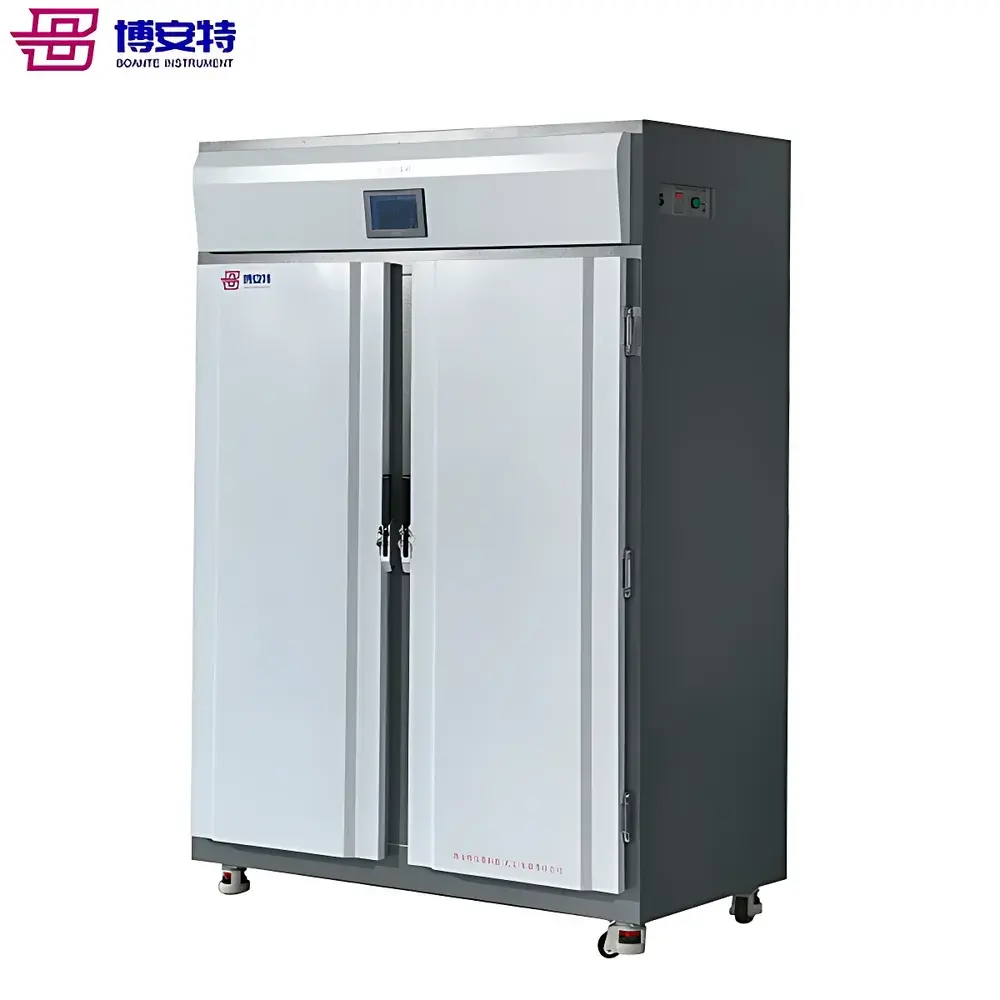
Boante BAT600/800/1250/1700-TC Plant Tissue Culture Incubator
| Brand | Boante |
|---|---|
| Origin | Hubei, China |
| Model | BAT600-TC / BAT800-TC / BAT1250-TC / BAT1700-TC |
| Capacity | 600 L / 800 L / 1250 L / 1700 L |
| Temperature Range | 5–45 °C (±0.2 °C fluctuation, ±0.5 °C uniformity) |
| Illumination | 0–300 μmol/m²/s (top-mounted, monochromatic LED, per-layer independent control) |
| Total Cultivation Area | 1.54 m² / 2.34 m² / 3.3 m² / 4.5 m² |
| External Dimensions | 850×805×1900 mm (BAT600-TC) to 1855×868×2030 mm (BAT1700-TC) |
| Control System | BAT200PG 7-inch color touchscreen controller with 24-segment programmable logic, APID temperature regulation, and 5-year onboard data logging |
Overview
The Boante BAT600/800/1250/1700-TC Plant Tissue Culture Incubator is an engineered environmental control system designed specifically for sterile in vitro propagation, meristem culture, callus induction, and photomorphogenic studies in plant biotechnology laboratories. It operates on a precisely regulated combination of temperature, light intensity, air distribution, and temporal programming—critical parameters governing cell division, organogenesis, and photoperiodic responses in explants. Unlike general-purpose incubators, this series integrates vertically directed low-velocity airflow, layer-specific illumination control, and adaptive thermal management to mitigate condensation-induced contamination—a leading cause of microbial breach in long-term tissue culture workflows. Its architecture complies with foundational biosafety and reproducibility requirements for GLP-aligned plant science protocols, supporting consistent physiological outcomes across replicates and experimental timelines.
Key Features
- Vertical laminar airflow system with diffused air dispersion: Delivers <15 cm/s uniform vertical flow across each shelf, minimizing surface condensation on Petri dishes and reducing risk of fungal or bacterial colonization.
- Per-shelf independent climate control: Four-tier configuration enables simultaneous operation at distinct light intensities (0–300 μmol/m²/s) and temperature setpoints within the same chamber—essential for multi-stage differentiation experiments.
- BAT200PG intelligent controller: 7-inch capacitive touchscreen interface with real-time clock synchronization, 24-segment programmable cycles (including dual-setpoint day/night profiles), and APID (Adaptive Proportional-Integral-Derivative) temperature regulation to suppress overshoot and stabilize thermal gradients to ±0.5 °C across horizontal planes.
- Thermal reliability engineering: Hot-gas bypass refrigeration circuit ensures continuous cooling without compressor cycling; electromagnetic defrost eliminates thermal disruption during maintenance intervals.
- Security and audit readiness: Four-tier password hierarchy (Factory Admin, Lab Admin, Operator, Engineer) with role-based access control; onboard memory retains ≥5 years of timestamped temperature, illumination, and alarm logs compliant with internal QA documentation standards.
Sample Compatibility & Compliance
The incubator accommodates standard tissue culture formats including Magenta boxes, glass jars (e.g., Bellco, Sigma-Aldrich), and polycarbonate culture vessels up to 160–200 mm height depending on model. Internal dimensions are optimized for ISO-standard shelving depth (≥585 mm) and clearance for manual handling under laminar flow hoods. While not certified to IEC 61000-6-3 or UL 61010-1 as a standalone medical device, its electrical design meets CE-marked EMC and safety thresholds for laboratory equipment used in non-clinical research environments. Temperature uniformity (±0.5 °C) and illumination stability (±3% over 24 h) align with ASTM E2927-13 guidelines for environmental chamber validation in botanical assay development.
Software & Data Management
The BAT200PG controller supports local data export via USB flash drive in CSV format, enabling integration with LIMS or Excel-based trend analysis. All logged parameters—including actual vs. setpoint temperature, irradiance output per shelf, door-open events, and fault codes—are time-stamped with UTC-synchronized clock accuracy. The system records minimum/maximum values per cycle segment and maintains persistent memory during power interruption (with automatic recovery upon restoration). Though no native Ethernet or cloud API is embedded, optional RS485 Modbus RTU interface allows third-party SCADA integration for centralized facility monitoring—subject to site-specific IT security review.
Applications
- Micropropagation of elite cultivars (e.g., orchids, potatoes, strawberries) under defined photoperiodic regimes
- Embryogenic callus maintenance and somatic embryogenesis induction under controlled spectral and thermal stress
- Photomorphogenesis assays involving phytochrome- or cryptochrome-mediated signaling pathways
- Long-term storage of axenic germplasm collections requiring stable low-temperature (5–10 °C) and low-light conditions
- Pre-acclimatization conditioning of in vitro-derived plantlets prior to greenhouse transfer
FAQ
What is the maximum allowable load per shelf without compromising airflow uniformity?
Each shelf is rated for ≤15 kg distributed load; exceeding this may obstruct diffuser vents and degrade vertical velocity profile consistency.
Can the incubator operate continuously at 5 °C with full illumination enabled?
Yes—thermal load from LEDs is factored into the refrigeration capacity; all models sustain 5 °C ambient with 300 μmol/m²/s irradiance at 100 mm distance.
Is calibration traceability available for temperature and light sensors?
Factory calibration certificates (NIST-traceable reference standards) are provided with each unit; field recalibration tools and procedures are included in the technical manual.
Does the system support CO₂ enrichment as a factory-installed option?
CO₂ control is available as a configurable add-on module (0–5% range, ±0.1% accuracy), integrated with the BAT200PG controller and validated for pH-sensitive media applications.
How is firmware updated, and what versioning protocol does Boante follow?
Firmware updates are delivered via encrypted USB image file; each release includes changelog, validation summary, and backward-compatible configuration migration paths.




