
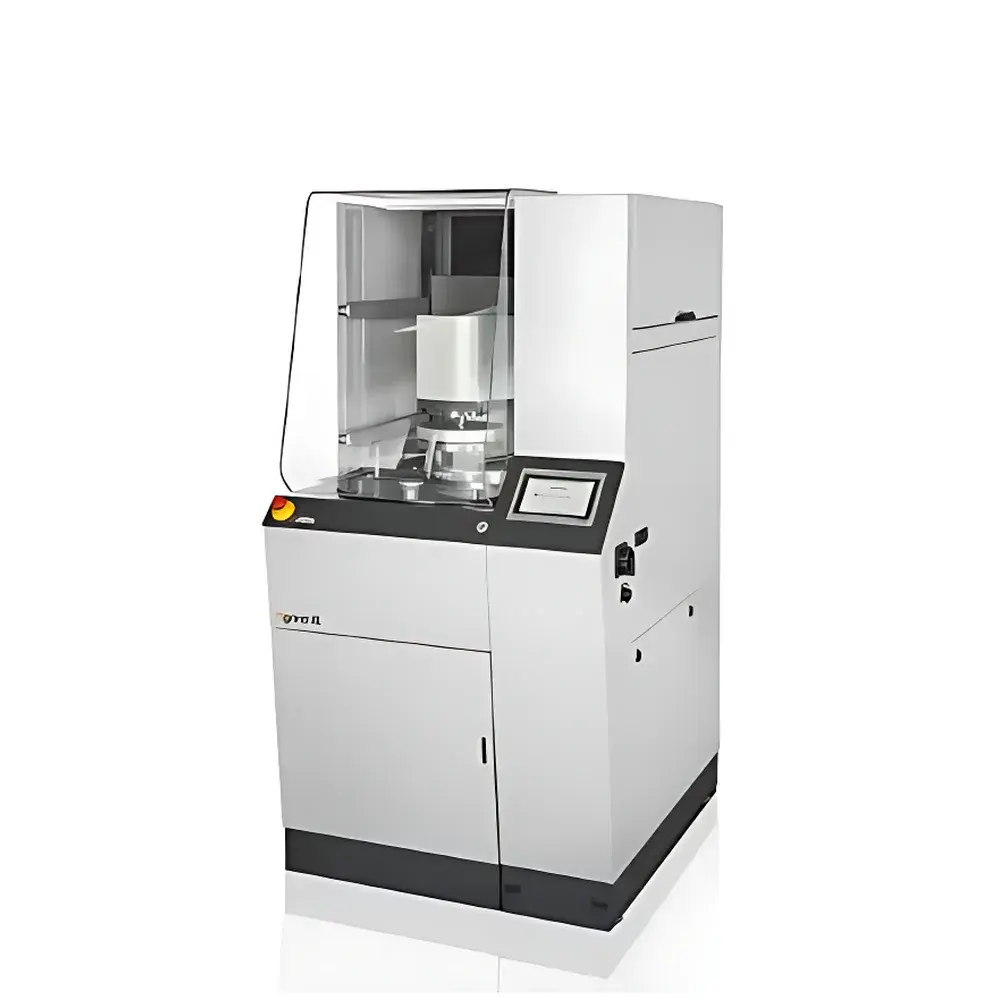
QATM QGRIND XL Automatic Metallographic Specimen Pre-Grinding Machine
| Brand | QATM |
|---|---|
| Origin | Germany |
| Model | QGRIND XL |
| Speed Range | 1000–2000 rpm (grinding wheel) / 30–160 rpm (specimen holder) |
| Grinding Wheel Diameter | up to 356 mm |
| Specimen Holder Diameter | 160–204 mm |
| Applied Force Range | 50–750 N (center-loaded, electronically controlled) |
| Material Removal Resolution | ±0.1 mm (display), 0.1–10 mm total removal range |
| Grinding Wheel Motor Power | 4 kW (S1 duty) |
| Specimen Holder Motor Power | 0.75 kW (S1 duty) |
| Electrical Supply | 400 V / 50 Hz (3Ph/N/PE), 480 V / 60 Hz (3Ph/N/PE), or 220 V / 60 Hz (3Ph/N/PE) |
| Total Power Requirement | 9 kVA |
| Dimensions (L×W×H) | 1055 × 860 × 1623 mm |
Overview
The QATM QGRIND XL is a high-precision, fully automated pre-grinding system engineered for reproducible metallographic specimen preparation in demanding laboratory and industrial quality control environments. Based on controlled abrasive removal via rotating silicon carbide or diamond-impregnated grinding wheels, the QGRIND XL employs a dual-axis motion architecture—simultaneous rotation of both the grinding wheel and specimen holder—to ensure uniform material removal and minimal edge rounding. Its core principle relies on real-time electronic force feedback and closed-loop pressure regulation, enabling consistent normal load application regardless of wheel wear or specimen geometry. This deterministic mechanical approach eliminates operator-dependent variability and aligns with ISO 16047, ASTM E3, and EN ISO 20481 standards for metallographic sample preparation. Designed for integration into end-to-end automated metallography workflows, the QGRIND XL serves as the critical first step before fine grinding and polishing—delivering planar, scratch-free surfaces suitable for subsequent microstructural analysis by optical microscopy, SEM, or EBSD.
Key Features
- Electronically regulated center-load pressure system (50–750 N) with real-time force monitoring and automatic compensation for wheel wear
- Dual independent motor drives: 4 kW grinding wheel motor (1000–2000 rpm) and 0.75 kW specimen holder motor (30–160 rpm, reversible direction)
- Precision material removal quantification: ±0.1 mm resolution over 0.1–10 mm total removal range, displayed and logged in real time
- Integrated diamond dressing unit with auto-scheduled activation based on cumulative grinding time or force deviation thresholds
- Optional integrated cleaning station with programmable rinse/dry cycles, reducing cross-contamination risk between specimens
- Robust cast-iron frame and reinforced gantry structure designed for long-term dimensional stability under continuous S1-duty operation
- Comprehensive safety architecture compliant with EN 60204-1 and EN ISO 13857, including light curtains, emergency stop circuitry, and interlocked access doors
Sample Compatibility & Compliance
The QGRIND XL accommodates round specimens from Ø160 mm to Ø204 mm, supporting standard metallographic mounts (phenolic, epoxy, acrylic) as well as large-section billets, weld coupons, and additively manufactured components. Its wide force range and adjustable rotational speeds enable optimization across diverse materials—including hardened steels, aluminum alloys, titanium, superalloys, and brittle ceramics—without chipping or thermal damage. All operational parameters are traceable and auditable, supporting GLP/GMP compliance requirements. The system meets CE marking directives, complies with IEC 61000-6-2/6-4 for electromagnetic compatibility, and supports 21 CFR Part 11–ready data export when paired with validated QATM LabSoft software (optional configuration). Calibration certificates per ISO/IEC 17025 are available upon request.
Software & Data Management
Controlled exclusively via the QATM LabSoft v5.x platform, the QGRIND XL provides a touch-enabled, intuitive interface with multilingual support (English, German, French, Chinese, Japanese). Each grinding cycle is fully parameterized—including speed profiles, dwell times, force ramping sequences, and dressing triggers—and stored with timestamped metadata (operator ID, specimen ID, batch number, environmental conditions). Raw force vs. time, removal depth vs. duration, and motor current logs are exportable in CSV or XML format for LIMS integration. Audit trails record all parameter changes, user logins, and system events, satisfying FDA and ISO 13485 documentation requirements. Remote diagnostics and firmware updates are supported over secure Ethernet (TCP/IP), with optional OPC UA connectivity for MES/SCADA integration.
Applications
- Routine pre-grinding of metallographic samples prior to fine grinding and polishing in QC labs serving aerospace, automotive, and energy sectors
- High-throughput preparation of weld qualification specimens per AWS D1.1, ISO 15614, or ASME Section IX
- Standardized surface conditioning of additively manufactured parts for porosity and grain structure evaluation
- Preparation of large-diameter cross-sections (e.g., turbine discs, rail sections) where manual grinding introduces unacceptable planarity error
- Research-grade specimen fabrication requiring sub-micron flatness repeatability across multi-sample batches
- Failure analysis laboratories requiring strict chain-of-custody tracking and process validation for litigation-support reports
FAQ
What types of grinding consumables are compatible with the QGRIND XL?
Standard resin-bonded silicon carbide papers (P80–P220), diamond-impregnated vitrified wheels (125–356 mm), and electroplated diamond discs are supported. QATM-certified consumables include traceable lot numbers and performance validation reports.
Can the QGRIND XL be integrated into an automated sample prep line?
Yes—the system features RS-232, Ethernet, and optional I/O terminals for seamless handshake with robotic loaders, conveyors, and downstream polishers (e.g., QPOL series). PLC-level integration protocols are documented in the QATM Automation Interface Manual.
Is force calibration required before each use?
No—electronic load cells are factory-calibrated and verified annually per ISO 7500-1. A quick verification routine using certified test weights is recommended before shift start and logged automatically.
Does the system support variable pressure profiles during a single grinding cycle?
Yes—up to five sequential pressure zones can be defined within one program, allowing progressive force ramping (e.g., aggressive initial removal followed by gentle finishing).
What maintenance intervals are specified for the grinding wheel drive system?
Main drive bearings are rated for 20,000 hours under S1 duty; scheduled lubrication is required every 2,000 operating hours. Full service documentation and OEM spare parts kits are provided with purchase.



