
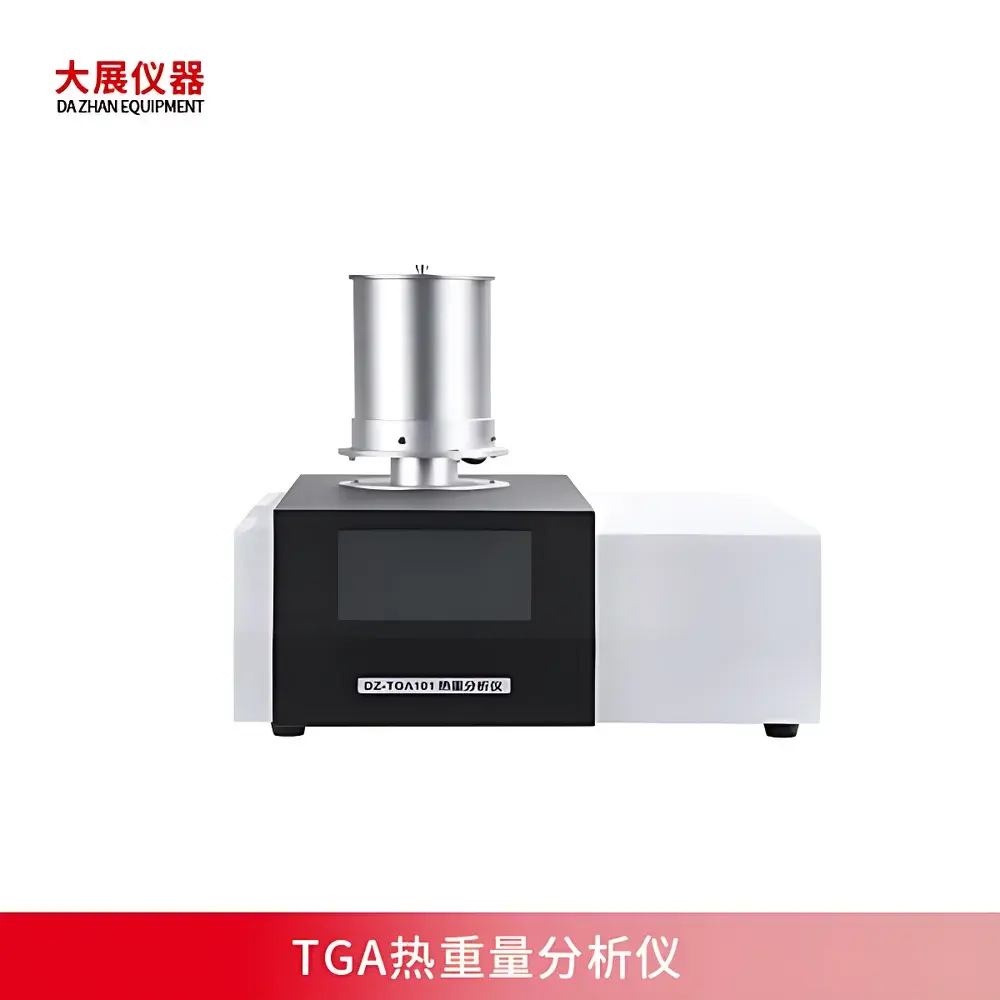
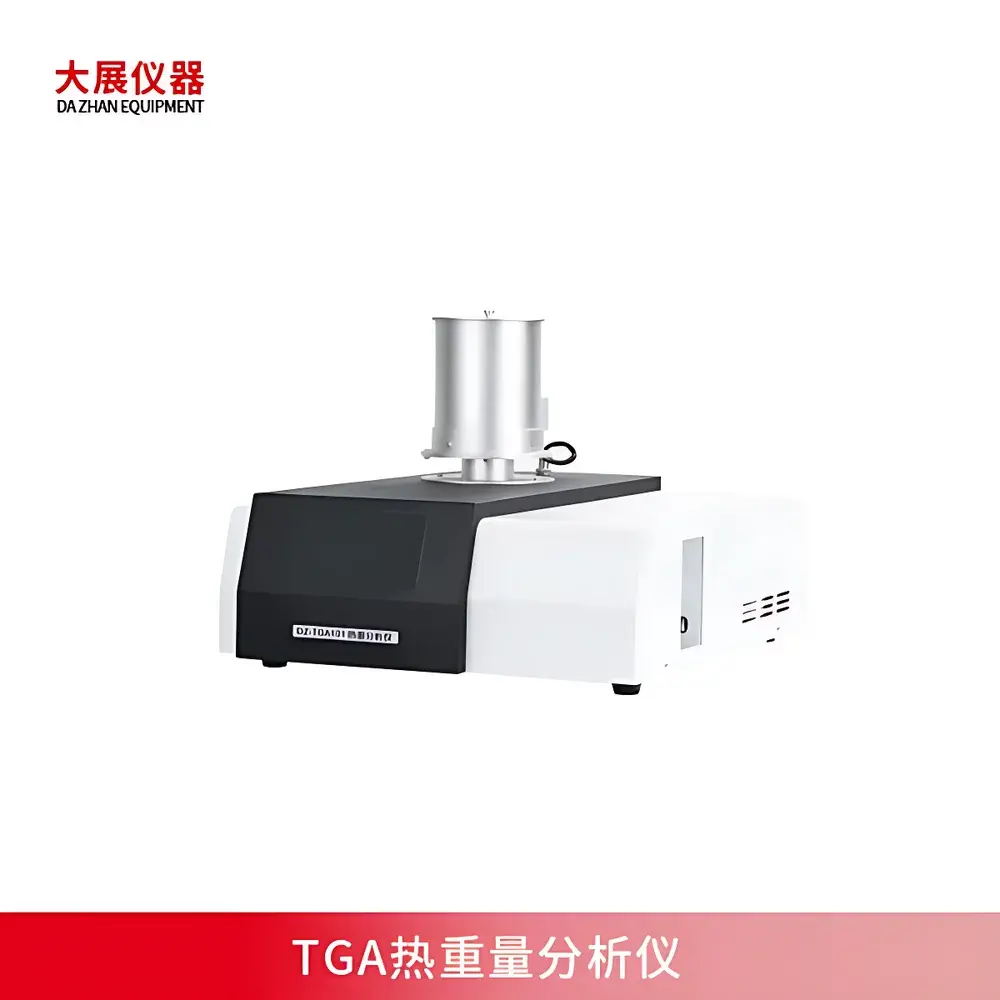
Nanjing Dazhan DZ-TGA101 Thermogravimetric Analyzer
| Brand | Nanjing Dazhan |
|---|---|
| Origin | Jiangsu, China |
| Manufacturer Type | Direct Manufacturer |
| Country of Origin | China |
| Model | DZ-TGA101 |
| Operating Environment | Ambient Pressure |
| Sample Capacity | Single Sample |
| Instrument Type | General-Purpose TGA |
| Temperature Range | Room Temperature to 1200 °C |
| Balance Sensitivity | 0.1 mg to 3 g (standard range), 1 mg to 2 g (high-precision range) |
| Heating/Cooling Rate | 0.1–100 °C/min |
| Maximum Sample Mass | 30 g |
| Temperature Resolution | 0.01 °C |
| Temperature Stability | ±0.1 °C |
| Cooling Time (1000 °C → 100 °C) | ≤15 min |
| Balance Accuracy | 0.01 mg |
| Minimum Mass Resolution | 0.1 µg |
| Isothermal Hold Duration | Up to 72 h (0–300 min programmable in 0.1 min increments) |
| Atmosphere Control | Dual-gas channel with integrated mass flow meters |
| Display | 7-inch high-resolution Chinese-language LCD touchscreen |
| Data Interface | Standard USB port |
| Software | Proprietary TGA analysis suite with TG/DTG curve fitting, Excel export, PDF report generation, thermal calibration correction (multi-point), and FDA 21 CFR Part 11–compliant audit trail (optional module) |
Overview
The Nanjing Dazhan DZ-TGA101 Thermogravimetric Analyzer is a precision-controlled, general-purpose thermal analysis instrument engineered for quantitative measurement of mass change as a function of temperature or time under controlled atmospheric conditions. Based on the fundamental principle of thermogravimetry—monitoring real-time sample mass loss or gain during programmed thermal excursions—the DZ-TGA101 delivers high reproducibility for evaluating thermal stability, decomposition kinetics, desorption/adsorption behavior, oxidation-reduction reactions, volatile content, filler loading, and compositional quantification. Its robust architecture integrates a dual-wound noble alloy (Ni-Cr) furnace, a thermally isolated microbalance system, and a water-jacketed chassis to minimize thermal drift and mechanical interference—ensuring baseline stability critical for low-mass-change detection across extended isothermal holds.
Key Features
- High-stability furnace with dual-row Ni-Cr heating elements operating up to 1200 °C, optimized for uniform temperature distribution and reduced electromagnetic interference.
- Top-opening furnace design enables rapid, tool-free sample loading—eliminating mechanical stress on the sample rod and minimizing operator-induced error during routine analysis.
- Thermally decoupled balance assembly: the microbalance sensor (Ni-Cr alloy construction) is physically and thermally isolated from the furnace via a water-cooled housing, ensuring <0.1 mg baseline drift over 60-minute isotherms at 800 °C.
- Dual-range balance configuration: selectable sensitivity modes (0.1 mg–3 g and 1 mg–2 g) support both high-capacity screening and high-resolution decomposition profiling; optional upgrade path extends maximum load to 30 g without sacrificing resolution.
- Programmable thermal control supporting multi-segment ramps, plateaus, and cooling cycles—with heating rates adjustable from 0.1 to 100 °C/min and temperature resolution of 0.01 °C.
- Integrated dual-atmosphere manifold with calibrated mass flow controllers (MFCs), enabling seamless switching between inert (N₂, Ar), oxidative (air, O₂), reductive (H₂, CO), static, or dynamic gas environments.
Sample Compatibility & Compliance
The DZ-TGA101 accommodates standard crucible formats—including alumina, platinum, and aluminum—with optional high-temperature ceramic variants rated to 1600 °C. It supports ASTM E1131 (Standard Test Method for Compositional Analysis by Thermogravimetry), ISO 11358 (Plastics — Thermogravimetry of polymers), and USP residual solvent testing protocols when configured with appropriate gas delivery and purge validation. The instrument’s hardware and firmware architecture comply with GLP/GMP documentation requirements; optional software modules provide full 21 CFR Part 11 compliance—including electronic signatures, role-based access control, and immutable audit trails for all method parameters, raw data, and report exports.
Software & Data Management
The proprietary DZ-TGA Control & Analysis Suite runs natively on Windows platforms and communicates via USB 2.0. It provides synchronized acquisition of TG (mass vs. temperature/time), DTG (first derivative), and temperature profiles with real-time baseline correction. Analytical functions include peak onset/endpoint determination (tangent, intersection, and derivative methods), mass-loss step integration, kinetic modeling (e.g., Flynn-Wall-Ozawa), and multi-curve overlay with statistical comparison. All reports are exportable in PDF (with embedded metadata), CSV, and Excel formats. The software includes multi-point temperature calibration routines traceable to NIST-certified reference materials and supports automated calibration verification before each run. Firmware and application updates are distributed free of charge via secure vendor portal.
Applications
- Quantitative assessment of polymer degradation onset, char yield, and filler content in thermoplastics, elastomers, and composites.
- Residual solvent and moisture analysis in pharmaceutical APIs and excipients per ICH Q5C guidelines.
- Thermal stability evaluation of catalysts, battery cathode/anode materials, and metal-organic frameworks (MOFs).
- Decomposition pathway mapping of inorganic salts, carbonates, and hydrates—supporting stoichiometric assignment and reaction enthalpy estimation.
- Quality control of coating formulations, pigments, and flame-retardant additives via volatile fraction profiling.
- Process development support for sintering, calcination, and pyrolysis optimization in ceramic and metallurgical R&D.
FAQ
What crucible types are compatible with the DZ-TGA101?
Standard configurations support alumina, aluminum, and platinum crucibles; high-temperature ceramic crucibles (up to 1600 °C) are available as optional accessories.
Can the instrument perform simultaneous TG-DTA or TG-DSC measurements?
The DZ-TGA101 is a dedicated thermogravimetric system. For simultaneous thermal analysis, Nanjing Dazhan offers the DZ-TG-DTA101 hybrid platform as a separate model.
Is remote operation supported?
Yes—via LAN-connected host PC using the included software; no proprietary network hardware or cloud dependency is required.
How is temperature calibration verified?
The software includes built-in multi-point calibration routines using certified reference materials (e.g., Ni, Cu, Al, KCl); calibration logs are stored with timestamp and operator ID.
What maintenance intervals are recommended?
Furnace insulation inspection every 12 months; balance recalibration quarterly or after relocation; gas line filter replacement every 6 months under continuous use.



