
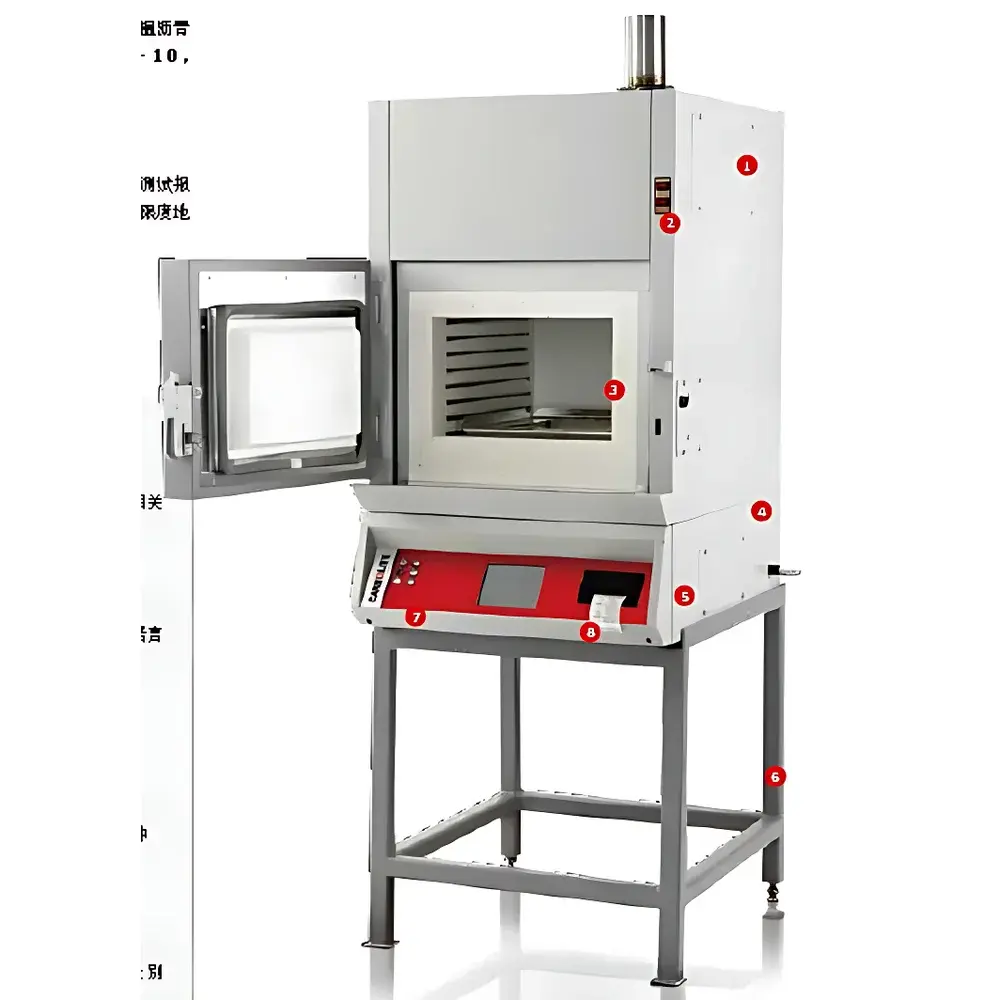
Carbolite Gero ABA-7/35B Asphalt Binder Analyzer
| Brand | Carbolite Gero |
|---|---|
| Origin | United Kingdom |
| Model | ABA-7/35B |
| Temperature Range | 750 °C |
| Temperature Uniformity | ±0.5 °C |
| External Dimensions | 980 × 600 × 775 mm |
| Internal Chamber Dimensions | 220 × 350 × 450 mm |
| Chamber Lining Material | Epoxy Resin Coated Steel |
| Heating Method | Calibrated Resistive Wire Elements |
| Weight Measurement Resolution | 0.1 g |
| Maximum Sample Mass | 4.5 kg |
| Typical Test Duration (6 mm Aggregate) | 20 min |
| Typical Test Duration (40 mm Aggregate) | 45 min |
| Data Output | USB, CSV-compatible |
| Safety Compliance | Dual Interlocked Door, Independent Forced-Air Combustion Zone Control, Power-Fail Locking Mechanism |
Overview
The Carbolite Gero ABA-7/35B Asphalt Binder Analyzer is a purpose-engineered thermal gravimetric instrument designed for the precise determination of asphalt binder content in hot-mix asphalt (HMA) and bituminous paving materials. It operates on the principle of controlled high-temperature combustion—specifically, loss-on-ignition (LOI)—to quantify organic binder mass fraction by measuring mass loss under standardized thermal conditions. Unlike solvent-based extraction methods (e.g., ASTM D2172 or EN 12697-1), the ABA-7/35B eliminates reliance on hazardous chlorinated solvents, thereby removing associated occupational exposure risks, waste disposal liabilities, and regulatory reporting burdens. Its dual-zone architecture isolates the primary heating chamber (up to 750 °C) from a separately regulated forced-air combustion zone, ensuring complete oxidation of hydrocarbons while minimizing NOx, SOx, and volatile organic compound (VOC) emissions. The system complies with key international test standards including ASTM D6307, EN 13108-1, and BS EN 12697-35, and supports full traceability required under ISO/IEC 17025-accredited laboratory environments.
Key Features
- Integrated high-resolution analytical balance (0.1 g resolution) with internal calibration capability using 5 kg certified weights
- Dual independent thermal control zones: main chamber (±0.5 °C uniformity at 750 °C) and auxiliary forced-air combustion chamber
- Robust epoxy resin-coated stainless steel chamber (220 × 350 × 450 mm) resistant to acidic condensates and thermal cycling
- Multi-language touchscreen interface (English, Spanish, French, Italian, Russian, Chinese); firmware supports custom language packs upon request
- Two-tier security access: operator mode (restricted parameter entry) and supervisor mode (full method editing, calibration, and audit log access)
- Automated LOI calculation engine with adjustable aggregate correction factors per EN 12697-35 Annex B
- USB-host data export directly to CSV format; compatible with Microsoft Excel, LabWare LIMS, and STARLIMS platforms
- Fail-safe mechanical door interlock: maintains positive lock during operation—even during mains power interruption—and automatically de-energizes heating elements upon door opening
- Low thermal mass insulation combined with high-efficiency resistive wire heating elements enables <30-minute warm-up to operational temperature
- Front-panel controls include dedicated switches for printer activation, safety test initiation, furnace power, and status LEDs for combustion and chamber heating
Sample Compatibility & Compliance
The ABA-7/35B accommodates sample masses up to 4.5 kg, enabling representative analysis of coarse-aggregate mixes (e.g., 40 mm nominal maximum size) without sub-sampling bias. Its large internal volume and optimized airflow design ensure uniform heat distribution across heterogeneous specimens, critical for reproducible binder quantification in dense-graded and porous asphalt matrices. The instrument meets structural and functional requirements of ASTM E1131 (thermal gravimetric analysis), EN 61000-6-3 (EMC immunity), and IEC 61010-1 (safety of electrical equipment for measurement). Optional thermocouple input allows real-time validation of chamber temperature profiles per GLP audit requirements. All firmware logs—including method parameters, raw weight readings, timestamps, operator IDs, and calibration events—are stored internally with write-protected integrity and support FDA 21 CFR Part 11-compliant electronic signatures when integrated with validated laboratory informatics systems.
Software & Data Management
No proprietary software installation is required. The embedded operating system manages method storage, execution sequencing, and result computation autonomously. Up to 20 user-defined test protocols—including ramp rates, hold times, target temperatures, and correction factor sets—can be named, saved, and recalled via touchscreen navigation. Each test generates a timestamped report containing initial mass, final mass, calculated binder %, correction factor applied, and total duration. Reports are printable via built-in dot-matrix printer (user-configurable formatting) or exported via USB as UTF-8 encoded CSV files with column headers compliant with ISO 8601 date/time notation. Audit trail records retain all parameter modifications, login/logout events, and calibration actions for ≥12 months without external backup. Data export paths are configurable to prevent overwriting and support automated ingestion into LIMS or ELN platforms via scheduled USB mount polling.
Applications
- Quality control of asphalt binder content in production hot-mix asphalt (HMA) batches per ASTM D6307 and EN 12697-35
- Verification of binder dosing accuracy during plant commissioning and routine maintenance
- Research-grade thermal stability assessment of polymer-modified binders (PMBs) and bio-bitumens
- Compliance testing for highway authority specifications (e.g., UK Highways Agency HA 68/07, Austroads APG-10)
- Forensic analysis of pavement failures linked to binder depletion or oxidation
- Teaching laboratories requiring hands-on instruction in thermal gravimetry and bituminous material science
FAQ
Does the ABA-7/35B require external ventilation or fume extraction?
No. Its integrated forced-air combustion zone and catalytic afterburner reduce VOC and CO emissions to levels compliant with EN 14175-3, eliminating mandatory ducted exhaust in most laboratory settings. Local regulations should still be verified.
Can the instrument be validated for ISO/IEC 17025 accreditation?
Yes. Full IQ/OQ documentation packages—including temperature mapping protocols, balance verification procedures, and repeatability studies—are available upon request and align with ILAC-G8:2022 guidance.
Is external balance integration supported?
Yes. RS-232 or USB-serial interfaces allow automatic acquisition of weight data from external analytical balances meeting OIML R76 Class II specifications.
What maintenance intervals are recommended?
Chamber coating inspection every 500 cycles; thermocouple verification annually; door gasket replacement every 2 years or after 1,000 cycles—whichever occurs first.
Are firmware updates provided post-purchase?
Yes. Carbolite Gero supplies free firmware revisions addressing regulatory updates (e.g., new EN annexes), enhanced data export options, and usability improvements via secure download portal with customer authentication.



