
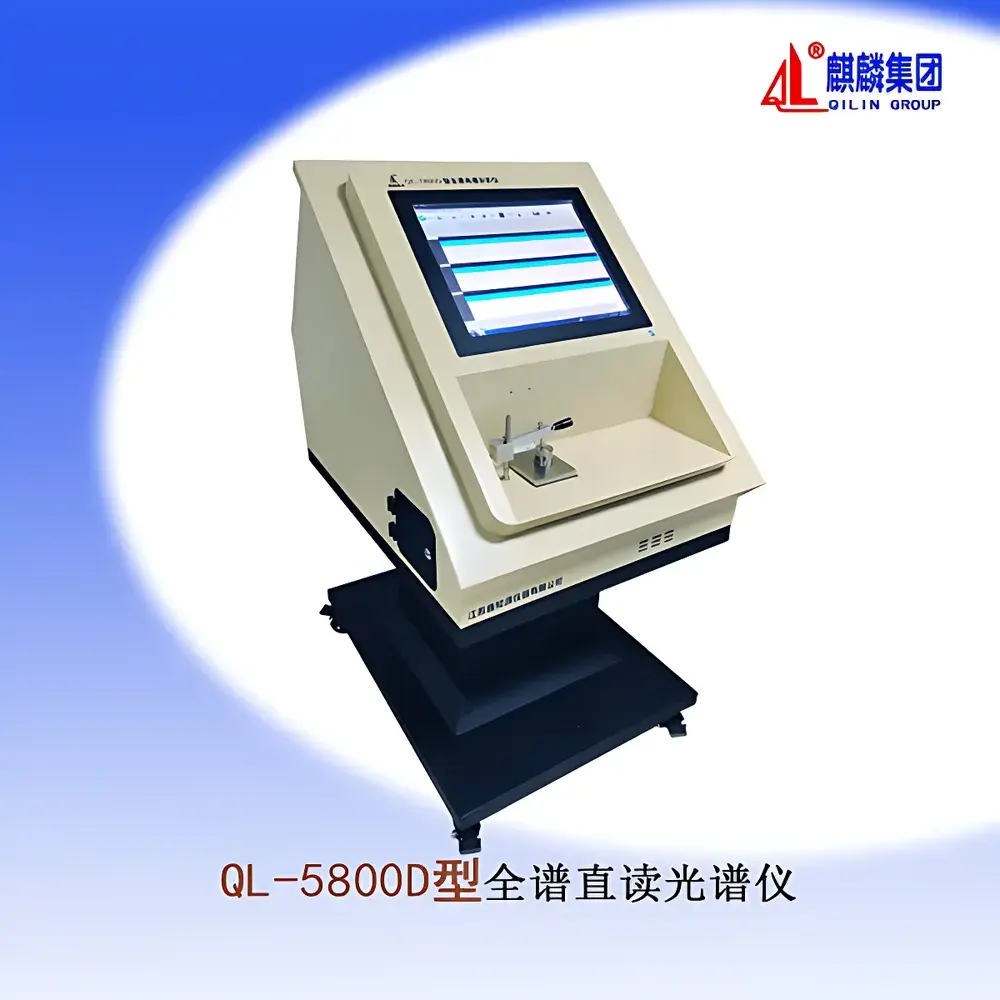
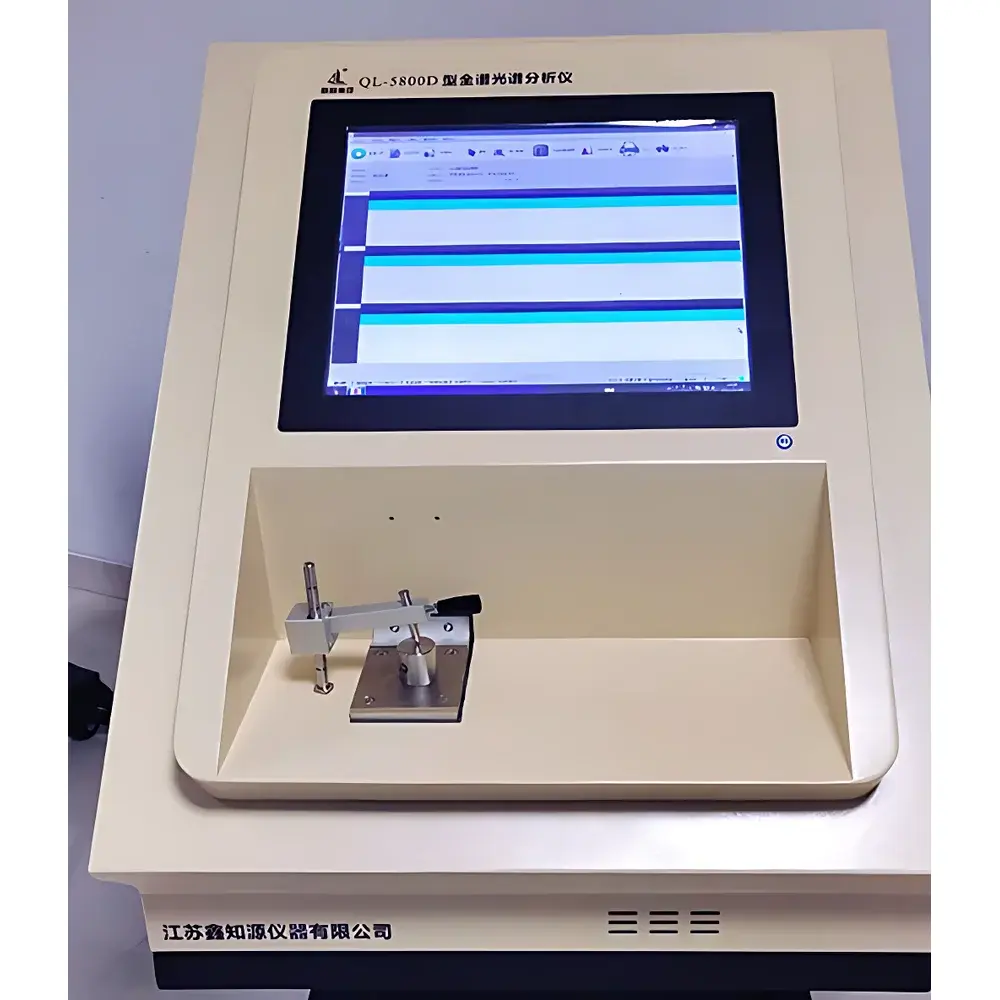
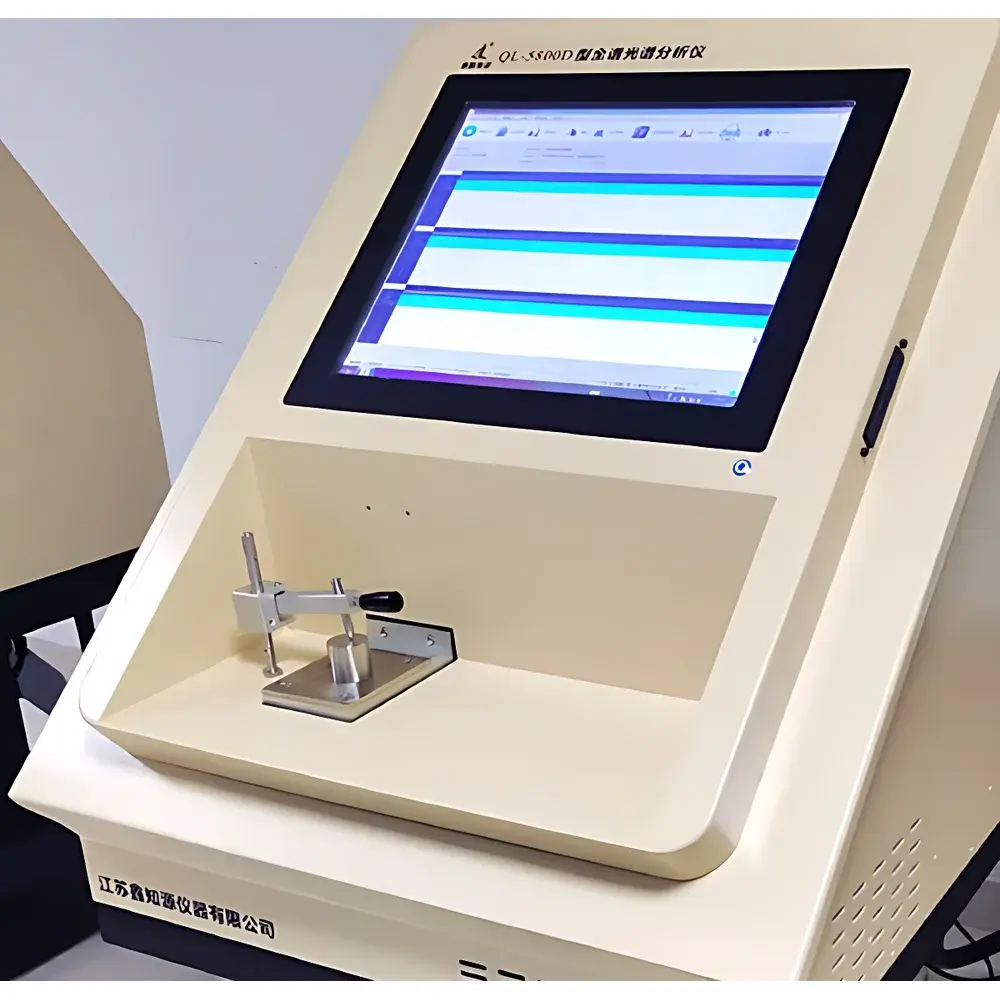
QL-5800D Full-Spectrum Direct-Reading Optical Emission Spectrometer by Qilin
| [Brand | Qilin / QL |
|---|---|
| Origin | Jiangsu, China |
| Instrument Type | Floor-standing |
| Excitation Method | Spark |
| Detector | CCD Array |
| Focal Length | 400 mm |
| Groove Density | 2400 lines/mm |
| Wavelength Range | 130–900 nm |
| Number of Channels | 60] |
Overview
The QL-5800D Full-Spectrum Direct-Reading Optical Emission Spectrometer is a high-performance spark source atomic emission spectrometer engineered for precise elemental analysis of metallic alloys in industrial and laboratory environments. It operates on the principle of spark-induced optical emission spectroscopy (OES): a controlled high-energy spark excites atoms in a solid metal sample, causing them to emit characteristic wavelengths of ultraviolet and visible light. These emissions are dispersed via a Paschen–Runge mount with a 400 mm focal length vacuum optical bench and resolved using a high-resolution 2400 lines/mm holographic grating. A thermoelectrically stabilized CCD array detector captures the full spectrum simultaneously across 130–900 nm, enabling quantitative multi-element analysis without mechanical wavelength scanning. Designed for continuous operation in foundries, metallurgical QA/QC labs, and third-party testing centers, the system delivers high reproducibility and long-term stability under demanding production conditions.
Key Features
- Paschen–Runge Vacuum Optical System: Sealed vacuum chamber eliminates atmospheric absorption below 190 nm—critical for accurate determination of C, P, S, and N in ferrous and non-ferrous matrices.
- Digital Spark Source with High-Energy Pre-Spark (HEPS) Technology: Adjustable discharge frequency (100–1000 Hz) and peak current up to 400 A ensure robust excitation of challenging elements—including carbon in cast iron—via patented multi-directional argon flow design.
- Full-Spectrum CCD Detection: Simultaneous acquisition across all spectral lines enables rapid analysis (~25 s per sample), dynamic background correction, and post-acquisition re-evaluation of calibration models without re-measurement.
- Thermal Stability Architecture: Optics compartment maintained at constant temperature minimizes thermal drift; critical for maintaining wavelength registration and intensity stability over extended shifts.
- Modular Power & Control Design: Independent power modules for excitation, detection, and vacuum subsystems enhance fault isolation and support uninterrupted operation in 24/7 production environments.
- Touchscreen Human-Machine Interface (HMI): Intuitive graphical interface compliant with Industry 4.0 principles supports real-time spectral visualization, method editing, and instrument diagnostics without external PC dependency.
Sample Compatibility & Compliance
The QL-5800D supports routine analysis of solid conductive samples across major metallic bases including Fe, Al, Cu, Ni, Co, Mg, Zn, Pb, Sn, and Ti. Sample preparation follows standardized grinding and cleaning protocols per ISO 11577 and ASTM E415. The instrument’s optical design meets spectral resolution requirements specified in ISO 10700 for OES-based compositional verification. Its data handling architecture supports audit-ready operation: software enforces user role-based access control, electronic signatures, and full audit trail logging aligned with GLP and GMP documentation expectations. While not pre-certified for FDA 21 CFR Part 11, the system provides configurable features—including secure user authentication, immutable data storage, and change history tracking—to facilitate internal validation for regulated environments.
Software & Data Management
Built-in analytical software provides comprehensive workflow management—from method setup and calibration curve generation to statistical process control (SPC) charting and report export. Calibration models are stored as encrypted binary files with metadata tagging (date, operator, instrument ID). All raw spectra and processed results are archived in vendor-neutral HDF5 format, enabling interoperability with third-party chemometric tools. Remote monitoring and diagnostic support are enabled via secure TLS-encrypted Ethernet connection; firmware updates and spectral library revisions are distributed through authenticated download channels. Data export options include CSV, XML, and PDF formats compatible with LIMS integration. Network-enabled configuration allows centralized management of multiple instruments across distributed facilities.
Applications
The QL-5800D is routinely deployed in metallurgical process control for incoming material inspection, melt shop composition verification, heat treatment validation, and scrap sorting. Key use cases include: carbon equivalence calculation in structural steels; trace element screening (e.g., Sn, As, Sb) in copper alloys to prevent hot shortness; low-level boron quantification in nickel superalloys; and rapid grade identification of aluminum die-castings. In R&D settings, its full-spectrum capability supports spectral library expansion for emerging alloy systems and facilitates interference correction studies in complex multi-matrix applications. The instrument also serves accredited testing laboratories performing contract analysis per ISO/IEC 17025 requirements, where documented measurement uncertainty and inter-laboratory comparability are essential.
FAQ
What sample forms are compatible with the QL-5800D?
Solid, flat, and electrically conductive metal samples with minimum dimensions of Ø20 mm × 5 mm thickness. Non-conductive or irregular geometries require specialized fixtures or alternative techniques (e.g., laser ablation).
Is vacuum pumping required before each analysis?
The integrated vacuum system maintains pressure below 10 Pa during operation; automated purge-and-pump cycles initiate at startup and are fully managed by firmware—no manual intervention is needed.
Can the instrument be validated for ISO/IEC 17025 compliance?
Yes—documentation packages include factory performance verification reports, traceable calibration certificates for wavelength and intensity axes, and guidance for establishing measurement uncertainty budgets per EURACHEM/CITAC guidelines.
What maintenance intervals are recommended?
Daily: electrode cleaning and argon line inspection.
Monthly: optical window cleaning and spark stand alignment verification.
Annually: CCD dark-current characterization, grating alignment verification, and full system performance qualification using certified reference materials (CRMs).





