
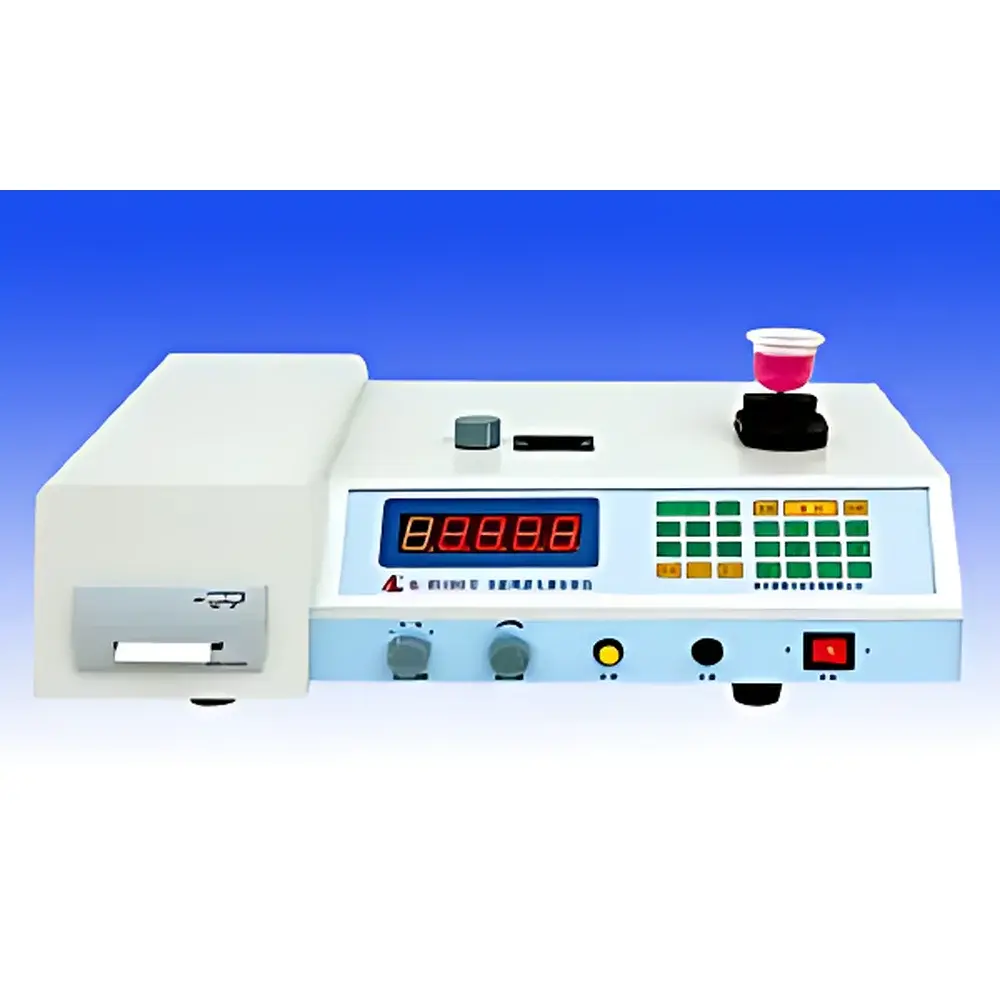
QL-BS1000 Precision Elemental Analyzer for Metallic Materials
| Brand | Qilin (QL) |
|---|---|
| Origin | Jiangsu, China |
| Model | QL-BS1000 |
| Wavelength Range | 400–800 nm (continuously adjustable) |
| Absorbance Range | 0–1.999 A |
| Concentration Display Range | 0.000–99.99% (auto-ranging) |
| Wavelength Accuracy | ±3 nm |
| Photometric Resolution | 0.001 A |
| Data Storage | Onboard EEPROM (retains data for ≥10 years without power) |
| Display | 1-inch numeric LED display |
| Power Supply | AC 220 V ±10%, 50 Hz ±5% |
| Power Consumption | ≤45 W |
| Net Weight | ≤15 kg |
| Compliance | Designed per GB/T 20001.4–2015 (Chinese Standard for Analytical Instrument Documentation), compatible with ASTM E306 and ISO 4943 methodologies for optical emission and absorption-based metal analysis |
Overview
The QL-BS1000 Precision Elemental Analyzer for Metallic Materials is a benchtop photometric elemental analyzer engineered for rapid, quantitative determination of major and minor metallic constituents—including Si, Mn, P, Ni, Cr, and Cu—in ferrous and non-ferrous alloys. It operates on the principle of molecular absorption spectrophotometry in the visible spectrum (400–800 nm), utilizing a continuously tunable light source to match optimal analytical wavelengths for each target element’s characteristic absorption bands. Unlike fixed-wavelength or filter-based systems, its continuously adjustable optical path enables method flexibility across diverse alloy matrices without hardware modification. The instrument implements single-beam, cold-light photometry with automatic zero and full-scale calibration, minimizing thermal drift and ensuring long-term baseline stability. Designed for routine QC/QA environments—such as foundry furnace-side control, incoming material inspection, and finished product certification—the QL-BS1000 delivers reproducible results under industrial conditions while maintaining compatibility with standardized wet-chemical digestion protocols (e.g., ASTM E306 for steel dissolution and ISO 4943 for copper alloy sample preparation).
Key Features
- Continuously adjustable wavelength selection (400–800 nm) with ±3 nm accuracy—enabling precise alignment to element-specific absorption maxima and reducing interferences from spectral overlap.
- Dual-range absorbance measurement (0–1.999 A) with 0.001 A resolution, supporting both low-concentration trace analysis and high-percentage bulk composition quantification.
- Auto-ranging concentration display (0.000–99.99%) with real-time conversion from absorbance via preloaded calibration curves.
- Onboard EEPROM memory storing up to nine independent calibration curves; retains all parameters and measurement history for ≥10 years without battery backup.
- Cold-light source architecture with imported photodetectors and temperature-stabilized optics—eliminating warm-up delays and reducing photometric noise.
- Microcontroller-based operation with dedicated function keys, enabling one-touch curve selection, auto-zero, and full-scale calibration.
- External sample dissolution capability—decoupling digestion from instrumentation to prevent reagent carryover, valve clogging, and tubing degradation.
- Compact footprint (<15 kg) and low power draw (≤45 W) suitable for shared lab benches or mobile metallurgical testing carts.
Sample Compatibility & Compliance
The QL-BS1000 is validated for use with acid-digested solutions derived from solid metallic samples following standard dissolution procedures: HCl/HNO₃ mixtures for stainless steels, HCl/HF for aluminum alloys, and HNO₃/HF/HClO₄ for nickel-based superalloys. It supports cuvette path lengths of 10 mm, 20 mm, and 30 mm (user-selectable), allowing optimization of sensitivity versus dynamic range. All operational parameters comply with documentation requirements outlined in GB/T 20001.4–2015 and align with procedural frameworks referenced in ASTM E306 (Standard Practice for Spectrophotometric Analysis of Metals) and ISO 4943 (Metallic Materials — Chemical Analysis — General Rules). While not inherently 21 CFR Part 11 compliant, audit trails and calibration logs can be exported manually for GLP/GMP-aligned recordkeeping when integrated into validated laboratory workflows.
Software & Data Management
The analyzer employs embedded firmware—not PC-dependent software—for core acquisition and calculation. All calibration curves are stored in non-volatile EEPROM with timestamped versioning. Users may load, edit, or delete curves via front-panel navigation; no external computer or proprietary drivers are required. Measurement data—including sample ID, wavelength setting, absorbance value, calculated % content, and date/time stamp—is retained in chronological sequence. Export is performed via optional RS-232 interface (hardware-compatible with legacy lab printers or ASCII-loggers); no cloud connectivity or remote access functionality is implemented. Data integrity is preserved through write-protection logic that prevents accidental overwriting of active calibration sets.
Applications
- Furnace-side composition verification during cast iron or carbon steel production, enabling real-time adjustment of charge materials.
- Incoming raw material screening for scrap metal recyclers—quantifying residual Cr, Ni, and Mo in mixed alloy batches prior to melting.
- Finished product release testing in mechanical component manufacturing, particularly for automotive crankshafts, gear blanks, and bearing housings where Mn/Si ratios impact hardenability.
- Quality assurance in brass and bronze foundries—monitoring Zn/Pb/Cu balance to ensure machinability and corrosion resistance.
- Educational laboratories conducting comparative spectroscopic analysis of alloy standards (e.g., NIST SRM 1251 series) for method validation exercises.
FAQ
Does the QL-BS1000 support multi-element sequential analysis in a single sample run?
No—it performs single-wavelength, single-element quantification per measurement cycle. Multi-element analysis requires sequential wavelength adjustments and separate calibrations per element.
Is external computer software required for operation or data export?
No. All functions—including calibration, measurement, and data recall—are executed via the onboard microcontroller. RS-232 output is optional and does not require driver installation.
What sample preparation methods are recommended for high-accuracy results?
Acid digestion per ASTM E306 or ISO 4943 is mandatory. Samples must be fully dissolved, filtered (0.45 µm), and matrix-matched with appropriate blank and standard solutions.
Can the instrument be recalibrated by the end user without service intervention?
Yes—zero and full-scale calibration are fully accessible via front-panel controls using certified reference solutions.
Is the QL-BS1000 suitable for regulatory submission under ISO/IEC 17025-accredited testing?
It may serve as a primary analytical tool within an accredited scope if operated under documented SOPs, with periodic verification against CRM materials and full traceability of calibration records.






