
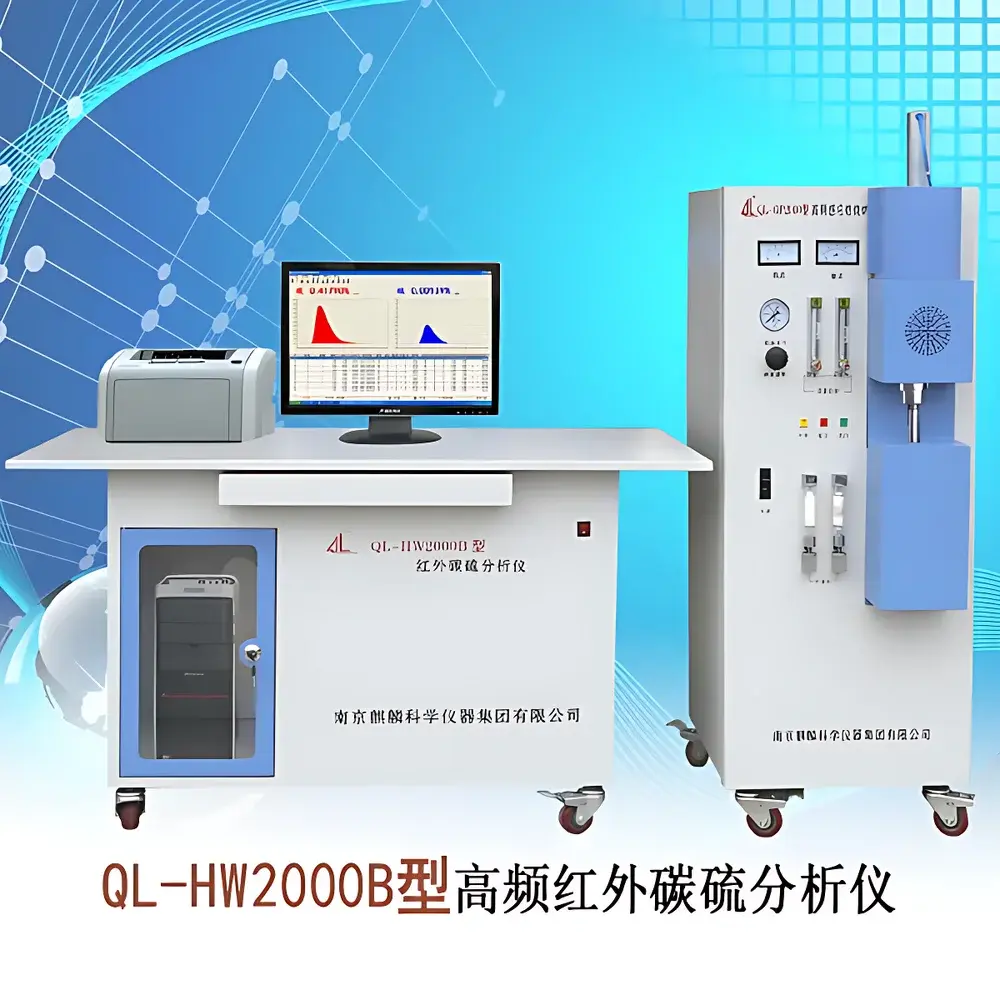
QL-Quantum HW2000B High-Frequency Infrared Carbon-Sulfur Analyzer
| Brand | QL |
|---|---|
| Origin | Jiangsu, China |
| Model | QL-HW2000B |
| Measurement Principle | Non-Dispersive Infrared (NDIR) Absorption |
| Heating System | 2.5 kVA High-Frequency Induction Furnace (18–20 MHz) |
| Carbon Range | 0.00001–10.0000 wt% (extendable to 99.999 wt%) |
| Sulfur Range | 0.00001–0.5000 wt% (extendable to 99.999 wt%) |
| Sensitivity | 0.1 ppm (minimum display resolution) |
| Precision | Carbon RSD ≤ 0.5% |
| Analysis Time | 25–60 s (user-adjustable) |
| Sample Weighing Accuracy | ±0.0001 g |
| Compliance | GB/T 20123–2006 & ISO 15350:2000 |
| Detector Type | High-Stability Pyroelectric Infrared Detector with Narrow-Band Optical Filters |
| Gas Control | Precision Mass Flow Controllers + Airtac Solenoid Valves (rated for ≥100,000 cycles) |
| Mechanical Drive | Aerospace-Grade Synchronous Motor in IR Cell (MTBF > 100,000 h) |
Overview
The QL-Quantum HW2000B is a high-frequency induction combustion infrared carbon-sulfur analyzer engineered for precise, trace-level quantification of total carbon (C) and sulfur (S) in solid inorganic and organic matrices. It operates on the principle of non-dispersive infrared (NDIR) absorption spectroscopy: following complete oxidation in a high-frequency induction furnace (2.5 kVA, 18–20 MHz), the evolved CO₂ and SO₂ gases are swept through dedicated optical cells where their characteristic infrared absorption bands—centered at 4.26 µm (CO₂) and 7.35 µm (SO₂)—are measured by thermally stabilized pyroelectric detectors. The system employs narrow-band interference filters to eliminate spectral overlap, particularly critical for accurate sulfur determination in high-carbon samples such as cast iron or ferroalloys. Designed for metallurgical QC labs, geological survey centers, and raw material certification facilities, the HW2000B delivers laboratory-grade reproducibility under routine production conditions.
Key Features
- High-frequency induction furnace with RF-controlled thermal ramping ensures uniform sample combustion across heterogeneous materials—including refractory ores, slag, and ceramic powders—minimizing incomplete oxidation artifacts.
- Dual-channel NDIR detection architecture with temperature-, pressure-, and flow-compensated signal processing enables stable baseline performance over extended operational cycles.
- Optimized gas handling subsystem featuring calibrated mass flow controllers and industrial-grade Airtac solenoid valves (certified for ≥100,000 actuations) guarantees repeatable carrier gas delivery and purge efficiency.
- IR absorption cell driven by aerospace-specified synchronous motor eliminates mechanical drift and supports continuous operation exceeding 100,000 hours without alignment degradation.
- Modular electronic architecture with isolated analog front-end and FPGA-based real-time signal conditioning reduces electromagnetic interference from furnace switching transients.
- Integrated analytical balance interface (0.1 mg resolution) enables direct sample mass import into analysis routines, supporting ASTM E1019-compliant reporting workflows.
Sample Compatibility & Compliance
The HW2000B accommodates a broad spectrum of solid sample types: ferrous alloys (carbon steel, stainless, cast iron), non-ferrous metals (copper, aluminum, nickel-based superalloys), mineralogical specimens (hematite, magnetite, bauxite, limestone), coal and coke, catalysts, ceramics, and refractory crucible residues. Sample mass ranges from 0.1 g to 1.0 g depending on expected C/S concentration and matrix volatility. All measurements adhere to the metrological requirements of GB/T 20123–2006 and ISO 15350:2000 for combustion-infrared determination of total carbon and sulfur. The instrument’s hardware design supports GLP-compliant audit trails when paired with validated LIMS integration; firmware logs include operator ID, sample ID, furnace parameters, gas flow rates, detector voltages, and raw absorbance integrals—fully traceable per FDA 21 CFR Part 11 data integrity guidelines.
Software & Data Management
QL-Quantum Analytical Suite v4.2 provides intuitive method configuration, real-time spectral visualization, and automated calibration curve generation using certified reference materials (CRMs) traceable to NIST SRMs. Software modules support multi-point linear and quadratic regression, blank subtraction, drift correction, and outlier rejection based on ICH Q2(R2)-aligned criteria. Export formats include CSV, XML, and PDF reports compliant with ISO/IEC 17025 documentation standards. Audit trail functionality records all user actions—including method edits, calibration updates, and result overrides—with immutable timestamps and digital signatures. Optional OPC UA server enables seamless integration with plant-wide MES or SAP QA systems for automated certificate-of-analysis generation.
Applications
This analyzer is routinely deployed in quality control laboratories for incoming raw material verification (e.g., iron ore grade assessment prior to blast furnace charging), in-process monitoring of alloy composition during secondary metallurgy, and final product certification for ASTM A743/A744 (cast stainless), ISO 6892-1 (tensile test correlation), and EN 10204 3.1 material test reports. Geological institutes utilize its extended dynamic range (down to 0.1 ppm C/S) for low-grade deposit characterization and environmental screening of mine tailings. Cement producers apply it to quantify organic carbon carryover in clinker feedstocks, while catalyst manufacturers rely on its sulfur sensitivity for Pt/Pd-supported formulations where <10 ppm S can poison active sites.
FAQ
What sample preparation is required prior to analysis?
Solid samples must be homogenized and dried to constant weight; particle size should be ≤0.2 mm for optimal combustion kinetics. No acid digestion or solvent extraction is needed.
Can the instrument measure both carbon and sulfur simultaneously?
Yes—CO₂ and SO₂ are detected in parallel via dual optical paths with independent detectors and filters, eliminating sequential measurement delays.
Is external calibration gas required for daily operation?
No—calibration is performed using solid CRMs (e.g., NIST SRM 1251a, GBW01301); zero gas is generated internally via catalytic purification of ambient air.
How is moisture interference mitigated during analysis?
A heated Nafion™ membrane dryer removes water vapor upstream of the IR cells without absorbing CO₂ or SO₂, preserving stoichiometric integrity.
Does the system support remote diagnostics and firmware updates?
Yes—via secure TLS-encrypted Ethernet connection; diagnostic logs include furnace coil impedance, detector dark current, and valve response latency metrics.





