
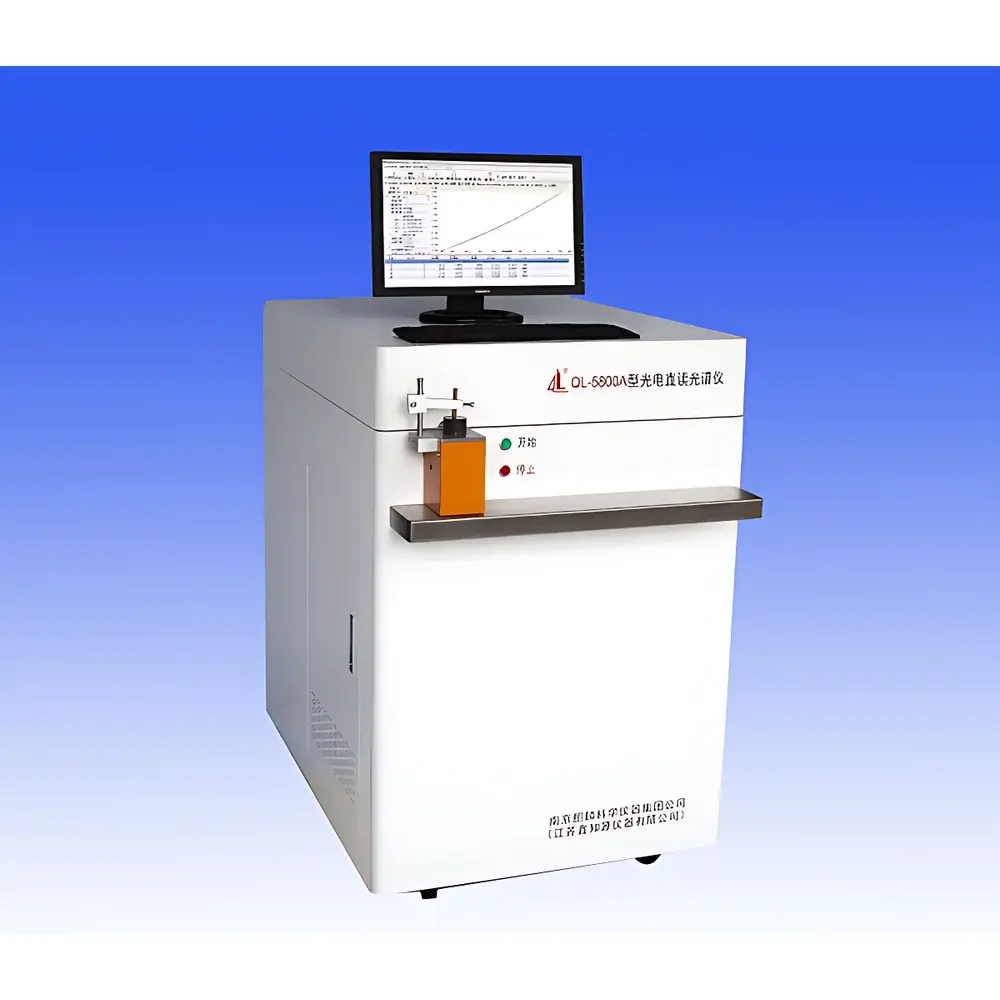
QL-5800A Spark Optical Emission Spectrometer (OES) – Kirin Brand
| Brand | Kirin |
|---|---|
| Model | QL-5800A |
| Optical System | Paschen–Runge Mount |
| Focal Length | 750 mm |
| Grating | 2400 grooves/mm concave |
| Wavelength Range | 130–650 nm |
| Dispersion | 0.55 nm/mm (1st order) |
| Slit Widths | 20 µm (entrance), 35/55/75 µm (exit) |
| Analytical Channels | 32 standard, up to 48 configurable |
| Vacuum System | Dual-valve controlled high-vacuum chamber |
| Argon Purity | ≥99.995% |
| Argon Pressure | 0.3–0.5 MPa |
| Analysis Time per Sample | ~20 s |
| Power Supply | 220 V ±10%, 50/60 Hz |
| Power Consumption | 1.5 kW |
| Dimensions (L×W×H) | 1150 × 950 × 1200 mm |
| Weight | ~300 kg |
| Operating System | Windows XP or Vista (multi-language support: English, Chinese, Japanese, Korean) |
Overview
The QL-5800A Spark Optical Emission Spectrometer (OES) is a benchtop direct-reading spectrometer engineered for high-precision elemental analysis of metallic alloys and conductive materials. Based on the Paschen–Runge optical configuration, it employs spark discharge excitation to atomize and ionize sample surfaces, generating characteristic atomic emission spectra in the vacuum ultraviolet to visible range (130–650 nm). The 750 mm focal length and 2400 grooves/mm concave grating deliver high spectral resolution and long-term optical stability—critical for reproducible quantification of major, minor, and trace elements (e.g., C, S, P, N, B, Sn, Pb, As) in ferrous and non-ferrous matrices. Designed for integration into production QA/QC labs, foundry floor control stations, and central metallurgical laboratories, the QL-5800A meets foundational requirements for routine compositional verification in accordance with ASTM E415, ISO 11577, and GB/T 4336 (Chinese national standard for spark OES).
Key Features
- Robust Paschen–Runge optical bench with sealed, vacuum-purged spectrograph chamber—dual-stage valve control maintains stable high vacuum (<10⁻³ Pa), minimizing hydrocarbon contamination and ensuring consistent UV transmission down to 130 nm.
- Modular high-voltage power supply with software-controlled regulation; voltage stability better than ±0.2% enables repeatable spark energy delivery across thousands of analyses.
- Optimized spark stand featuring low-volume argon flush design (consumption ≤12 L/min during analysis), self-aligning tungsten counter-electrode (≥100,000 discharges lifetime), and removable safety-shielded viewport for rapid cleaning and geometry calibration.
- Integrated data acquisition system with industrial-grade shielding and modular PCB architecture—designed for electromagnetic compatibility in factory environments with variable power quality and RF noise.
- High-dispersion optical path (0.55 nm/mm at first order) supports simultaneous detection across 32–48 customizable analytical channels, each with individually adjustable photomultiplier tube (PMT) gain and background correction.
- Fully automated hardware diagnostics—including arc gap monitoring, vacuum integrity checks, and high-voltage circuit self-test—reduces unscheduled downtime and simplifies preventive maintenance scheduling.
Sample Compatibility & Compliance
The QL-5800A accepts solid, electrically conductive samples including cast iron, carbon and alloy steels, stainless steels, aluminum, copper, nickel, titanium, and magnesium-based alloys. Sample surface flatness ≤0.05 mm and minimum diameter ≥10 mm are recommended for optimal excitation homogeneity. The instrument complies with IEC 61000-6-2 (immunity) and IEC 61000-6-4 (emission) for industrial electromagnetic environments. While not pre-certified to FDA 21 CFR Part 11, its audit-trail-capable software architecture (user login, method versioning, raw spectrum archiving, and timestamped result logs) supports validation under GLP/GMP frameworks when deployed with documented SOPs and electronic signature protocols.
Software & Data Management
The QL-5800A operates under Windows XP or Vista with Kirin’s proprietary OES analysis suite. The interface provides multi-level user roles (Operator, Supervisor, Administrator), real-time spectral visualization, and automatic matrix-matched calibration curve generation using certified reference materials (CRMs). Quantitative results are reported directly in weight percent (wt%) with optional ppm reporting for trace elements. The embedded sample management database stores full spectral records, calibration history, operator IDs, and environmental metadata (argon pressure, vacuum level, ambient temperature). Language modules include English, Simplified Chinese, Japanese, and Korean—enabling global deployment without UI localization delays. Export formats include CSV, XML, and PDF reports compatible with LIMS integration via ODBC or TCP/IP.
Applications
- Real-time melt composition verification in electric arc furnace (EAF) and ladle metallurgy operations.
- Grade identification and positive material identification (PMI) for incoming raw materials and finished components in automotive and aerospace supply chains.
- Trace element screening (e.g., residual Cu, Sn, As in low-alloy steels) to prevent hot shortness or embrittlement.
- Quality conformance testing against ASTM A743/A744 (cast stainless), ASTM B16 (copper alloys), or EN 10204 3.1 certification requirements.
- Routine analysis of wear-resistant coatings, weld metal deposits, and recycled scrap streams where elemental segregation must be monitored.
FAQ
What types of samples can be analyzed on the QL-5800A?
Solid, electrically conductive metallic samples—including castings, forgings, rolled plates, and machined parts—with flat, clean, and representative surfaces.
Is vacuum pump oil contamination a concern with long-term operation?
No—the dual-valve vacuum control system minimizes pump runtime and isolates the optical chamber from oil vapor backstreaming, extending pump service intervals beyond 12 months under typical usage.
Can the instrument be upgraded to add more analytical channels after installation?
Yes—its modular PMT detector array and firmware architecture support field expansion to up to 48 channels without optical realignment.
Does the software support compliance with regulated laboratory environments?
The software includes audit trail logging, user authentication, and method version control—prerequisites for GLP/GMP validation; however, full 21 CFR Part 11 compliance requires site-specific configuration and procedural documentation.
What argon purity is required for reliable UV-range analysis (e.g., C, P, S)?
Argon ≥99.995% purity (oxygen + moisture <1 ppm) is mandatory to maintain transmission below 190 nm and ensure accurate quantification of light elements.
Related Products




