
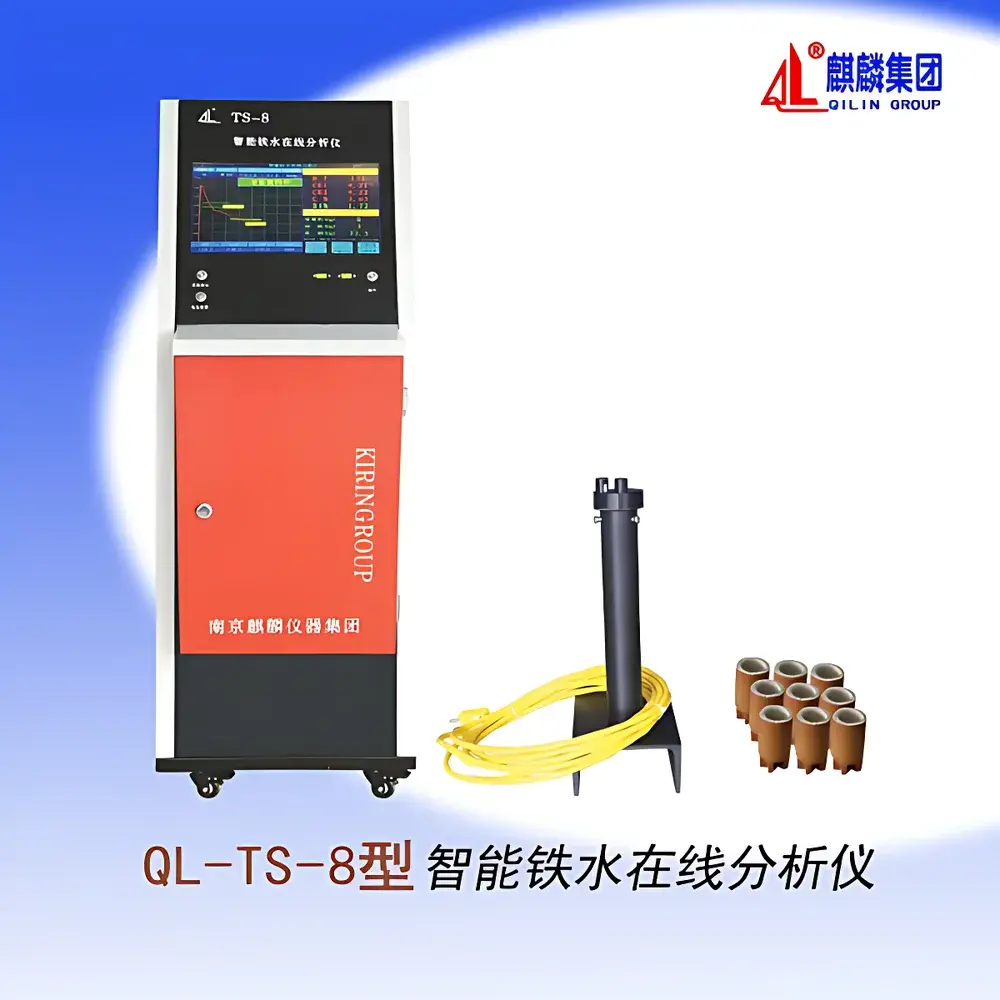
Qilin QL-TS-8 Intelligent On-Line Carbon-Silicon Analyzer for Molten Iron
| Brand | Qilin / QL |
|---|---|
| Origin | Jiangsu, China |
| Manufacturer Type | Authorized Distributor |
| Regional Classification | Domestic (China) |
| Model | QL-TS-8 |
| Price | USD 5,300 (FOB Jiangsu) |
| CE Range | 3.2–4.8 wt% (±0.08 wt%) |
| C Content | 2.8–4.2 wt% (±0.04 wt%) |
| Si Content | 0.9–3.0 wt% (±0.04 wt%) |
| Analysis Time | ≤60 s |
| Data Storage Capacity | 3,000 measurements |
| Calibration Lines | 8 user-defined |
| Target Compositions | 8 configurable |
| Graphical Output | Solidification curve, derivative curve (dT/dt), trend plots |
| USB Export | Optional |
Overview
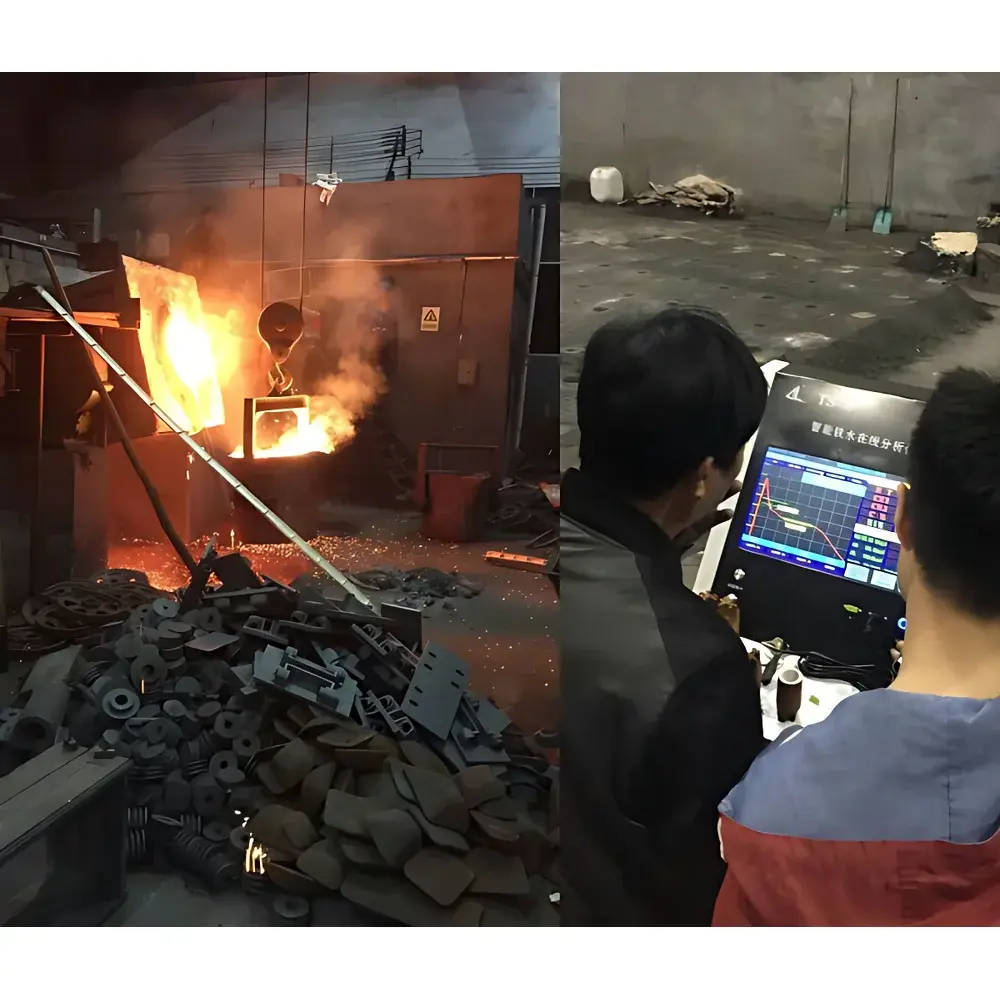
The Qilin QL-TS-8 Intelligent On-Line Carbon-Silicon Analyzer for Molten Iron is a thermoelectric solidification analysis (TSA) instrument engineered for real-time compositional monitoring during ferrous foundry operations. Unlike traditional wet chemical or spectrometric methods requiring sample extraction and laboratory turnaround, the QL-TS-8 employs rapid thermal arrest curve interpretation—based on ASTM E1122 and ISO 945-1 principles—to determine carbon equivalent (CE), total carbon (C), silicon (Si), undercooling degree, and nodularity index directly from molten iron samples in the ladle or tapping stream. Its core measurement principle relies on high-stability K-type thermocouples embedded in disposable ceramic probes, capturing precise cooling rate profiles during eutectic solidification. The system then applies proprietary algorithmic regression against pre-calibrated thermal arrest signatures to compute elemental concentrations with traceable repeatability. Designed for integration into continuous casting lines, cupola furnaces, and induction melting stations, it delivers actionable data within 60 seconds—enabling immediate process correction before mold pouring begins.
Key Features
- Real-time thermal arrest curve acquisition with dual-point temperature sampling at 10 Hz resolution
- On-board calibration management supporting up to eight independent calibration curves, each assignable to specific base alloys (e.g., GG25, GJS400-18, GJS700-2)
- Automated composition adjustment calculation: inputs include measured C/Si, target specification, melt mass, and element recovery rate to output precise inoculant or ferroalloy addition quantities
- Embedded 3.5-inch TFT display with touch interface for direct parameter configuration, curve visualization, and pass/fail flagging per measurement
- Non-volatile memory storing 3,000 chronological records—including full thermal curves, derivative plots (dT/dt), and timestamped operator annotations
- USB host port enabling export of CSV-formatted datasets (including raw thermocouple voltage, smoothed temperature, first/second derivative peaks, and final composition reports) to external storage media
- Ruggedized aluminum housing rated IP54 for resistance to foundry ambient conditions: dust ingress, splashed coolant, and ambient temperatures up to 60°C
Sample Compatibility & Compliance
The QL-TS-8 is validated for use with gray iron (ASTM A48), ductile iron (ASTM A536), and compacted graphite iron (ASTM A842) melts ranging from 1,200°C to 1,450°C. Probe immersion depth and dwell time follow ISO 17830-2 guidelines for representative sampling. All firmware and data handling routines comply with GLP documentation requirements, including audit-trail-enabled user login, timestamped measurement logs, and immutable record sequencing. While not certified to IEC 61508 for safety instrumented systems, its operational logic adheres to EN 61000-6-2 (EMC immunity) and EN 61000-6-3 (EMC emission) standards. Traceability is maintained via NIST-traceable thermocouple calibration certificates supplied with each probe batch.
Software & Data Management
Data integrity is enforced through write-once logging: once stored, measurement records cannot be edited or deleted. The internal database supports chronological filtering by date range, alloy grade, or operator ID. Trend analysis tools generate X-bar/R charts for CE, C, and Si over successive heats—exportable as PNG or PDF for SPC reporting. Optional PC software (QL-DataLink v3.2, Windows 10/11 compatible) provides advanced statistical process control features, including Cp/Cpk calculation, out-of-spec alerting, and integration with MES platforms via OPC UA (tested with Siemens SIMATIC IT and Rockwell FactoryTalk). All exported files include embedded metadata: probe serial number, calibration expiry, ambient humidity/pressure (if external sensors connected), and firmware revision.
Applications
- Pre-pour quality gate for ductile iron production: verifying nodularity readiness prior to magnesium treatment confirmation
- Dynamic charge correction in cupola operations: compensating for coke ash variability and scrap composition drift
- Process validation during green sand mold transitions: correlating thermal arrest parameters with mechanical test results (UTS, elongation)
- Foundry training and apprenticeship: visualizing solidification behavior differences between hypoeutectic/hypereutectic irons using live derivative curve overlays
- Supplier qualification audits: generating auditable digital records demonstrating consistent CE control across delivery batches (per ISO/TS 16949 clause 8.2.3)
FAQ
What sample volume is required for a valid measurement?
A minimum of 150 mL of undisturbed molten iron must be collected in a pre-heated refractory cup; probe immersion depth shall be ≥40 mm below surface.
Can the analyzer distinguish between combined carbon and free graphite carbon?
No—the QL-TS-8 reports total carbon content derived from solidification thermodynamics; differentiation requires complementary LECO combustion analysis or metallographic quantification.
Is probe calibration required before each shift?
Probe-specific offset compensation is performed automatically during warm-up; full recalibration against reference melts is recommended every 48 operational hours or after 200 measurements.
Does the system support remote diagnostics or firmware updates?
Yes—via optional RS-485 Modbus RTU interface, enabling integration with SCADA systems for health monitoring and scheduled OTA updates using signed firmware packages.
How does the analyzer handle slag-covered or oxidized melt surfaces?
Operators must skim surface oxide prior to sampling; excessive slag inclusion causes thermal lag and false eutectic arrest detection—validated by simultaneous visual inspection of the solidified cup sample.






