
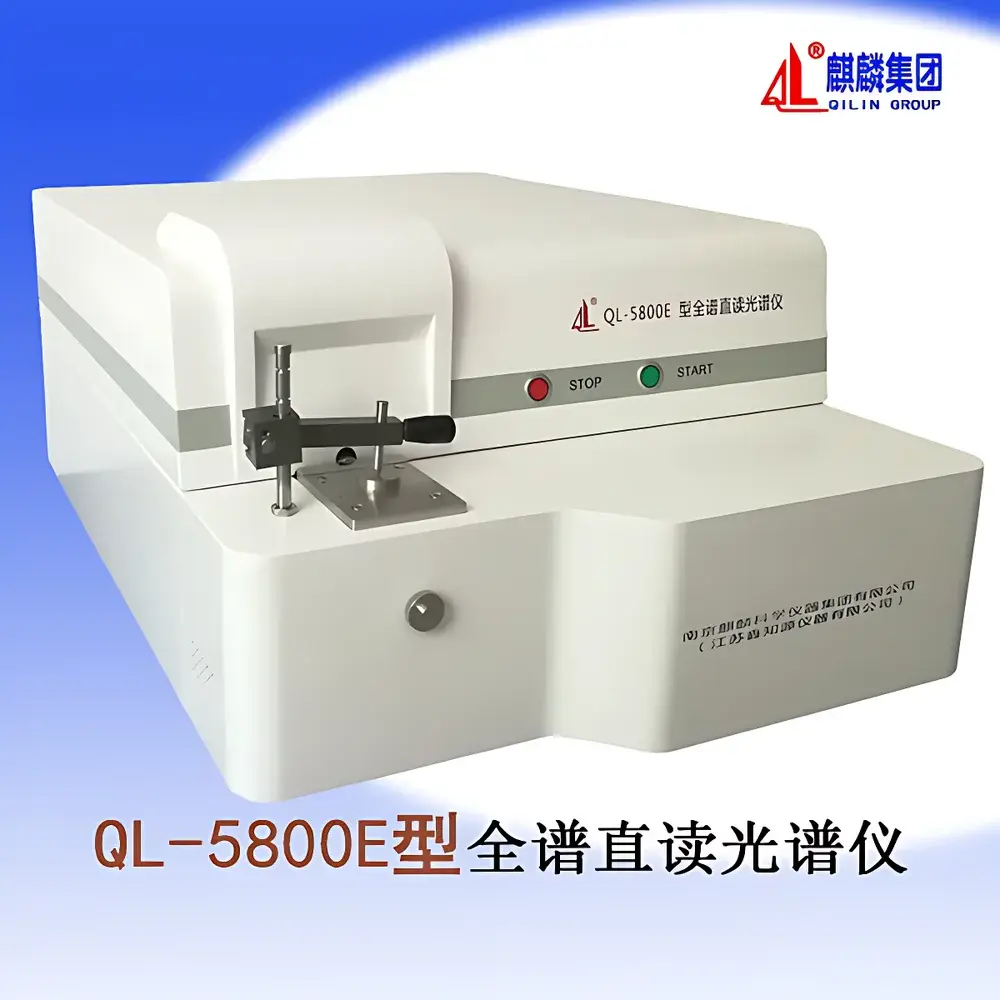
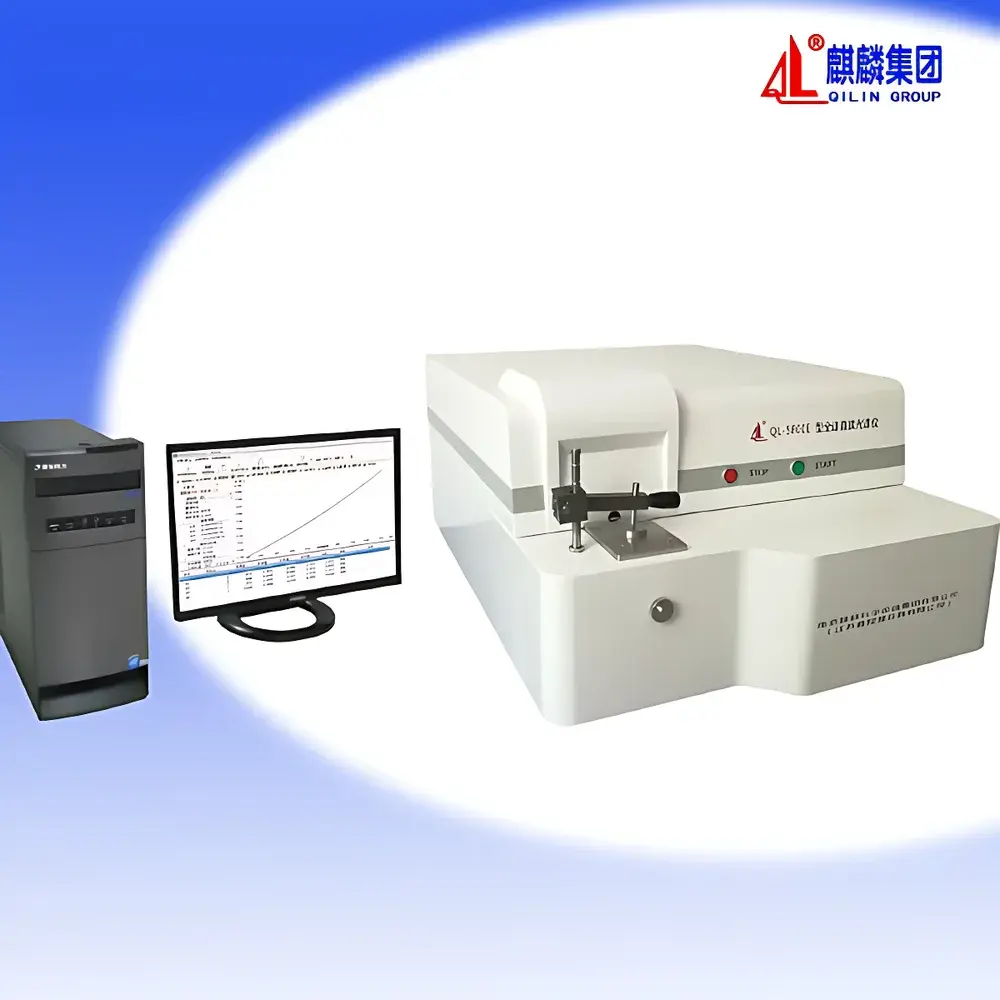
QL-5800E Full-Spectrum Direct-Reading Spark Optical Emission Spectrometer
| Brand | QL |
|---|---|
| Origin | Jiangsu, China |
| Instrument Type | Benchtop |
| Excitation Mode | Spark |
| Detector | High-Performance CMOS Array (CCD-compatible architecture) |
| Focal Length | 401 mm |
| Grating Groove Density | 2400 lines/mm |
| Wavelength Range | 140–680 nm |
| Number of Simultaneous Channels | 60 |
| Optical System | Paschen-Runge Mount with Vacuum-Enclosed Roland Circle |
| Light Source | Digital Plasma Spark Source with High-Energy Pre-Ignition (HEPS) |
| Discharge Frequency | 100–1000 Hz |
| Max Discharge Current | 500 A |
| Vacuum System | Multi-Stage Oil-Backstream Prevention with Differential Pressure Valve & In-Line Oil Trap |
| Analysis Gap | 4 mm |
| Electrode Material | Tungsten Jet Electrode |
| Argon Consumption | Optimized via Integrated Pneumatic Module |
| Data Interface | Gigabit Ethernet (TCP/IP) |
| Dimensions (W×D×H) | 780 × 565 × 360 mm |
| Weight | 78 kg |
| Typical Analysis Time | ~20 s per sample |
Overview
The QL-5800E Full-Spectrum Direct-Reading Spark Optical Emission Spectrometer is an industrial-grade benchtop instrument engineered for precise, rapid elemental analysis of solid metallic samples using spark source optical emission spectroscopy (Spark-OES). It implements a Paschen-Runge optical layout with a vacuum-sealed Roland circle spectrometer, enabling high-resolution spectral dispersion across a broad wavelength range (140–680 nm). Unlike traditional photomultiplier tube (PMT)-based systems limited to fixed channels, the QL-5800E employs a high-sensitivity CMOS array detector—designed with CCD-compatible readout architecture—to capture the full emission spectrum simultaneously. This configuration supports both quantitative analysis of major alloying elements and trace-level detection of critical non-metals including C, P, S, N, B, and As in ferrous and non-ferrous matrices. The system operates under controlled argon purge and vacuum conditions to eliminate atmospheric nitrogen and oxygen interference, ensuring spectral integrity and measurement reproducibility essential for ISO/IEC 17025-compliant metallurgical laboratories.
Key Features
- Full-spectrum CMOS detection with pixel-level spectral resolution, enabling flexible reconfiguration of analytical lines without hardware modification
- Digital plasma spark source with adjustable discharge parameters (frequency: 100–1000 Hz; current up to 500 A), optimized via High-Energy Pre-Ignition (HEPS) for stable ablation and minimal matrix effects
- Vacuum optical chamber with multi-stage oil-backstream prevention: differential pressure valve isolates the vacuum chamber when the pump is idle; integrated oil trap prevents hydrocarbon contamination of CMOS sensor and optics
- Modular argon gas management system featuring jet-electrode design (tungsten electrode with coaxial Ar flow), reducing argon consumption by >30% versus conventional spark stands
- Plug-in lens architecture allows safe, tool-free optical access under vacuum—enabling routine cleaning and alignment without venting or recalibration
- Real-time environmental monitoring of vacuum level, optical chamber temperature, argon pressure, and source stability via embedded microcontroller
- Gigabit Ethernet interface compliant with TCP/IP protocol ensures noise-immune data transmission, remote diagnostics, and seamless integration into LIMS or MES environments
Sample Compatibility & Compliance
The QL-5800E accommodates a wide range of conductive solid metal samples—including castings, ingots, billets, machined parts, and wire rods—with an open-type spark stand and modular clamping system supporting geometries from Ø3 mm wires to 100 mm diameter discs. It delivers certified performance for multi-base analysis across Fe, Al, Cu, Ni, Co, Mg, Ti, Zn, Pb, Sn, and Ag matrices. Factory-preloaded calibration curves comply with ASTM E415 (steel), ASTM E1086 (stainless steels), ASTM E1991 (aluminum alloys), and ISO 11573 (copper alloys). All firmware and software modules support audit trails, user-access control, and electronic signature functionality aligned with FDA 21 CFR Part 11 requirements for regulated manufacturing environments.
Software & Data Management
QL-SpectraSuite™ software provides bilingual (English/Chinese) operation on Windows 7/8/10 platforms and supports method-driven workflows, automated calibration validation, drift correction, and QC charting per ASTM E3061. Each analysis generates a complete metadata packet—including raw spectrum, integration windows, background correction models, and instrument status logs—stored in vendor-neutral .spc format. Data export supports CSV, XML, and SQL database protocols. Remote monitoring dashboards display real-time status of vacuum integrity, argon pressure, source energy, and detector temperature, with configurable email/SNMP alerts for out-of-spec conditions.
Applications
The QL-5800E serves as a primary analytical tool in foundry process control, incoming material inspection, scrap sorting, and R&D laboratories across steelmaking, aluminum extrusion, copper refining, aerospace component certification, and nuclear-grade alloy verification. Its ability to quantify low-Z elements (e.g., carbon in low-alloy steels at ≤0.005 wt%, sulfur in stainless grades at ≤0.001 wt%) meets stringent specifications defined in EN 10027, GB/T 4336, and JIS G 1253. Routine use includes ladle-to-ladle composition verification, heat treatment validation, failure analysis of in-service components, and supplier qualification audits requiring GLP/GMP documentation.
FAQ
Does the QL-5800E require daily vacuum pumping?
No—the system maintains stable vacuum (<5 Pa) for ≥72 hours after initial evacuation; automatic pressure monitoring triggers pump activation only when threshold is exceeded.
Can calibration curves be transferred between instruments?
Yes—calibration files (.cal) are portable across QL-5800E units of identical optical configuration; cross-instrument validation requires reference standardization per ISO 17025 Clause 6.4.3.
Is argon purity specification defined?
Yes—Grade 4.8 (99.998% pure, H2O < 5 ppm, O2 < 5 ppm) is required to prevent spectral interference and electrode oxidation.
What maintenance intervals are recommended?
Optical window cleaning every 2000 sparks; electrode tip dressing every 5000 sparks; vacuum pump oil replacement every 6 months or 3000 operating hours.
How is spectral drift compensated during long-term operation?
The system performs automatic pixel mapping calibration prior to each analysis sequence, referencing internal Ne/Ar emission lines to correct for thermal/mechanical drift in real time.





