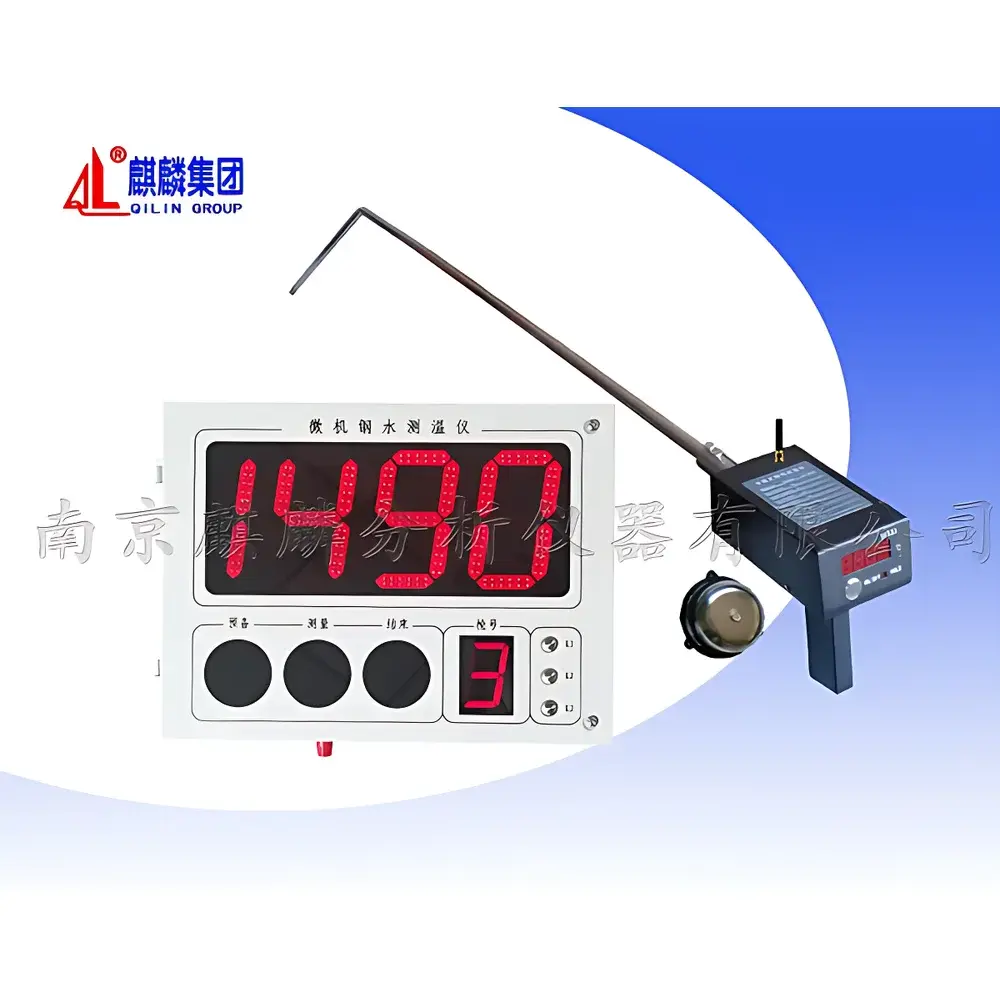
QL-TS-2 Wireless Wall-Mounted Microcomputer Molten Metal Thermometer by Qilin
| Brand | Qilin |
|---|---|
| Model | QL-TS-2 |
| Measurement Range (Fast) | 500–1999 °C |
| Continuous Range | 200–1999 °C |
| Thermocouple Type | S, B, R, WRe3/25 |
| Display | 3.5-digit, 5-inch high-brightness red LED (digit height: 127 mm) |
| Operating Temperature | 0–55 °C |
| Storage Temperature | −40–85 °C |
| Humidity (Operating) | <85% RH |
| Humidity (Storage) | <95% RH |
| Power Supply | AC 220 V / 50 Hz, 20 W |
| Dimensions (Single-Side) | 400 × 300 × 110 mm |
| Dimensions (Dual-Side) | 400 × 300 × 130 mm |
| Wireless Band | 868 MHz ISM |
| Line-of-Sight Transmission Distance | ≤200 m |
| Sampling Interval | 20 ms |
| Data Storage | 200 records |
| Output Interfaces (Configurable) | RS485, RS232, isolated BCD, 4–20 mA analog, DC12V audio alarm, thermal printer port |
Overview
The QL-TS-2 Wireless Wall-Mounted Microcomputer Molten Metal Thermometer is an industrial-grade temperature measurement system engineered for real-time, non-contact-free, high-reliability monitoring of molten metal baths in primary and secondary metallurgical processes. Designed specifically for continuous operation in harsh foundry and steelmaking environments, the instrument employs a high-speed 16-bit embedded microprocessor architecture and supports interchangeable Type S, B, R, and tungsten-rhenium (WRe3/25) thermocouples—enabling accurate measurement across a broad operational range from 200 °C to 1999 °C. Its core measurement principle relies on cold-junction compensation (CJC) via a precision integrated temperature sensor, coupled with software-based linearization and automatic calibration circuitry. The 20 ms sampling interval ensures rapid response to transient thermal events during tapping, ladle refining, or casting operations, while the built-in electromagnetic interference (EMI) suppression provides robust immunity against 50 Hz power-line noise—a critical requirement in electric arc furnace (EAF) and induction melting facilities.
Key Features
- Wall-mounted, ruggedized enclosure rated for continuous use in ambient temperatures up to 55 °C and relative humidity below 85% RH
- High-visibility 5-inch red LED display with 127 mm digit height, optimized for viewing at distances exceeding 20 meters in low-light or smoke-affected production areas
- 868 MHz ISM-band wireless telemetry with ≤200 m line-of-sight transmission range—eliminates cabling hazards near molten metal handling zones
- Dual-mode operation: fast immersion measurement (500–1999 °C) and extended continuous monitoring (200–1999 °C), configurable per thermocouple type
- Integrated data acquisition subsystem featuring 16-bit ADC resolution, programmable filtering, and automatic zero-drift correction
- Configurable I/O suite including isolated RS485 (Modbus RTU compatible), RS232, 4–20 mA analog output, BCD parallel interface, and DC12V active buzzer output
- Onboard non-volatile memory stores up to 200 timestamped temperature records with user-defined logging intervals
- Voice announcement capability (optional) for audible temperature readouts in high-noise environments—compliant with OSHA 1910.95 and EU Directive 2003/10/EC acoustic safety thresholds
Sample Compatibility & Compliance
The QL-TS-2 is validated for direct contact measurement of molten ferrous and non-ferrous metals—including carbon steel, stainless steel, cast iron, copper alloys, aluminum melts, and slag phases—using industry-standard disposable or reusable thermocouple probes. Its hardware design conforms to IEC 61000-6-2 (immunity) and IEC 61000-6-4 (emissions) for industrial environments. While not certified to SIL or ATEX standards, its electrical isolation architecture (≥1500 V AC between sensor input and all outputs) meets functional safety requirements for Category 2 process instrumentation per IEC 61508. The device supports traceable calibration workflows aligned with ISO/IEC 17025 laboratory practices and integrates seamlessly into QA/QC documentation systems required under ASTM E2877 (Standard Guide for Temperature Measurement in Molten Metals) and GB/T 7724–2008 (Chinese national standard for industrial thermometers).
Software & Data Management
Data export and remote configuration are supported via optional PC-based utility software communicating over RS485 or RS232 interfaces. The software enables firmware updates, calibration coefficient editing, alarm threshold setting, and batch export of stored readings in CSV format. All configuration changes and measurement logs can be time-stamped and exported with operator ID fields—supporting basic audit trail functionality consistent with GLP and internal quality management systems (QMS). Though not natively compliant with FDA 21 CFR Part 11, the system permits integration with third-party SCADA or MES platforms that provide electronic signature and record retention capabilities.
Applications
- Real-time temperature verification during ladle transfer, tundish filling, and continuous casting start-up sequences
- Secondary metallurgy process control: RH degassing, CAS-OB heating, and LF refining cycle validation
- Molten slag temperature monitoring for slag basicity optimization and refractory wear assessment
- Foundry cupola and induction furnace charge temperature profiling prior to tapping
- Quality gate enforcement in ISO 9001-certified production lines requiring documented thermal compliance per heat number
- Preventive maintenance support—correlating thermal drift patterns with thermocouple probe degradation or furnace lining erosion
FAQ
What thermocouple types are supported by the QL-TS-2?
The instrument accepts Type S, B, R, and tungsten-rhenium (WRe3/25) thermocouples—each selectable via front-panel menu or configuration software.
Is the wireless transmission encrypted or secured?
No encryption is implemented; the 868 MHz RF link uses fixed-frequency modulation and is intended for short-range, point-to-point telemetry within controlled plant environments.
Can historical data be exported without connecting to a PC?
No—the 200-record internal memory requires serial connection (RS232/RS485) for retrieval; no SD card or USB interface is provided.
Does the unit meet NIST-traceable calibration requirements?
Yes—calibration certificates with NIST-traceable references (via accredited third-party labs) are available upon request and conform to ISO/IEC 17025 reporting formats.
What is the recommended maintenance interval for the display and electronics?
Visual inspection and cleaning every 6 months; full functional verification and CJC sensor recalibration recommended annually or after exposure to thermal shock >200 °C/min.