
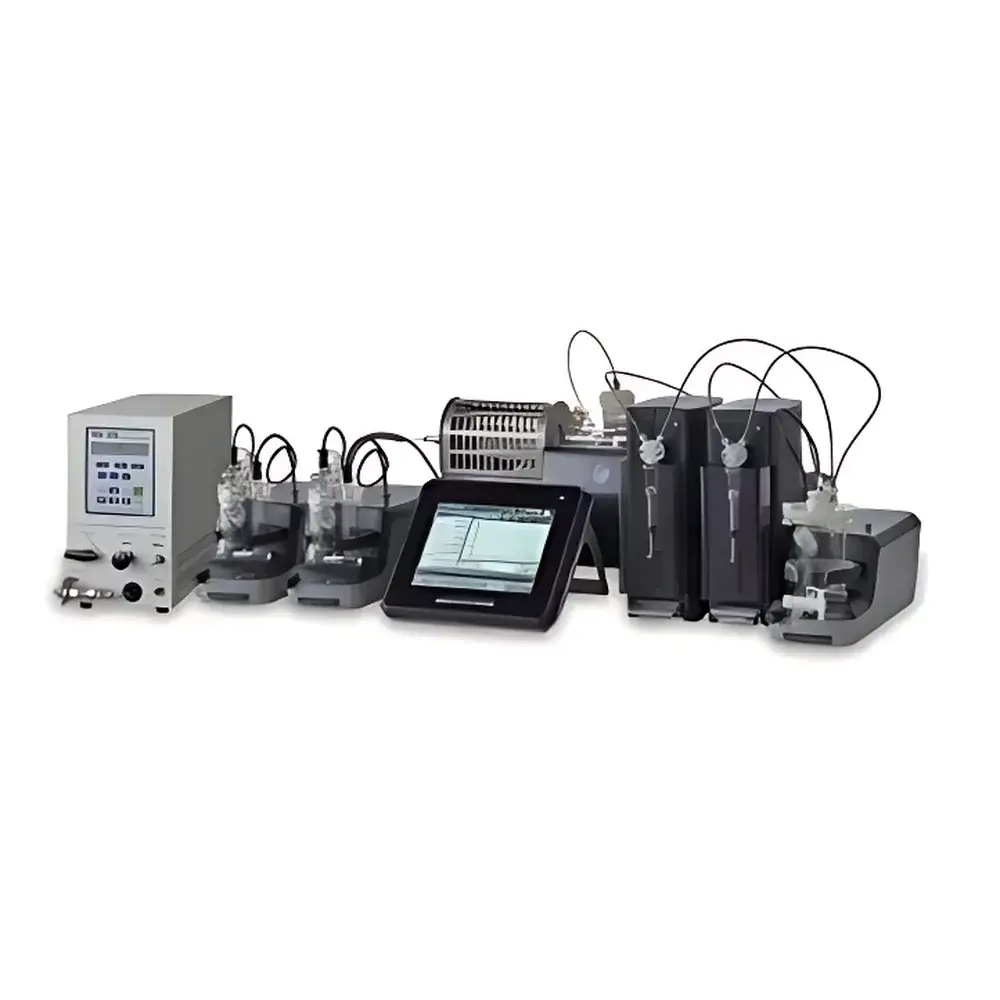
Mitsubishi Chemical CVS-210 Universal Trace Moisture Detection System
| Brand | Mitsubishi Chemical |
|---|---|
| Origin | Japan |
| Model | CVS-210 |
| Titration Method | Fully Automated Coulometric Karl Fischer Titration |
| Instrument Type | Coulometric Karl Fischer Moisture Analyzer |
| Measurement Resolution | ±0.1 μA |
| Water Content Range | 0.5 μg to 999.9999 mg |
| Accuracy | <0.3% RSD |
| Minimum Dispensing Volume | 0 μL |
| Titration Control Precision | 0 (coulometric, current-controlled, no reagent dispensing) |
Overview
The Mitsubishi Chemical CVS-210 Universal Trace Moisture Detection System is a high-precision, coulometric Karl Fischer (KF) analyzer engineered for quantitative determination of trace water content across solid, liquid, and gaseous samples. Unlike volumetric KF systems that rely on standardized titrant delivery, the CVS-210 employs electrogenerated iodine via controlled constant-current electrolysis—ensuring stoichiometric accuracy, exceptional sensitivity down to 0.5 μg H₂O, and inherent reproducibility without reagent calibration drift. Its modular architecture integrates a central control unit with dedicated, physically isolated sample introduction pathways: one optimized for viscous oils and standard liquids (via syringe or auto-sampler interface), another for pressurized gas streams (using regulated flow-through cell and moisture-permeable membrane interface), and two additional channels configurable for solid-phase analysis (e.g., headspace extraction or oven-coupled thermal desorption). This design eliminates cross-contamination risks and enables concurrent multi-phase analysis under identical environmental and electrochemical conditions.
Key Features
- Four independent, electrically isolated detection channels—each equipped with dedicated generator and indicator electrodes, sealed electrolyte reservoirs, and channel-specific parameter memory—to support simultaneous solid, liquid, and gas measurements without signal interference.
- 8.4-inch high-resolution color touchscreen HMI with intuitive graphical workflow navigation, real-time current/voltage/endpoint curve visualization, and on-screen electrode status diagnostics.
- Coulometric generation of iodine at fixed current (±0.1 μA resolution), eliminating mechanical burette errors and enabling sub-microgram quantification with <0.3% relative standard deviation across repeated analyses.
- Integrated data integrity architecture: audit-trail-enabled storage for up to 9,999 test records, including timestamp, operator ID, method parameters, raw current-time integrals, and endpoint confirmation flags.
- Multi-tier user access control (administrator, supervisor, analyst) with password-protected method editing, result modification lockout, and electronic signature capability compliant with ALCOA+ principles.
Sample Compatibility & Compliance
The CVS-210 accommodates diverse sample matrices without method revalidation: low-volatility lubricants (ISO 8503-3), hygroscopic polymers (ASTM D6304), pharmaceutical excipients (USP <921>), semiconductor process gases (SEMI F21), and battery-grade electrolytes (IEC 62620). All wetted components—including the glass electrolysis cell, PTFE gas diffusion membrane, and stainless-steel sample injection ports—are chemically inert to KF reagents (e.g., Hydranal-Coulomat AG) and resistant to hydrolysis by aggressive solvents. The system meets ISO/IEC 17025 requirements for testing laboratories and supports 21 CFR Part 11-compliant electronic records when paired with validated LIMS integration protocols. Full GLP/GMP documentation packages—including IQ/OQ/PQ templates, electrode certification logs, and reagent lot traceability reports—are available upon request.
Software & Data Management
The embedded firmware (v3.2+) provides native CSV export, USB mass-storage mode, and RS-232/Ethernet interfaces for networked deployment. Data files include unprocessed current-time series, integrated coulombs, calculated water mass (μg), normalized concentration (ppm or % w/w), and statistical summaries (mean, SD, CV%). Optional PC-based software (CVS-Link Suite) adds automated report generation (PDF/Excel), trend analysis across batches, method version control with rollback, and secure cloud backup with TLS 1.2 encryption. All data modifications are logged with immutable timestamps and user context, satisfying FDA and EMA expectations for analytical data lifecycle management.
Applications
- Quality control of lithium-ion battery cathode materials and electrolyte solvents where residual H₂O >20 ppm induces HF formation and cell degradation.
- Stability-indicating assay of lyophilized biologics per ICH Q5C, detecting moisture-induced aggregation onset below 0.2% w/w.
- Trace moisture monitoring in SF₆ insulating gas for high-voltage switchgear (IEC 60480 limits: ≤150 ppm v/v).
- Process validation of solvent recovery systems in API manufacturing, verifying drying endpoint consistency across batch cycles.
- Research into hydration kinetics of metal-organic frameworks (MOFs), leveraging real-time current profiling during controlled vapor exposure.
FAQ
How does the CVS-210 achieve sub-microgram detection without volumetric reagent delivery?
It uses coulometric iodine generation: water reacts stoichiometrically with electrochemically produced iodine (I₂), and total charge passed (Q = I × t) directly calculates water mass via Faraday’s law (1 mole H₂O ≡ 2 × 96,485 C). No burette calibration or reagent standardization is required.
Can the same electrode set be used for both liquid and gas analysis?
No—gas analysis requires a specialized dual-compartment cell with hydrophobic membrane separation to prevent electrolyte contamination; liquid and solid modes use standard single-compartment cells with platinum generator and double-platinum indicator electrodes.
Is method validation support provided for regulated industries?
Yes: Mitsubishi Chemical offers application notes aligned with USP <921>, ASTM D6304, and ISO 15512, plus documented verification protocols for accuracy, precision, linearity, LOD/LOQ, and robustness per ICH Q2(R2).






