
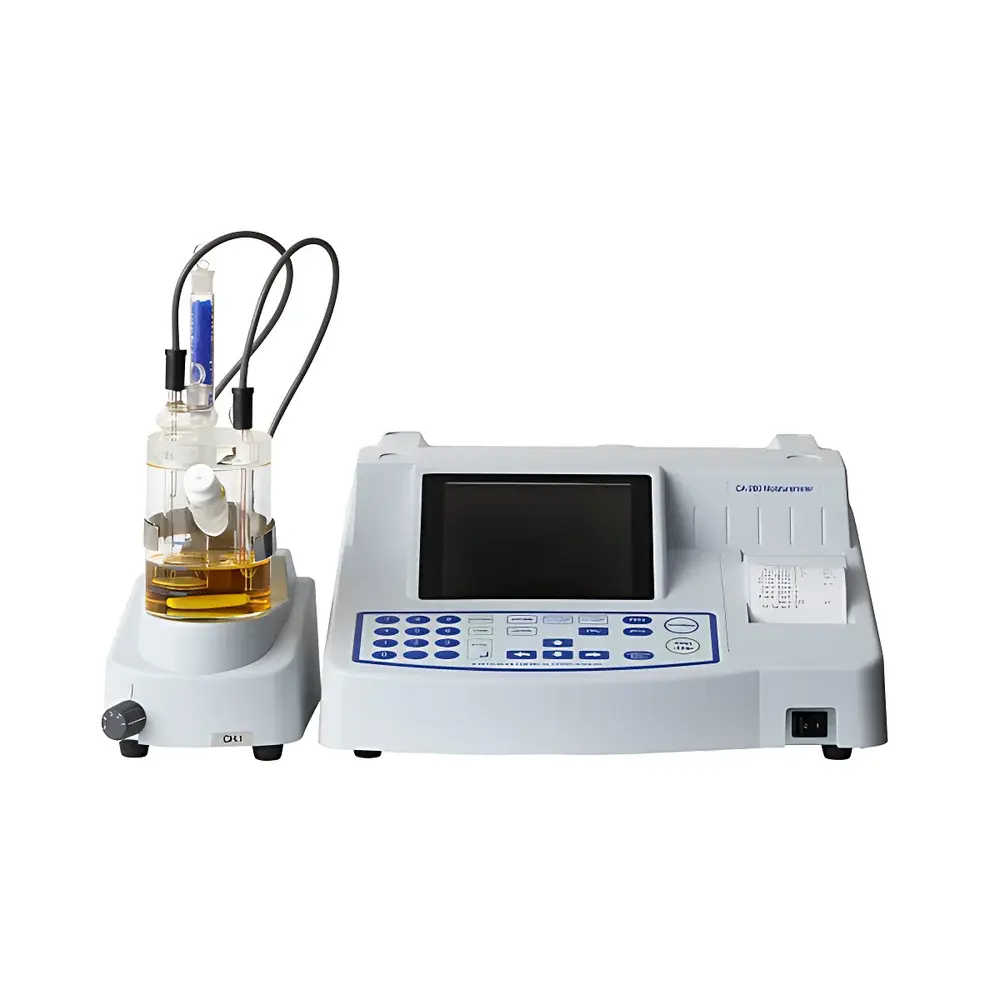
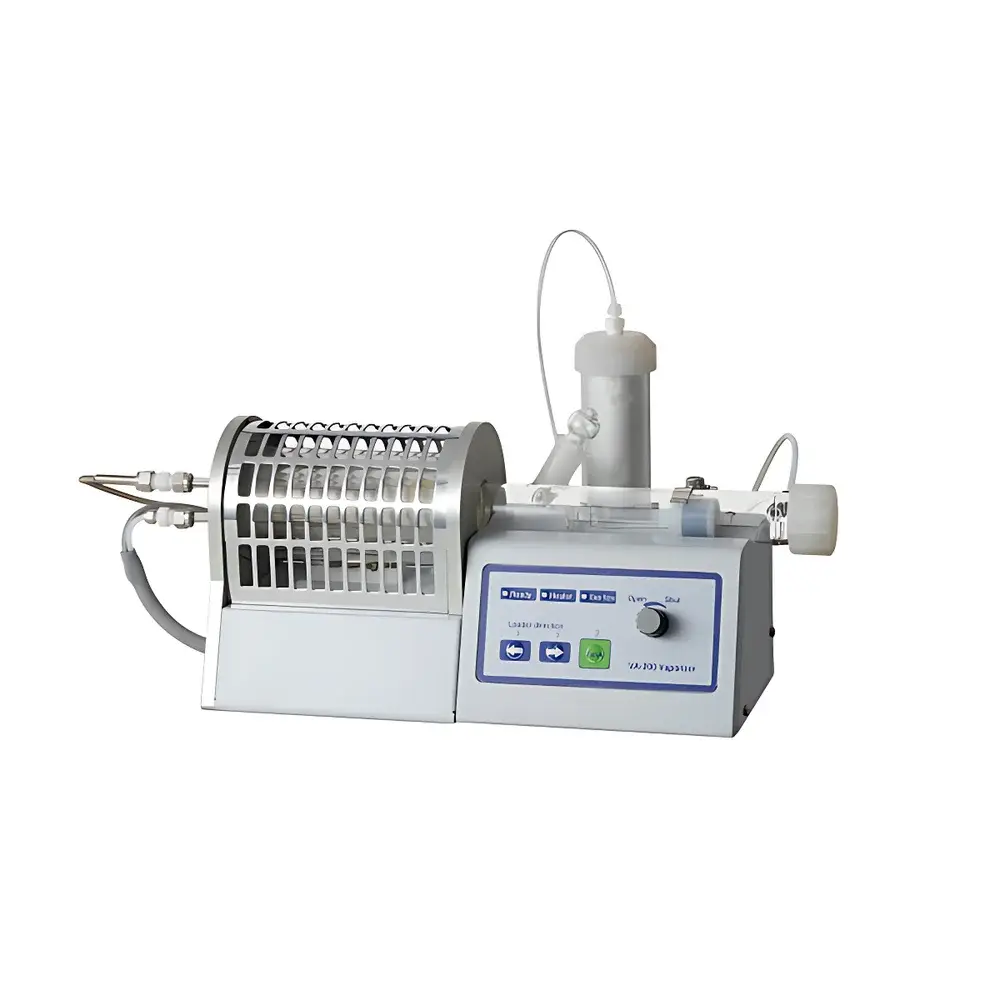
MITSUBISHI CHEMICAL CA-200 Coulometric Karl Fischer Moisture Analyzer
| Brand | MITSUBISHI CHEMICAL |
|---|---|
| Origin | Japan |
| Instrument Type | Coulometric Karl Fischer Moisture Analyzer |
| Moisture Range | 1 ppm – 100% w/w (10 µg – 100 mg H₂O) |
| Accuracy | ≤0.3% RSD (for ≥1 mg H₂O, n=10) |
| Minimum Dispensing Volume | 1/2000 of burette volume |
| Electrolysis Current | 430 mA |
| Titration Speed | 36 µg H₂O/sec (avg. 2.2 mg H₂O/min) |
| Display | 5.7-inch color LCD |
| Data Storage | 20 user-defined methods × 50 sub-files |
| Interface | RS-232C (optional), USB storage port, balance input (auto-weighing), internal/external communication ports |
| Power | AC 100–120 V / 230–240 V, 50/60 Hz |
| Dimensions (Analyzer) | 220 × 350 × 360 mm (W×D×H) |
| Weight | ~5 kg |
| VA-200 Vaporizer | Temp. range 70–300 °C, N₂ carrier gas 0.1–0.5 L/min, max. sample mass 10 g, weight ~5.5 kg |
Overview
The MITSUBISHI CHEMICAL CA-200 is a high-precision coulometric Karl Fischer moisture analyzer engineered for trace- to macro-level water quantification in solid, liquid, and gaseous samples. It operates on the electrochemical principle of the Karl Fischer reaction—where iodine generated *in situ* via controlled electrolysis reacts stoichiometrically with water in the titration cell. This coulometric method eliminates volumetric reagent delivery errors, enabling direct quantification of water content based on Faraday’s law (1 mole of I₂ ≡ 1 mole of H₂O ≡ 2 × 96,485 C). The CA-200 delivers exceptional reproducibility for samples containing 10 µg to 100 mg of water—corresponding to concentration ranges from 1 ppm to 100% w/w—making it suitable for stringent quality control in polymer manufacturing, pharmaceutical excipient release testing, and high-purity chemical certification.
Key Features
- Dual-channel expandability: Supports simultaneous connection of two coulometric cells, dual vaporizers (e.g., VA-200), or dual reagent dispensing units—enabling parallel analysis without hardware duplication.
- Intelligent electrode management: Automatic polarization compensation and real-time background current correction minimize drift and eliminate manual electrode cleaning between runs.
- Programmable magnetic stirrer: Five-step smooth-speed regulation ensures consistent mixing across viscosity gradients—from low-viscosity solvents to molten polymers—without vortex formation or splashing.
- Modular reagent handling: Optional reagent purge-and-refill module enables one-touch replacement of spent KF electrolyte, reducing downtime and operator exposure to hygroscopic reagents.
- Open calculation architecture: Users define custom formulas (e.g., % H₂O, ppm vs. dry mass, normalized per functional group) directly in the instrument firmware—results auto-calculated and displayed post-titration.
- Flexible electrode configuration: Interchangeable membrane-free and membrane-type generator electrodes: membrane-free for routine analysis with single-component AQUAMICRON reagents; membrane-type for challenging matrices (ketones, aldehydes, low-hydroxy acids) requiring isolation of anolyte/catholyte compartments.
- Integrated thermal printer: Prints full audit trail including date/time stamp, method ID, sample ID, weight entry, titration curve, endpoint detection logic, and final result—fully compliant with GLP documentation requirements.
Sample Compatibility & Compliance
The CA-200—paired with the VA-200 heated vaporizer—enables reliable moisture determination in thermally stable and semi-volatile solids including polyolefins, PET, nylon, rubber compounds, pharmaceutical tablets, inorganic salts, and metal oxides. For liquids, direct injection supports oils (transformer, lubricating), solvents, monomers, and food-grade glycerin. Gaseous samples (e.g., propane, vinyl chloride) are analyzed via gas sampling loops connected to the VA-200’s carrier gas manifold. All operation adheres to ASTM D6304, ISO 12937, USP , and EP 2.5.12. Data integrity meets FDA 21 CFR Part 11 requirements when used with optional PC software featuring electronic signatures, audit trails, and role-based access control.
Software & Data Management
The embedded firmware supports up to 20 independent method files, each containing 50 configurable sub-methods—allowing fine-tuned optimization for sample class (e.g., “PET granules – VA-200 @ 180°C”, “Lithium carbonate – direct injection”). All results—including raw current-time curves, endpoint thresholds, and drift corrections—are timestamped and stored internally (200 records) or exported via USB to CSV or proprietary .KFA formats. RS-232C connectivity enables integration into LIMS environments or automated QC dashboards. Method validation reports include repeatability (CV%), linearity (R² > 0.999 over 10–100 mg H₂O), and system suitability checks per USP .
Applications
- Polymer industry: Quantifying residual moisture in engineering plastics prior to extrusion or injection molding to prevent hydrolytic degradation.
- Pharmaceutical manufacturing: Release testing of hygroscopic APIs and excipients against ICH Q5C stability thresholds.
- Energy sector: Monitoring water contamination in insulating oils per IEEE C57.106 and ASTM D1533.
- Food science: Validating low-moisture specifications in powdered dairy, starches, and dehydrated vegetables.
- Electronics materials: Ensuring ultra-low water content (<10 ppm) in solder fluxes and encapsulation resins to avoid delamination.
FAQ
What sample types require the VA-200 vaporizer?
Solid and semi-solid samples—including plastics, powders, and viscous pastes—must be coupled with the VA-200 to ensure complete and reproducible water release prior to coulometric detection.
Can the CA-200 comply with 21 CFR Part 11?
Yes—when operated with the optional PC-based KF Manager software, the system provides electronic signatures, immutable audit trails, and user-access hierarchies required for regulated environments.
How does the membrane-free electrode differ from the membrane-type?
Membrane-free electrodes simplify maintenance and reduce reagent consumption for routine analyses; membrane-type electrodes are essential for reactive matrices that interfere with the anolyte or catholyte compartments.
Is calibration required before each analysis?
No—coulometric KF analyzers like the CA-200 are inherently absolute methods; calibration is verified using certified water standards (e.g., sodium tartrate dihydrate) at defined intervals per SOP.
What is the minimum detectable water mass?
The system reliably detects 10 µg H₂O with ≤0.3% RSD, corresponding to ~1 ppm in a 1 g solid sample or ~0.1 ppm in a 10 g sample when used with VA-200.
Related Products




