
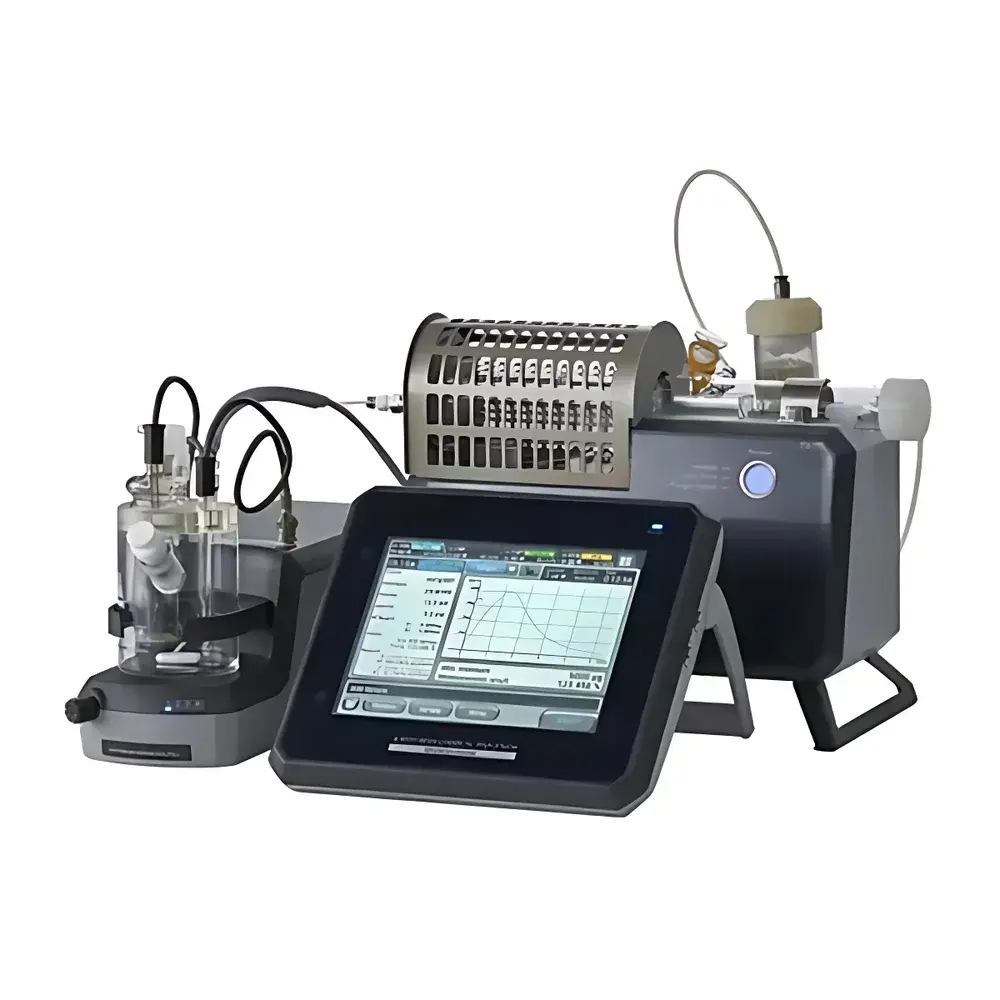
Nittoseiko Analytech CA-310B Coulometric Karl Fischer Moisture Analyzer
| Brand | Nittoseiko Analytech |
|---|---|
| Origin | Japan |
| Instrument Type | Coulometric Karl Fischer Moisture Analyzer |
| Titration Method | Fully Automated Coulometric Titration |
| Measurement Resolution | 0.1 µg H₂O |
| Moisture Range | 5 µg – 999.9999 mg H₂O |
| Accuracy | < 0.3% RSD (for samples > 1 mg H₂O) |
| Minimum Dispensing Increment | 1/2000 of burette volume |
| Titration Control Precision | 0.1 µg H₂O |
| Electrolysis Current | Up to 516 mA |
| Average Titration Speed | 2.2 mg H₂O/min (2.64 mg H₂O/min in High-Speed Mode) |
| Background Correction | Automatic, Real-Time Display |
| Sample Heating Control | Stepwise Temperature Optimization (Patent No. 3284783) |
| Electrode Options | Membrane-Free or Membrane-Type Generator Electrodes |
| Compliance | GLP/GMP Data Integrity Support |
| Interface | 4× USB, 1× LAN, RS-232 for Balance Integration |
| Display | 8.4″ Color TFT Touchscreen |
| Data Storage | 9999 Test Records |
| Scheduled Power-On/Off | 99 Presets |
| Dimensions (Main Unit) | 244 × 161 × 215 mm (W×D×H) |
| Weight (Main Unit) | 2.0 kg |
Overview
The Nittoseiko Analytech CA-310B is a high-precision coulometric Karl Fischer moisture analyzer engineered specifically for trace-level water quantification in electrochemical and battery materials—where sub-milligram moisture content directly impacts electrolyte stability, SEI formation, and cell lifetime. Unlike volumetric KF systems, the CA-310B employs controlled-current coulometric titration: iodine is generated electrochemically at the anode via Faraday’s law (I × t = nF), enabling absolute quantification of water without reagent standardization. This principle delivers inherent accuracy, minimal reagent consumption, and exceptional sensitivity down to 5 µg H₂O—critical for Li-ion cathode precursors (e.g., Ni-rich NMC, LFP), anode coatings (graphite, silicon composites), and solid-state electrolyte powders (Li₆PS₅Cl, LLZO). Its design reflects decades of refinement from Mitsubishi Chemical’s legacy in KF methodology, now advanced under Nittoseiko Analytech’s ISO 9001-certified manufacturing in Japan.
Key Features
- Coulometric detection with 0.1 µg H₂O resolution and 1 mg H₂O—validated per ASTM E203 and ISO 760
- Stepwise temperature-controlled vaporizer (Patent No. 3284783): dynamically adjusts heating profile based on real-time evaporation kinetics, minimizing thermal degradation of thermally labile battery active materials
- Modular multi-channel architecture: up to four independent measurement cells connect to a single master console—enabling parallel analysis with inter-channel statistical validation and reduced throughput variance
- Intelligent SOP-driven operation: preloaded standard operating procedures guide users through sample weighing, injection, and conditioning steps with on-screen prompts and mandatory confirmation points
- Dual-electrode compatibility: membrane-free electrodes support rapid maintenance using single-component AQUAMICRON® reagents; membrane-type electrodes extend analyte scope to ketones (e.g., acetone solvent residues), low-hydroxyl acids, and aldehydes commonly found in binder systems
- High-speed electrolysis mode: increases iodine generation rate to 2.64 mg H₂O/min while maintaining endpoint stability—reducing assay time by ~18% versus conventional coulometric protocols
- Automated background correction: continuously monitors and subtracts ambient drift during analysis, ensuring robustness in non-climate-controlled QC labs
Sample Compatibility & Compliance
The CA-310B accommodates solid, liquid, and slurry samples typical in battery R&D and production—powdered cathodes, slurried anodes, separator films, and electrolyte solutions. When paired with optional vaporizers (VA-300, VA-236S, VG-200 series), it achieves complete water release from hygroscopic, low-surface-area materials without charring. All firmware and data handling comply with GLP and GMP requirements: audit trails record operator ID, timestamp, method version, raw current-time curves, and manual interventions. Electronic signatures, user role-based access control, and encrypted USB/LAN data export meet FDA 21 CFR Part 11 readiness criteria. Calibration verification logs, electrode activation cycles, and system suitability tests (e.g., 10 µg water standard recovery) are automatically archived.
Software & Data Management
Embedded firmware supports full lifecycle data integrity: test records include metadata (sample ID, batch, analyst, environmental conditions), raw polarographic current traces, titration curves, and statistical summaries (mean, SD, %RSD across replicates). Data export is configurable via USB or LAN—CSV for LIMS integration or proprietary .KFD format retaining curve fidelity. The 8.4″ capacitive touchscreen provides intuitive navigation with multilingual UI (English, Japanese, Chinese); all SOPs, calibration certificates, and instrument logs reside locally with password-protected backup/restore. Firmware updates preserve historical configuration, and error diagnostics include contextual help menus—e.g., “Low conductivity detected” triggers electrode cleaning guidance and voltage-check protocol.
Applications
- Quantifying residual moisture in LiCoO₂, NCA, and NCMA cathode powders prior to slurry mixing—preventing HF generation from LiPF₆ hydrolysis
- Verifying drying efficacy of silicon-carbon anode composites after solvent removal (NMP, water)
- Monitoring moisture ingress in dry-room-stored separators (PP/PE membranes) and pouch cell laminates
- Validating shelf-life stability of solid electrolytes exposed to controlled humidity chambers
- Supporting IEC 62660-1 and UL 1642 compliance testing by delivering traceable, auditable moisture data for safety documentation
FAQ
What sample types require the membrane-type generator electrode?
Ketone-based solvents (e.g., acetone used in cleaning), low-hydroxyl organic acids (e.g., adipic acid in binder formulations), and certain aldehydes exhibit side reactions with iodine in membrane-free systems; the隔膜 electrode isolates the generation chamber to suppress interference.
Can the CA-310B interface with automated sample changers?
Yes—via RS-232 or LAN, it accepts weight data from METTLER TOLEDO, Sartorius, and Shimadzu analytical balances and can trigger external autosamplers using TTL-level I/O signals.
How is system suitability verified before routine use?
A 10 µg water standard (certified reference material) is analyzed daily; recovery must fall within 97–103%, and %RSD across three injections ≤ 2.0%—records are auto-logged with pass/fail flags.
Is wireless channel control supported out-of-the-box?
Wireless operation (Wi-Fi or Bluetooth) requires optional Nittoseiko module CA-WL1; standard configuration uses shielded Ethernet or direct USB.
What environmental conditions optimize 5 µg detection capability?
Ambient temperature 23 ± 2°C, RH < 40%, and vibration isolation are recommended; the instrument’s internal desiccant cartridge and sealed reaction cell minimize ambient moisture ingress during ultra-trace analysis.





