
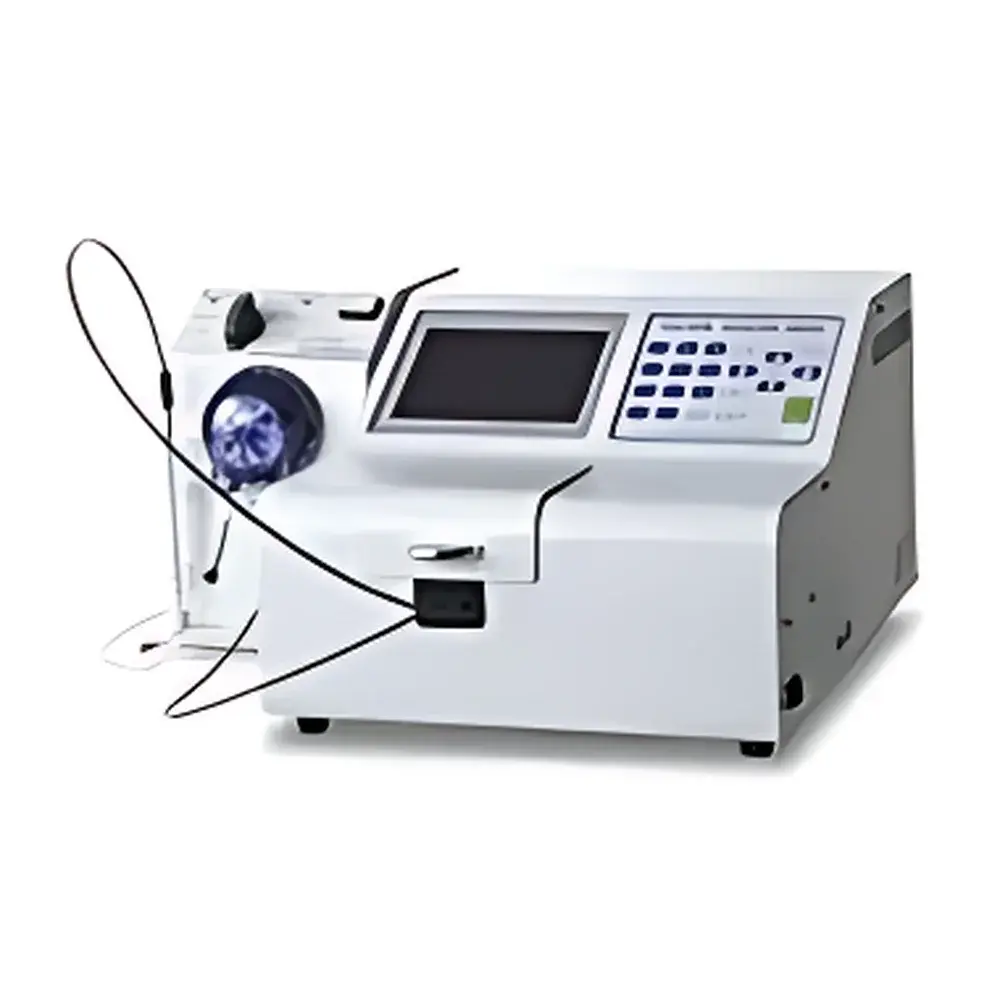
Mitsubishi Chemical PT-200 Integrating Sphere Turbidimeter
| Brand | Mitsubishi Chemical |
|---|---|
| Origin | Japan |
| Model | PT-200 |
| Form Factor | Benchtop Laboratory Instrument |
| Turbidity Measurement Range | 0–1000 ppm (kaolin), 0–100 ppm (polystyrene) with 10 mm cell |
| Colorimetric Range | 0–10 degrees |
| Resolution | 0.1 NTU |
| Accuracy | ±3% RSD (1–10 ppm, 10 mm cell) |
| Operating Temperature | 0–25 °C |
| Light Source | 12 V / 50 W Halogen Lamp |
| Detector | Silicon Photodiode |
| Integrating Sphere Diameter | Φ80 mm |
| Display | 5.7-inch Full-Color LCD (supporting alphanumeric, kanji, and katakana) |
| Interface | RS-232C, USB |
| Power Supply | AC 100 ±10 V, 50/60 Hz, 118 VA |
| Dimensions | 300(W) × 430(D) × 220(H) mm |
| Weight | ~11 kg |
| Compliance | JIS K 0101, Japanese Waterworks Testing Methods |
Overview
The Mitsubishi Chemical PT-200 Integrating Sphere Turbidimeter is a precision benchtop instrument engineered for high-fidelity turbidity quantification in regulated laboratory and municipal water quality environments. It employs the integrating sphere photometric method—fully compliant with JIS K 0101 and Japanese Waterworks Testing Standards—to decouple scattered light (Td) from transmitted parallel light (Tp) via spatially resolved detection within a calibrated Φ80 mm integrating sphere. This optical architecture enables simultaneous, independent measurement of both components: scattered light is directed exclusively to sensor D1, while collimated transmittance reaches sensor D2. The Td/Tp ratio serves as the fundamental analytical signal, linearized against certified turbidity standards (e.g., formazin or polymer suspensions) to generate traceable calibration curves. Unlike single-detector nephelometers, this dual-signal acquisition mitigates errors from sample coloration, absorbance, or path-length variability—critical for accurate turbidity assessment in colored or low-turbidity waters (down to 0.1 ppm equivalent) and high-concentration suspensions (up to 1000 ppm kaolin).
Key Features
- Dual-sensor integrating sphere optics enabling true Td/Tp ratio calculation per JIS K 0101 requirements
- Configurable path length support: 10 mm and 50 mm cuvettes for optimized dynamic range across low- and high-turbidity applications
- Integrated desiccant gas inlet port to suppress condensation on optical surfaces during high-humidity operation
- Real-time integration timing control to minimize data dispersion caused by particle settling or convection during measurement
- Onboard storage for up to 20 user-defined calibration curves and 999 measurement records with timestamp and operator ID
- 5.7-inch full-color LCD interface supporting multilingual character sets (including kanji and katakana) for localized operational clarity
- Halogen lamp illumination (12 V / 50 W) with stable spectral output across the visible range (400–700 nm)
Sample Compatibility & Compliance
The PT-200 accommodates standard quartz or optical-grade glass cuvettes (10 mm and 50 mm path lengths) and is validated for aqueous suspensions including kaolin, polystyrene latex, and formazin-based reference standards. Its turbidity measurement methodology satisfies JIS K 0101 (Japanese Industrial Standard for water quality testing) and aligns with core principles of ISO 7027 (optical methods for turbidity) and EPA Method 180.1. For colorimetric analysis, it implements transmission photometry per Japanese Waterworks Testing Methods, reporting results in platinum-cobalt (Pt-Co) degrees. The instrument’s design supports GLP-compliant workflows: all calibrations, measurements, and configuration changes are time-stamped and stored internally, and audit-ready data export is enabled via RS-232C or USB mass storage.
Software & Data Management
Data integrity is maintained through built-in non-volatile memory that logs raw sensor outputs (D1 and D2 voltages), calculated Td/Tp ratios, final turbidity values (ppm or NTU), color values (degrees), and associated metadata—including date/time, operator ID, calibration curve ID, and cuvette path length. Exported files are saved in CSV format for direct import into LIMS or statistical analysis platforms. Firmware supports firmware update via USB and permits configuration locking to prevent unauthorized parameter changes—a requirement in GMP-regulated water testing laboratories. While no proprietary PC software is bundled, the RS-232C interface enables integration with custom SCADA or laboratory automation systems adhering to Modbus RTU or ASCII command protocols.
Applications
The PT-200 is routinely deployed in municipal drinking water treatment plants for raw intake monitoring, coagulation/flocculation optimization, and finished water compliance verification. It is also applied in pharmaceutical manufacturing for purified water (PW) and water-for-injection (WFI) system validation per JP/USP , in semiconductor fab ultrapure water (UPW) QC labs where sub-ppm sensitivity is required, and in academic environmental research for suspended solids characterization in estuarine and wastewater matrices. Its immunity to chromophore interference makes it particularly suitable for turbidity measurement in humic-rich surface waters, dyed effluents, and bioreactor broths where conventional nephelometers exhibit significant bias.
FAQ
Does the PT-200 comply with ISO 7027 or US EPA Method 180.1?
It fully complies with JIS K 0101 and Japanese Waterworks Testing Methods; its optical principle aligns with ISO 7027 Annex A (ratio nephelometry), though formal ISO/IEC 17025 accreditation requires lab-specific validation.
Can the instrument measure both turbidity and color simultaneously?
Yes—turbidity and color are measured sequentially in a single sample load using the same optical path, with automatic mode switching and independent calibration tables.
What is the minimum detectable turbidity level with the 50 mm cell?
Using the 50 mm path-length cell, the instrument achieves a practical lower limit of quantitation (LLOQ) of 0.1 ppm kaolin-equivalent turbidity at ≤3% RSD.
Is the halogen lamp user-replaceable, and what is its typical lifetime?
Yes—the lamp module is field-serviceable; rated lifetime is ≥2,000 hours under continuous operation at nominal voltage.
Does the PT-200 support 21 CFR Part 11 compliance?
It provides foundational elements (audit trail, electronic signatures via password-protected user roles, and immutable data logging), but full Part 11 compliance requires supplementary procedural controls and IT infrastructure validation per organizational SOPs.




