
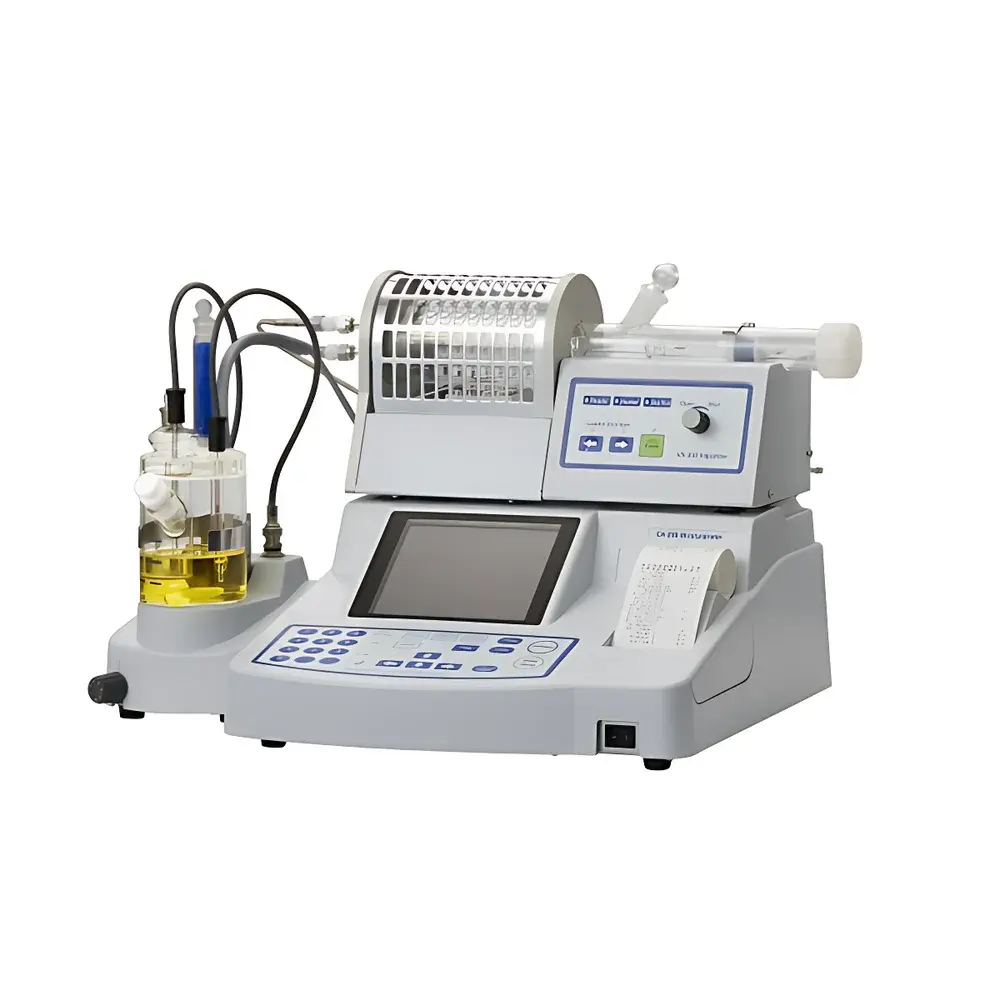
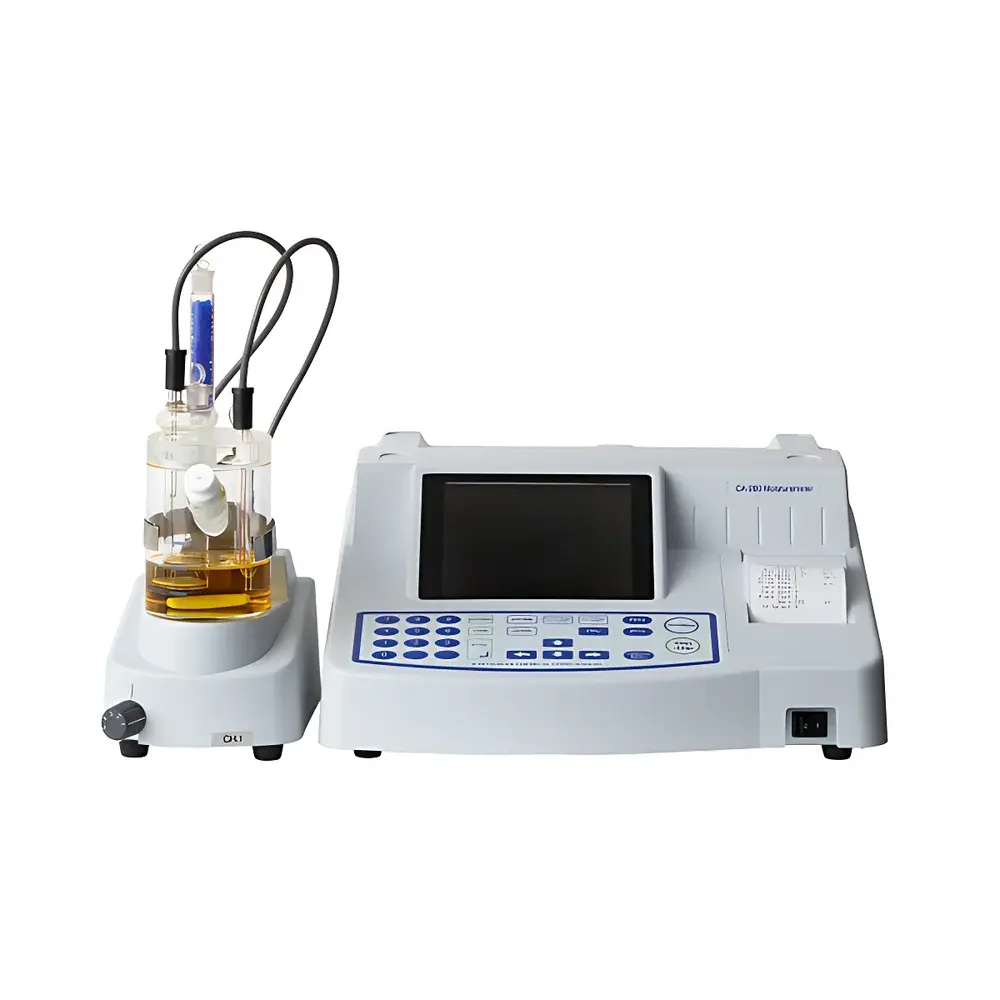
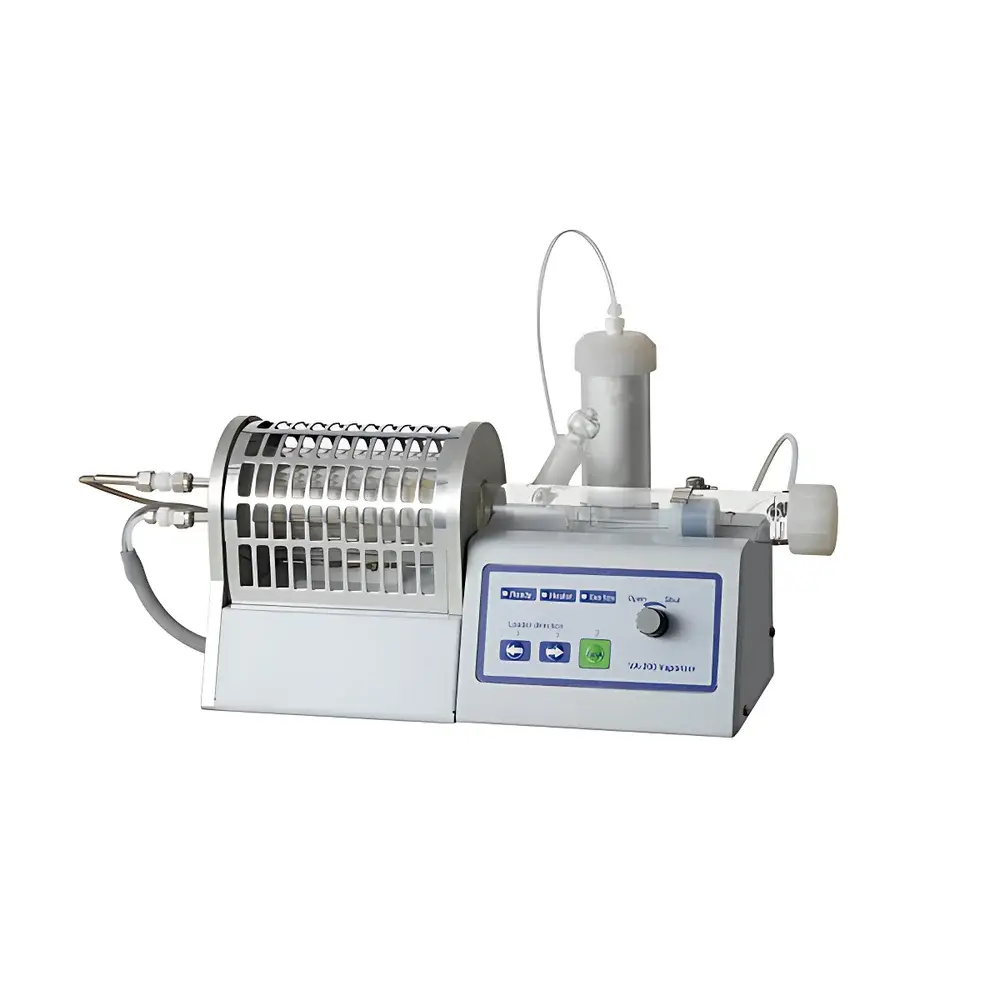
MITSUBISHI CHEMICAL CA-200 Coulometric Karl Fischer Moisture Analyzer for Lithium-Ion Battery Separator Films
| Brand | MITSUBISHI CHEMICAL |
|---|---|
| Origin | Japan |
| Model | CA-200 |
| Measurement Principle | Coulometric Karl Fischer Titration |
| Detection Range | 10 µg – 100 mg H₂O |
| Accuracy | CV ≤ 0.3% for samples ≥ 1 mg H₂O (n = 10) |
| Electrolysis Current | 430 mA |
| Average Titration Speed | 2.2 mg H₂O/min (36 µg H₂O/sec) |
| Display | 5.7-inch color LCD |
| Data Storage | 20 user-defined methods × 50 sub-files each |
| Interface | RS-232C (optional), USB storage port, analytical balance input |
| Power Supply | AC 100–120 V / 230–240 V, 50/60 Hz |
| Host Dimensions & Weight | 220 × 350 × 360 mm, ~5 kg |
| Stirrer Dimensions & Weight | 120 × 180 × 148 mm, ~1 kg |
| VA-200 Sample Heater | Temp. Range 70–300 °C, N₂ carrier gas flow 0.1–0.5 L/min, max. sample mass 10 g, weight ~5.5 kg |
Overview
The MITSUBISHI CHEMICAL CA-200 is a high-precision coulometric Karl Fischer moisture analyzer engineered specifically for trace water quantification in demanding electrochemical and battery materials applications—most notably lithium-ion battery separator films. It operates on the fundamental electrochemical principle of coulometric Karl Fischer titration, where iodine is generated *in situ* via controlled electrolysis of an iodide-containing reagent, and stoichiometrically reacts with water according to the classic Karls Fischer reaction: I₂ + SO₂ + H₂O + 3RN + CH₃OH → 2RN·HI + RN·HSO₄CH₃. The amount of water is determined by integrating the total charge passed during electrolysis (Faraday’s law), delivering inherently absolute, reagent-independent quantification without volumetric calibration drift. Unlike volumetric systems, the CA-200 eliminates burette errors and solvent consumption variability—critical for reproducible analysis of low-moisture, high-value separators where specification limits often fall below 10 ppm. Its design prioritizes metrological rigor, long-term stability, and compatibility with stringent quality assurance frameworks required in battery manufacturing and R&D.
Key Features
- Dual-Channel Expandability: Supports simultaneous connection of two coulometric cells, two vaporizers (e.g., VA-200), or two titration units—enabling parallel analysis or method comparison without hardware duplication.
- Intelligent Electrode Management: Automatic electrode polarization compensation and real-time impurity rejection algorithms eliminate manual cleaning cycles and mitigate baseline drift caused by electrode fouling—a common challenge in heterogeneous solid-sample analysis.
- Five-Step Precision Stirring: Integrated magnetic stirrer with five-step smooth-speed control ensures consistent mixing kinetics across diverse viscosities and particle suspensions, maintaining hydrodynamic stability critical for coulometric endpoint detection.
- One-Touch Reagent Exchange: Optional reagent dispensing/pumping module enables automated drain-and-refill of spent electrolyte—reducing operator exposure, minimizing cross-contamination risk, and ensuring reagent freshness for consecutive low-level measurements.
- Open-Formula Architecture: Users define custom calculation protocols—including unit conversions, normalization to sample mass/volume, and statistical post-processing—directly embedded into method files for unambiguous audit trails.
- Modular Electrode Options: Interchangeable membrane-free and membrane-type generator electrodes: membrane-free configuration simplifies maintenance using single-component AQUAMICRON reagents; membrane-equipped variant extends compatibility to ketones, aldehydes, and carboxylic acids that interfere with conventional coulometric systems.
Sample Compatibility & Compliance
The CA-200, when coupled with the VA-200 programmable oven vaporizer, achieves reliable moisture release from thermally stable solids—including polyolefin-based battery separators (PP, PE), ceramic-coated films, polymer electrolytes, and composite electrodes—without thermal decomposition. The VA-200’s transparent conductive glass heater enables visual monitoring of sample behavior during heating (70–300 °C), while precise nitrogen purge (0.1–0.5 L/min) sweeps liberated water vapor quantitatively into the titration cell. This configuration meets ASTM E203–22 and ISO 15512 requirements for moisture determination in plastics and battery materials. System architecture supports full GLP/GMP compliance: all method parameters, raw coulombic integrals, titration curves, and operator IDs are timestamped and stored internally or exported via USB. Optional RS-232C interface enables integration into LIMS and satisfies FDA 21 CFR Part 11 requirements for electronic records and signatures when paired with validated software.
Software & Data Management
The CA-200 firmware provides native support for 20 independent method templates, each containing up to 50 nested sub-methods—ideal for managing multi-stage protocols (e.g., pre-drying hold, ramped heating, plateau quantification). All 200 most recent results—including sample ID, date/time, measured water mass (µg), calculated concentration (ppm or %), relative standard deviation, and full titration curve—are retained onboard. Real-time graphical display of current vs. time allows immediate visual assessment of endpoint sharpness and system responsiveness. Integrated thermal printer outputs fully annotated reports: method name, instrument serial number, operator ID, ambient conditions, balance tare values, raw coulombs, water mass, and statistical summary—ensuring complete traceability per ISO/IEC 17025 clause 7.8. Data export to CSV via USB facilitates secondary statistical analysis in JMP, Minitab, or Python-based QA pipelines.
Applications
Primary application focus includes QC/QA of lithium-ion battery separator films, where residual moisture directly impacts electrolyte hydrolysis, HF generation, and interfacial resistance growth. Beyond battery materials, the platform serves pharmaceutical excipient drying validation (USP ), moisture mapping in polymer resins (ASTM D6980), trace water in transformer oils (IEC 60814), and hygroscopicity studies of metal oxides and catalyst supports. Its broad dynamic range (10 µg–100 mg H₂O) and solid-sample capability also support regulatory testing of food packaging films, desiccant efficacy, and semiconductor-grade solvents—where measurement uncertainty budgets must remain below ±2% RSD at sub-50 ppm levels.
FAQ
What sample types require the VA-200 vaporizer?
Solid and semi-solid matrices—including battery separators, powders, granules, and viscous pastes—that cannot be directly injected into the titration cell.
Can the CA-200 comply with FDA 21 CFR Part 11?
Yes—when configured with audit-trail-enabled software, electronic signature modules, and secure user access controls (via optional PC interface), it supports Part 11-compliant workflows.
How does the membrane-free electrode improve operational efficiency?
It eliminates membrane replacement, reduces reagent preparation steps, and shortens system re-equilibration time—ideal for high-throughput labs running routine separator QC.
Is calibration required before each analysis?
No—coulometric KF is fundamentally absolute; calibration is performed once using certified water standards (e.g., sodium tartrate dihydrate) to verify system linearity and Faraday efficiency.
What maintenance intervals are recommended for routine operation?
Daily: electrode inspection and dry-gas line check; Quarterly: VA-200 heater calibration verification and cell seal integrity test; Annually: full electrolytic cell refurbishment and amperometric sensor validation.





