
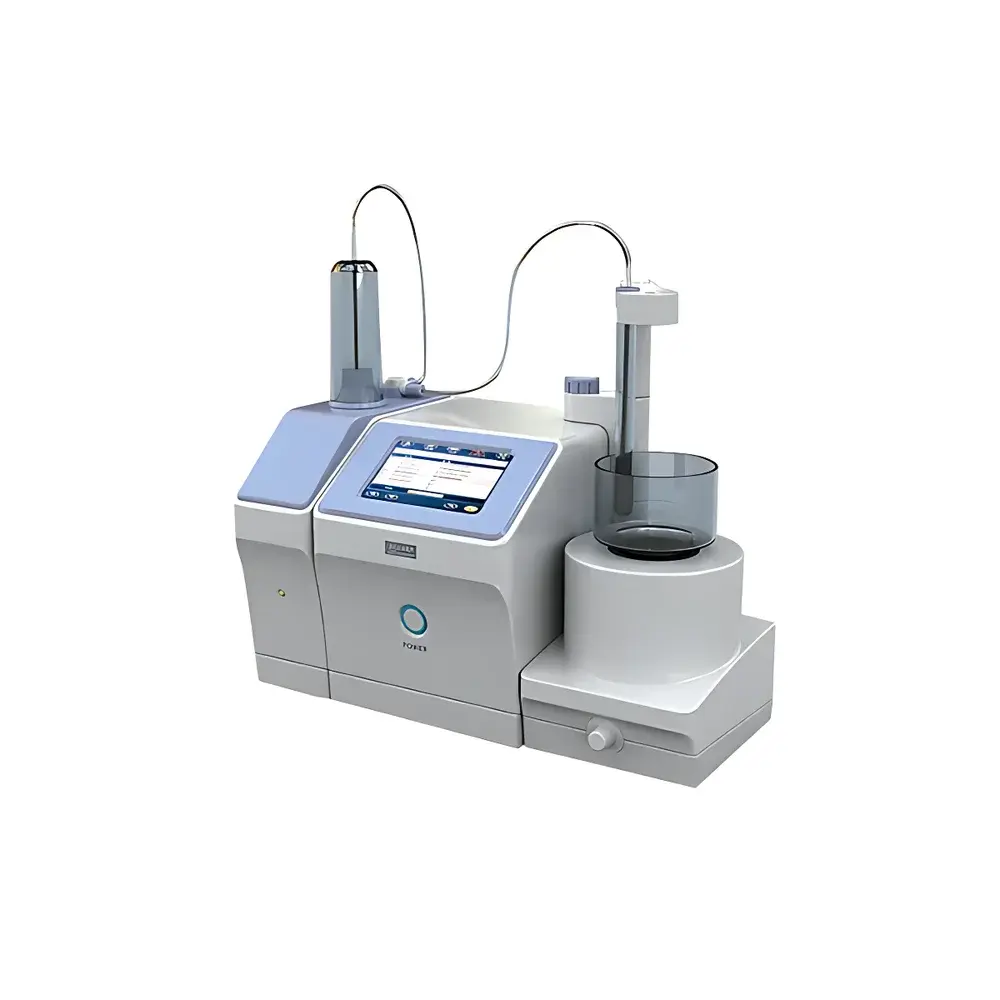
Sonnen T13 COD & Total Organic Carbon (TOC) Titration Analyzer
| Brand | Sonnen |
|---|---|
| Origin | Shanghai, China |
| Model | T13 |
| Instrument Type | Benchtop Laboratory Analyzer |
| Measurement Principle | Potentiometric/Colorimetric Titration with K₂Cr₂O₇ Digestion (Digestion Performed Externally) |
| Optical Detection | 16-bit RGB Trichromatic Color Sensor with Dual-Channel Synthesis Algorithm |
| Titration Resolution | 1/60,000-step Motorized Burette Drive |
| Minimum Dispensing Volume | 10 µL |
| Accuracy | ±0.2% (at 20 mL titrant delivery) |
| Fill/Empty Cycle Time | 30 s at 100% fill rate |
| Host Dimensions (L×W×H) | 200 × 200 × 260 mm |
| Titration Module Dimensions (L×W×H) | 70 × 200 × 160 mm |
| Net Weight (Standard Configuration) | ~4.3 kg |
| Interface | Bluetooth 5.0 (up to 12 modules), Wi-Fi 802.11n, RS-232/USB-C for printer output |
| Display | High-brightness capacitive touchscreen with bilingual (English/Chinese) GUI and 12 customizable graphical soft-keys |
Overview
The Sonnen T13 COD & Total Organic Carbon (TOC) Titration Analyzer is a modular, benchtop laboratory instrument engineered for precise, traceable, and repeatable determination of Chemical Oxygen Demand (COD) and total organic carbon content in aqueous and semi-solid environmental samples—including wastewater, surface water, leachates, soil extracts, and solid waste digests. Unlike integrated spectrophotometric COD analyzers, the T13 implements standardized open-system titrimetry per ISO 6060 and ASTM D1252 (Method B), where oxidation is completed externally using certified K₂Cr₂O₇ digestion (e.g., with Sonnen’s compatible 100 mL digestion block), followed by automated redox or colorimetric endpoint detection. Its dual-mode detection architecture—supporting both potentiometric and high-fidelity trichromatic colorimetric titration—ensures robustness across variable sample matrices, including turbid, colored, or chloride-rich waters where photometric interference is common. The system operates under a deterministic real-time control firmware architecture, eliminating reliance on ambient lighting or subjective visual endpoint interpretation.
Key Features
- Modular titration architecture: One host controller synchronizes up to twelve independent titration modules via Bluetooth 5.0 or IEEE 802.11n Wi-Fi, enabling parallel analysis and scalable throughput.
- 16-bit RGB trichromatic color sensor with proprietary dual-channel synthesis software: Captures full spectral response across red, green, and blue channels; compensates for background chromaticity and improves endpoint discrimination in low-contrast transitions (e.g., diphenylamine sulfonate or ferroin endpoints).
- Precision burette actuation: Stepper-driven 1/60,000-step motor ensures volumetric reproducibility ≤±0.2% RSD at 20 mL delivery; minimum dispensing volume of 10 µL supports micro-titration protocols without dilution.
- Corrosion-resistant integrated plunger pump: Chemically inert ceramic-plated stainless-steel piston and PTFE/sapphire valve train withstand repeated exposure to concentrated H₂SO₄, Ag₂SO₄, and Fe(NH₄)₂(SO₄)₂ solutions.
- Bilingual (English/Chinese), icon-driven GUI: 7-inch capacitive touchscreen with 12 programmable soft-keys enables method-specific workflows—preconfigured for ISO 6060, EPA 410.4, and China HJ 828–2017—and supports GLP-compliant user authentication and audit trail logging.
- Automated sequence execution: Full cycle automation includes auto-zeroing, syringe priming, blank subtraction, dynamic slope-based endpoint recognition, and post-titration rinse/purge routines.
Sample Compatibility & Compliance
The T13 accommodates samples pre-digested in standard 100 mL borosilicate digestion tubes (compatible with Sonnen’s DS-100 series digesters). It accepts liquid samples with suspended solids ≤50 mg/L (post-filtration), chloride concentrations up to 2,000 mg/L (with HgSO₄ masking), and pH ranges from 1.0 to 12.0 during titration. All hardware and firmware comply with IEC 61326-1 (EMC for laboratory equipment) and IEC 61010-1 (safety requirements). Data integrity meets FDA 21 CFR Part 11 requirements through electronic signatures, time-stamped audit logs, and immutable method parameter locking. Method validation documentation aligns with ISO/IEC 17025:2017 clause 7.2.2 for titrimetric measurement uncertainty estimation.
Software & Data Management
The embedded operating system supports local storage of ≥10,000 result records with full metadata (operator ID, timestamp, digestion batch ID, calibration history, raw sensor traces). Export formats include CSV, PDF (with embedded chromatograms and titration curves), and XML for LIMS integration. Optional PC-based SonnenTitra Suite v3.2 provides advanced statistical tools—Shewhart control charts, ANOVA for inter-module comparison, and ISO 5725-based precision profiling. All data transfers are encrypted via TLS 1.2; no cloud storage is performed unless explicitly enabled by user-configured enterprise SFTP endpoints.
Applications
- Routine compliance monitoring of municipal and industrial effluents per EU Directive 91/271/EEC and US Clean Water Act discharge permits.
- Research-grade quantification of biodegradable vs. refractory organic fractions in anaerobic digestion feedstocks and digestates.
- Validation of UV/H₂O₂ or ozone-based AOP (Advanced Oxidation Process) efficiency in pilot-scale wastewater treatment studies.
- Soil leachate characterization for landfill monitoring programs under RCRA Subtitle D guidelines.
- Educational use in university environmental chemistry labs—supports method development exercises in endpoint detection theory, uncertainty propagation, and matrix interference correction.
FAQ
Does the T13 perform digestion internally?
No. Digestion is conducted externally using standardized reflux or sealed-tube methods (e.g., ISO 6060 or HJ 828–2017); the T13 performs only post-digestion titration.
Can it be used for chloride-rich samples?
Yes—when paired with mercury sulfate masking agents per ASTM D1252, and calibrated with chloride-spiked reference standards.
Is method validation support available?
Yes. Sonnen provides application notes detailing LOD/LOQ determination, spike recovery protocols, and ISO 5725-based intermediate precision studies.
What consumables require periodic replacement?
Burette pistons (recommended every 10,000 cycles), color sensor protective windows (annually), and PTFE valve seals (biannually under continuous operation).
How is traceability maintained across multi-user environments?
Each login session generates a unique digital signature linked to operator credentials, instrument firmware hash, and calibration certificate IDs—all embedded in exported PDF reports.
Related Products







